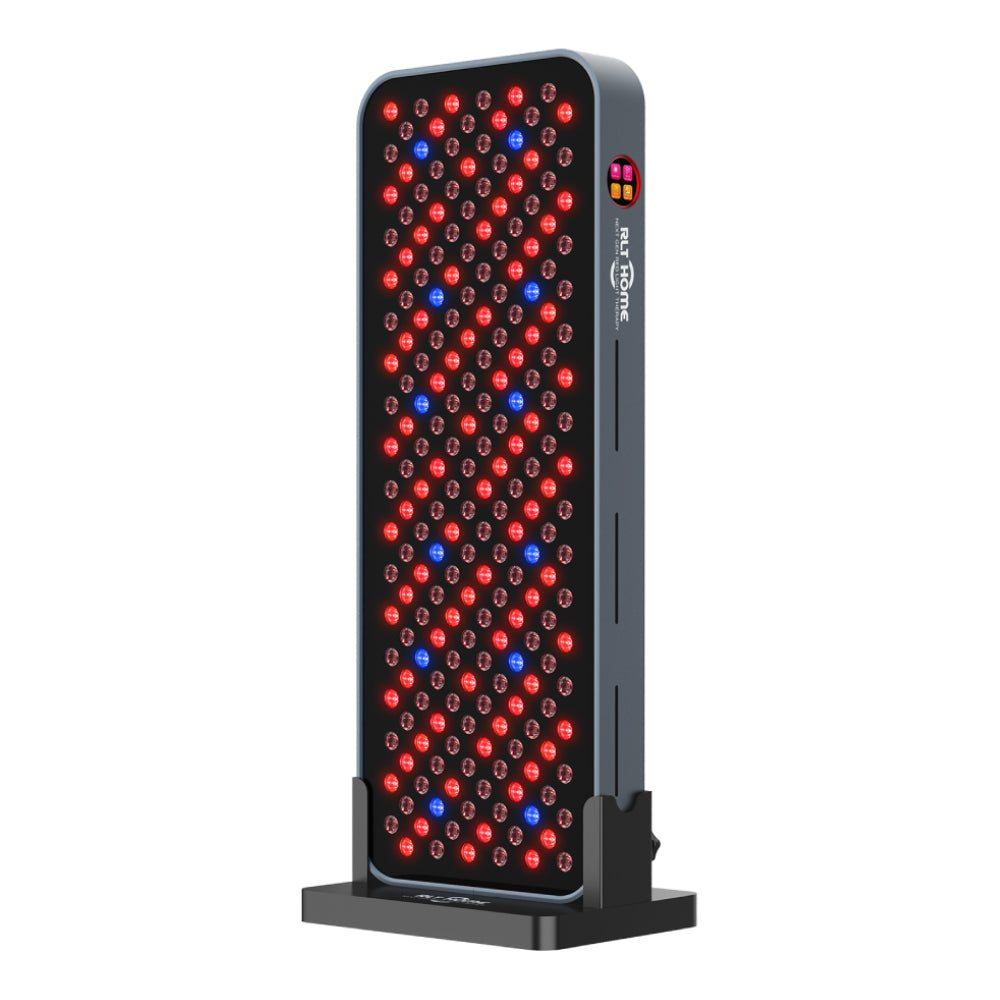
No red light panel has been shown to help psoriasis, so this list ranks panels only on how closely their published specs match the one small trial the site has on file: nine patients with psoriasis that had resisted other treatment, treated with 633nm red plus 830nm near-infrared LED light (PMID 19764893). That trial had no control group, the psoriasis evidence page grades the topic Limited, and clinic UV phototherapy, topical treatment and prescription drugs are far better evidenced.
Choosing a panel? Our ranking of the best red light therapy panels is computed from published, method-labeled specs across 188 devices. For psoriasis, the spec that matters is having both a red band near 633nm and a near-infrared band near 830nm, with the share of output in each published.
What the evidence does and does not support
The trial reported clearance of 60 to 100 percent in nine patients, who continued under clinical care. The site reads that as a signal that justifies larger trials, not as proof a panel works. It is also a clinic study, so it gives no home dose, distance or schedule. The red light versus UV phototherapy page explains why narrowband UVB, which a clinic prescribes and doses, is the better-evidenced route, and why a panel is at most an optional adjunct that should not delay or replace tested treatment. Panels emit no UV.
So the honest purpose of a "best panels for psoriasis" list is narrow: if you and your dermatologist decide to try light at home, which panels carry the wavelength pairing the trial used, and which are easiest to use over the areas psoriasis tends to affect?
The criteria
Every model here is scored on database fields only, the same way every list on this site is scored. See how rankings work for the method. The same criteria and cautions apply to every brand.
| Criterion | Why it matters for this topic |
|---|---|
| Red plus 830nm bands | The trial paired 633nm and 830nm. A panel with 630nm or 660nm plus 830nm is the closest match. |
| Published wavelength density | Whether the brand publishes the share of output per band, so you can see how much is in the matching bands. |
| Method-labeled irradiance | mW/cm2 at a stated distance with the measuring method named. See the irradiance page. |
| Coverage | Plaques on elbows, knees and trunk need more area than a face-sized panel. See treatment area and coverage. |
| Price, warranty and trial terms | Verified price with date, warranty, return window and fees. |
The picks
Prices are the verified figures shown on each database page and change, so confirm on the brand site before buying. None of these panels was used in the trial.
1. RLT Home Total Spectrum COMPACT
The RLT Home Total Spectrum COMPACT ranks first because it publishes a per-band breakdown that includes both the red and the 830nm bands: 19% at 630nm, 19% at 660nm and 14% at 830nm, with other bands also listed (480nm, 810nm, 850nm and 1064nm). Irradiance is 99.0 mW/cm2 at 6 inches, measured by Electropossible Ltd with a spectrometer. The database notes the brand commissioned those tests and that no unaffiliated reviewer measurement is on file, so treat the figure with that in mind.
The panel is 30.3 by 11.8 inches, the largest listed coverage among the four. Price is $1,095 (verified 2026-09-12), with a 3-year warranty and a 60-day trial with no restocking fee. It mounts vertically only and has no app. It is FDA-registered, which the database says is a listing and not a clearance.
2. BlockBlueLight PowerPanel MEGA
The BlockBlueLight PowerPanel MEGA states 10% at 630nm, 40% at 660nm and 5% at 830nm, all brand-stated. Its 167 mW/cm2 at 6 inches is a brand claim, and independent testing by Light Therapy Insiders measured lower. For psoriasis the 830nm share is the smallest of the models that publish one. Price is $1,500 (verified 2026-09-12), with a 5-year warranty and a 30-day trial. There is no restocking fee, but the customer pays return shipping, and purchases made with discount codes over 15% become exchange or credit only. Panel size is not stated.
3. PlatinumLED BioMax 900 (classic 9th gen)
The PlatinumLED BioMax 900 has no brand breakdown. The database shows an independent array-blend reconstruction of about 48% combined at 630 to 660nm and no 830nm figure, so the match to the trial's pairing cannot be confirmed from published data. Independent measurement gives 90.3 mW/cm2 at 6 inches and about 75 mW/cm2 at 12 inches. Price is $1,299 (verified 2026-08-13), with a 3-year warranty and a 60-day trial, but a 20% restocking fee plus customer-paid shipping applies to elective returns. Coverage is not stated.
4. Hooga HG300
The Hooga HG300 carries 660nm and 850nm, with the split not stated. It lacks the 830nm band the trial used, so it is the weakest match, though 850nm is a nearby near-infrared band (see the 830nm page for how close wavelengths compare). Its 73 mW/cm2 at 6 inches is claimed with no method stated, and independent testing found roughly half that. The database page recommends halving the claimed figure for dosing. At $199 (verified 2026-09-12) it is the budget option, with a 3-year warranty and a 60-day trial where the return label cost is deducted from the refund. At 12.2 by 8.2 inches it covers little more than a few plaques at a time.
Who each pick suits
- Most trial-like wavelength mix, largest area: the COMPACT.
- Highest claimed output, with the caveats above: the PowerPanel MEGA, if you accept a brand claim that independent testing did not match.
- Independent irradiance figures and a long trial, but no 830nm data: the BioMax 900.
- Lowest cost to try: the HG300, knowing the mix differs from the trial.
Dosing and what to do first
There is no established home dose for psoriasis. The dose calculator turns distance and minutes into energy per session, but it cannot say what amount suits a skin condition. The site's psoriasis page notes a general skin protocol of 10 to 20 minutes at 6 to 12 inches, several times a week, and says to discuss it with a dermatologist rather than escalate on your own. Read how to choose a panel for the general buying questions.
Cautions
- Tell your dermatologist before adding light, especially if you are on UV phototherapy, and ask whether any medicine you take is photosensitizing. See the photosensitizing medications guide.
- Use eye protection with bright panels. See the eye protection guide.
- Avoid applying light over broken or actively infected skin without medical guidance.
- Red light does not cure psoriasis, and this list does not claim any panel treats it. For skin goals that panels have been tested on, see the best panels for skin and anti-aging. General safety information is on the safety and side effects page.
Bottom line
On published fields, the panels that best match the one small psoriasis trial are the ones that carry both a red band and 830nm and say how much output sits in each. By that rule the COMPACT leads, the MEGA is second, and the other two have gaps. The evidence is Limited, so the better question is whether a panel belongs in your treatment plan at all, and that is a conversation for a dermatologist.