The evidence grade for rheumatoid arthritis is Limited. A Cochrane review of placebo-controlled laser trials reported short-term improvements in pain and morning stiffness, but the trials were small and old, they used clinic lasers rather than home panels, and the review found no better outcome than placebo when it looked again three months later.
Choosing a panel? Our ranking of the best red light therapy panels is computed from published, method-labeled specs across 188 devices. For rheumatoid arthritis, the spec that matters is a stated irradiance at a stated distance, because the review itself said the trials did not report enough device detail to tell which dose or wavelength mattered.
Rheumatoid arthritis is an autoimmune disease with medical management. Nothing on this page is a reason to change or delay care from a rheumatologist, and light has never been tested as a replacement for disease-modifying medication. The question here is narrower: what does the best available review say about light as a short-term add-on for symptoms?
How the grade is set
The site uses four grades, Strong, Moderate, Limited and Insufficient, explained on the evidence grades page. Limited means there is some controlled evidence pointing in one direction, but it is thin, short, or hard to apply to home devices. Rheumatoid arthritis lands there for four reasons:
- the controlled trials are few and small;
- the effect on pain and stiffness was short-lived;
- most trials treated the hands with clinic lasers, not panels;
- the reviewers could not say which wavelength, dose or schedule mattered.
Compare that with the knee osteoarthritis page, graded Moderate because a much larger set of placebo-controlled trials exists and dose-subgroup data were available. The wider joint pain evidence hub places rheumatoid arthritis alongside those other conditions.
The Cochrane review
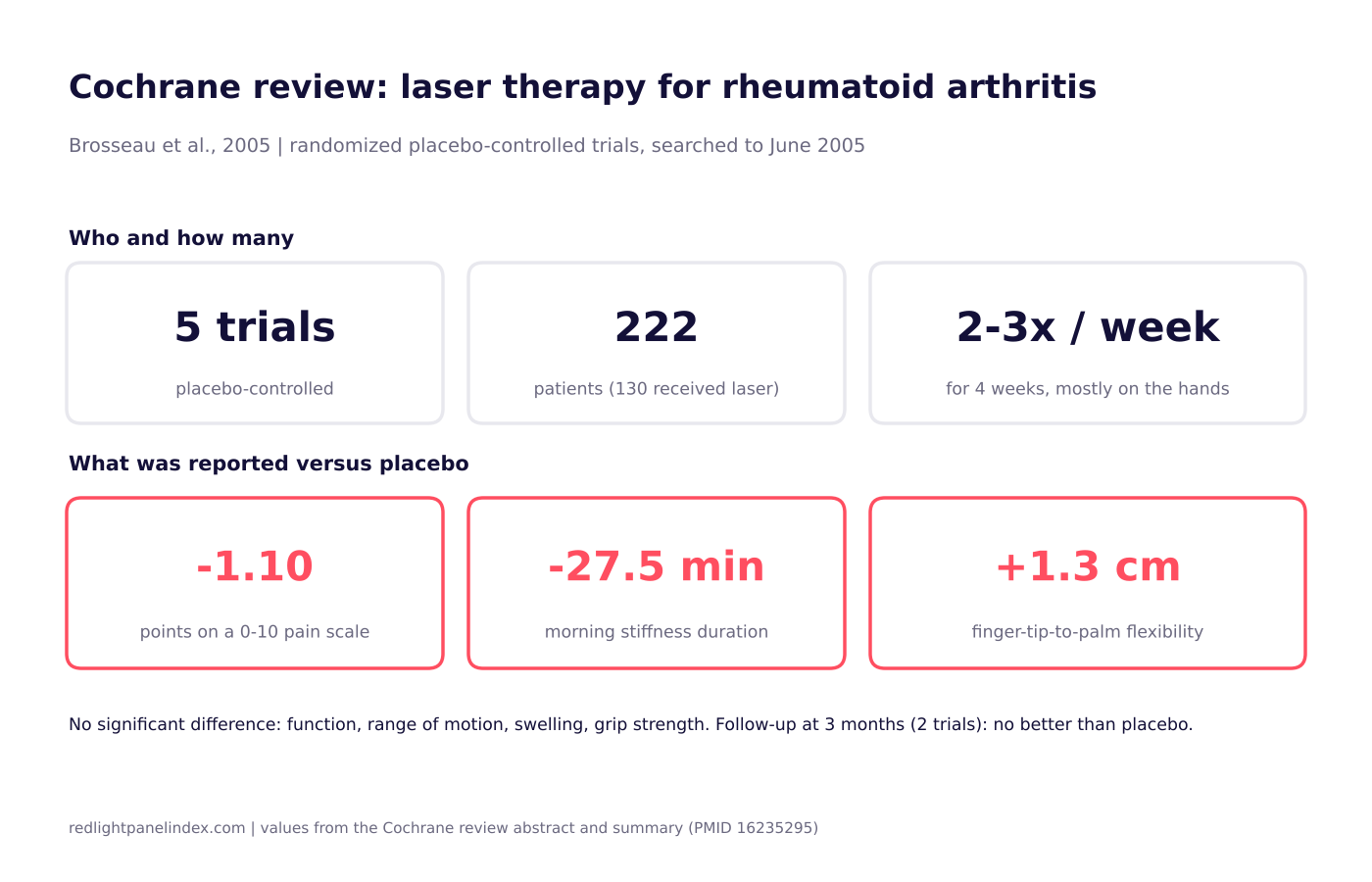
Brosseau and colleagues updated an earlier Cochrane review of low level laser therapy for rheumatoid arthritis, searching the literature to June 2005 (PMID 16235295). It included only randomized controlled trials in people with a clinical diagnosis of the disease. Per the review's abstract and plain-language summary, the pooled analysis covered five placebo-controlled trials with 222 patients, 130 of whom received laser. The plain-language summary rounds this to six studies and over 220 people, and this page uses the abstract's counts.
Who was studied. Adults with rheumatoid arthritis. Treatment was mostly applied to the hands, usually two to three times a week for four weeks.
Device and dose. The review describes many different wavelengths and dosages across the trials and gives no single protocol. This page therefore states none. The authors specifically noted that the trials lacked data on how effectiveness is affected by wavelength, treatment duration, dosage, and application site.
What was reported against placebo:
| Outcome | Reported result |
|---|---|
| Pain | Reduced by 1.10 points on a 10-point visual analog scale (95% CI 1.82 to 0.39) |
| Morning stiffness | Duration shorter by about 27.5 minutes (95% CI 2.9 to 52) |
| Finger-tip-to-palm flexibility | Improved by 1.3 cm (95% CI 0.8 to 1.7) |
| Function, range of motion, swelling, grip strength | No significant difference from placebo |
The confidence interval for morning stiffness is wide: the lower end, 2.9 minutes, is close to no change. The pain result is also modest in absolute terms. A reduction of about one point on a ten-point scale is a statistically detectable difference, but whether an individual would notice it in daily life varies.
Side effects. None were reported in the included studies.
Follow-up. Only two studies measured outcomes three months after treatment, and laser was no better than placebo at that point. The summary describes the benefits as not appearing to last.
Authors' conclusion. The reviewers wrote that low level laser therapy could be considered for short-term treatment for relief of pain and morning stiffness in people with rheumatoid arthritis, particularly given that it has few side effects. They also called effectiveness still controversial and asked for consistent reporting of device characteristics and application technique.
Reading the review fairly
A few points help put those figures in proportion.
It is a 2005 review of earlier trials. The search ended in June 2005. Device technology, dose reporting and trial methods have all changed since. A newer trial could shift the picture, and this page cannot say what such a trial found, because none is in the register used for this grade.
Subgroup differences were not significant. According to the summary, differences by dose, wavelength, site or treatment length did not reach significance, though longer administration times and shorter wavelengths may have worked better. That is a hint, not a finding, and it does not support choosing a panel by wavelength alone.
One trial used the opposite hand as control. It found no significant pain benefit. Because most trials treated the hand, effects on other joints are unclear.
The pooled sample is small. 222 patients across five trials, split into laser and placebo arms, leaves little room to detect subgroup effects or rare events.
For how a larger and better-powered set of trials compares, see the knee osteoarthritis meta-analysis review, which pooled 22 trials and reported dose-subgroup results. A review of that size does not exist for rheumatoid arthritis on this site.
What was not studied
- Home LED panels. The review covers low level laser therapy delivered by clinic devices. No trial in it used a wall-mounted panel at a working distance.
- A defined dose. Because the trials varied so much, there is no wavelength and dose pairing that the review supports.
- Joints other than the hands. Most of the evidence is hand treatment. Feet, knees, shoulders and wrists are largely untested in this set. The shoulder pain page covers a different condition with its own evidence.
- Disease activity and joint damage. The outcomes were symptoms and hand function. Nothing in the review addresses blood markers, inflammation scores or radiographic progression.
- Long-term use. Follow-up stopped at three months, and in that window laser was no better than placebo.
- Combination with medication. The review does not describe how light interacts with disease-modifying drugs.
A practical section for someone who still wants to try it
If you and your clinician decide a short trial of light is reasonable, these steps keep it grounded in what was actually studied.
- Treat it as symptom support, not disease control. The reported effects were on pain, stiffness and hand flexibility over a few weeks, not on the underlying disease.
- Keep the schedule short and bounded. The reviewed trials ran roughly four weeks at two to three sessions a week. Choose an end date and compare how your hands feel against a written baseline, such as morning stiffness in minutes.
- Work out your dose rather than guessing. Take a panel's method-labeled irradiance at a stated distance and enter it in the dose calculator to see how many minutes a target dose would take. The distance guide explains why a few inches changes the number a lot.
- Understand the wavelength bands. The wavelength guide lists the red and near-infrared bands panels use, and the 810 nm vs 850 nm page compares the two most common near-infrared choices. The review gives no basis for preferring one.
- Compare panels on published specs. The joint pain panel ranking and the how to choose guide show how to read listings. A hand-sized treatment area does not need a full-body panel.
- Check the irradiance method. The irradiance explainer shows why figures measured differently are not comparable.
Cautions
- Talk to your rheumatologist first. This applies especially if your joints are inflamed, swollen or hot, or if you recently changed medication.
- Photosensitizing drugs. Some medications raise sensitivity to light. The photosensitizing medications guide is the place to check, and your pharmacist can confirm.
- Heat. Panels warm the skin at close range. Inflamed joints can be sensitive to heat, so keep distance and watch for discomfort.
- Eyes. Use eye protection as described in the safety and side effects page.
- Do not stop prescribed treatment. No evidence reviewed here supports using light in place of medication.
Summary
- Grade: Limited.
- The Cochrane review pooled five placebo-controlled laser trials with 222 patients, mostly treating the hands for about four weeks.
- It reported small short-term differences in pain, morning stiffness and hand flexibility, and no significant difference in function, range of motion, swelling or grip strength.
- At three months, laser was no better than placebo in the two studies that followed up.
- No home panel was studied, and no wavelength or dose could be recommended from the data.