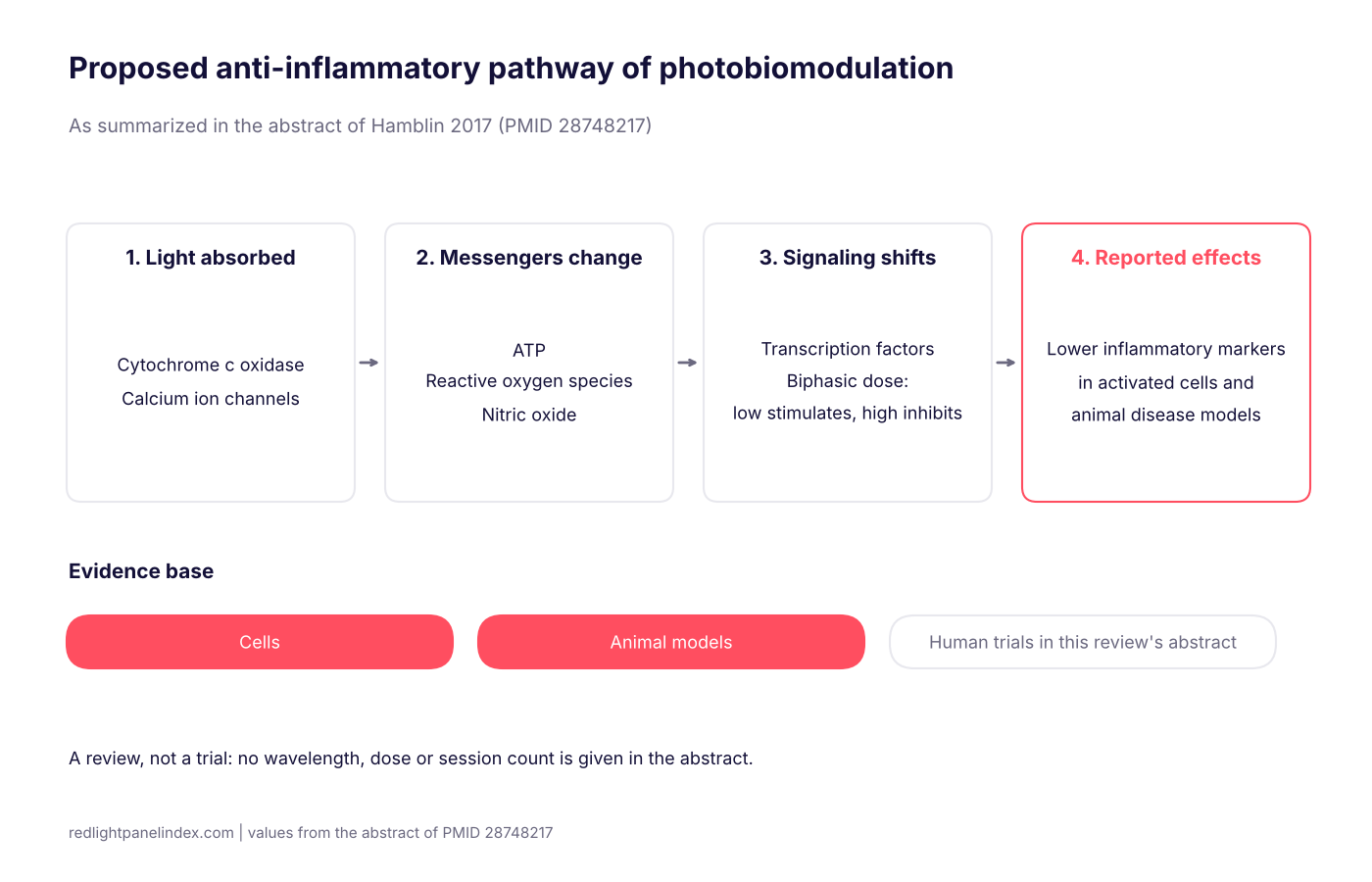
A 2017 review by Michael Hamblin in AIMS Biophysics (PMID 28748217) pulls together the proposed ways red and near-infrared light may reduce inflammation and reports that the strongest reproducible finding across the literature is an overall reduction in inflammatory markers, seen in activated inflammatory cells and in animal disease models. It is a map of mechanisms and of laboratory evidence, not a human trial, and it cannot tell a panel owner how long to stand in front of a device.
Choosing a panel? Our ranking of the best red light therapy panels is computed from published, method-labeled specs across 188 devices. For inflammation questions, the spec that matters is method-labeled irradiance, because every dose-dependent claim in this review depends on how much light actually reaches tissue.
What the review asked
The paper's title, "Mechanisms and applications of the anti-inflammatory effects of photobiomodulation," states the two questions. First, by what steps does absorbed light end up changing inflammatory signaling? Second, in which disease models has that been reported? Photobiomodulation, also called low-level laser or light therapy, is described in the abstract as the use of red and near-infrared light to promote healing, relieve pain and reduce inflammation. The site's photobiomodulation overview covers the field's history; this page covers only what this one review says.
Who was studied
Nobody, in the sense a trial study means it. This is a narrative review, so there is no sample size, no sham group and no enrollment. It summarizes work done in cultured cells and in animal models, and the abstract reports effects in activated inflammatory cells and in animal models of disease. Any number a reader sees quoted from this review should be checked against the paper itself, because the abstract this page draws from does not give effect sizes.
Device and parameters
The abstract does not state a single wavelength, irradiance, dose or session count, because a review spans many studies that each used their own. It describes the light only as red and near-infrared. That matters for a home user. A reader looking for "the dose that lowers inflammation" will not find one here, and the dose calculator can compute what a panel delivers but cannot say what this review's source studies would have wanted.
The proposed pathway
According to the abstract, the review lays out these steps:
- Absorption. Light is absorbed by cytochrome c oxidase in the mitochondria and by calcium ion channels. The site's cytochrome c oxidase explainer covers the enzyme, and the page on mitochondria and ATP covers what the chain does downstream.
- Secondary messengers. Effects on ATP, reactive oxygen species and nitric oxide follow. See reactive oxygen species and nitric oxide for each.
- Transcription factors. The review describes changes in transcription factors, the proteins that switch inflammatory genes up or down. Per the abstract, the factor NF-kB can be activated in quiescent cells even while inflammatory markers fall in activated cells.
- A dose that works in both directions. Low light levels are described as stimulating and high levels as inhibiting, the pattern on the biphasic dose response page.
What was reported
The abstract reports lower markers of inflammation in activated inflammatory cells and in animal disease models. It names the strongest reproducible effect as an overall reduction in inflammation, particularly for joint disorders, traumatic injuries, lung disorders and brain conditions. The inflammation evidence page lists further tissues and mediators that the review mentions, including macrophage markers and prostaglandins in animal models.
Two points about reading that sentence. "Reproducible" refers to the laboratory and animal literature the author surveyed. And a list of conditions where animal effects were reported is a list of places researchers looked, not a list of conditions a home device has been shown to help.
Limitations
Some limits come from the review's type, and some from the field it describes:
- It is a review by a researcher active in the field. It synthesizes; it does not independently test, and a narrative review does not follow a fixed protocol for which studies to include.
- Cells and animals are not people. A pathway shown in a dish or a rodent may not operate the same way at the depth, dose and duration a person gets from a panel.
- No parameters transfer. With no stated wavelength, irradiance or session length in the abstract, there is nothing in it to compare against a panel's measured output.
- The two directions of the dose curve cut both ways. If high doses inhibit, more minutes is not a safe assumption.
- A mechanism is not an outcome. Lower prostaglandins in a rat model do not show that a person recovers faster.
What this means for a home panel
The review is a reasonable answer to "why would light affect inflammation at all?" It is not an answer to "will my panel reduce my inflammation?" The one human trial this site's sources contain that measured an inflammatory chemical used a 904nm laser on seven people (see the Achilles tendinitis review), and the gap between that and a multi-LED panel is explained in the LED versus laser guide.
Practical steps that follow from the review:
- Treat the mechanism as background, not as a claim a vendor can cite for its own panel. Page text that quotes this review should name the wavelength and dose its own device delivers.
- Check the irradiance your panel delivers at your working distance with the calculator rather than assuming a longer session is better.
- Use the grade on the evidence by condition pages to see where human trials exist; joint pain is one of the areas the review highlights for animal effects, and the human evidence there is graded separately.
- Keep expectations tied to the evidence grading scheme: this review supports a Limited reading for inflammation as a general claim, not a stronger one.
Cautions
A person with an inflammatory condition, an autoimmune disease or a current injury should discuss any light therapy with a clinician. Nothing in this review's abstract tests a home panel against those conditions, and it is not a basis for replacing medical care.