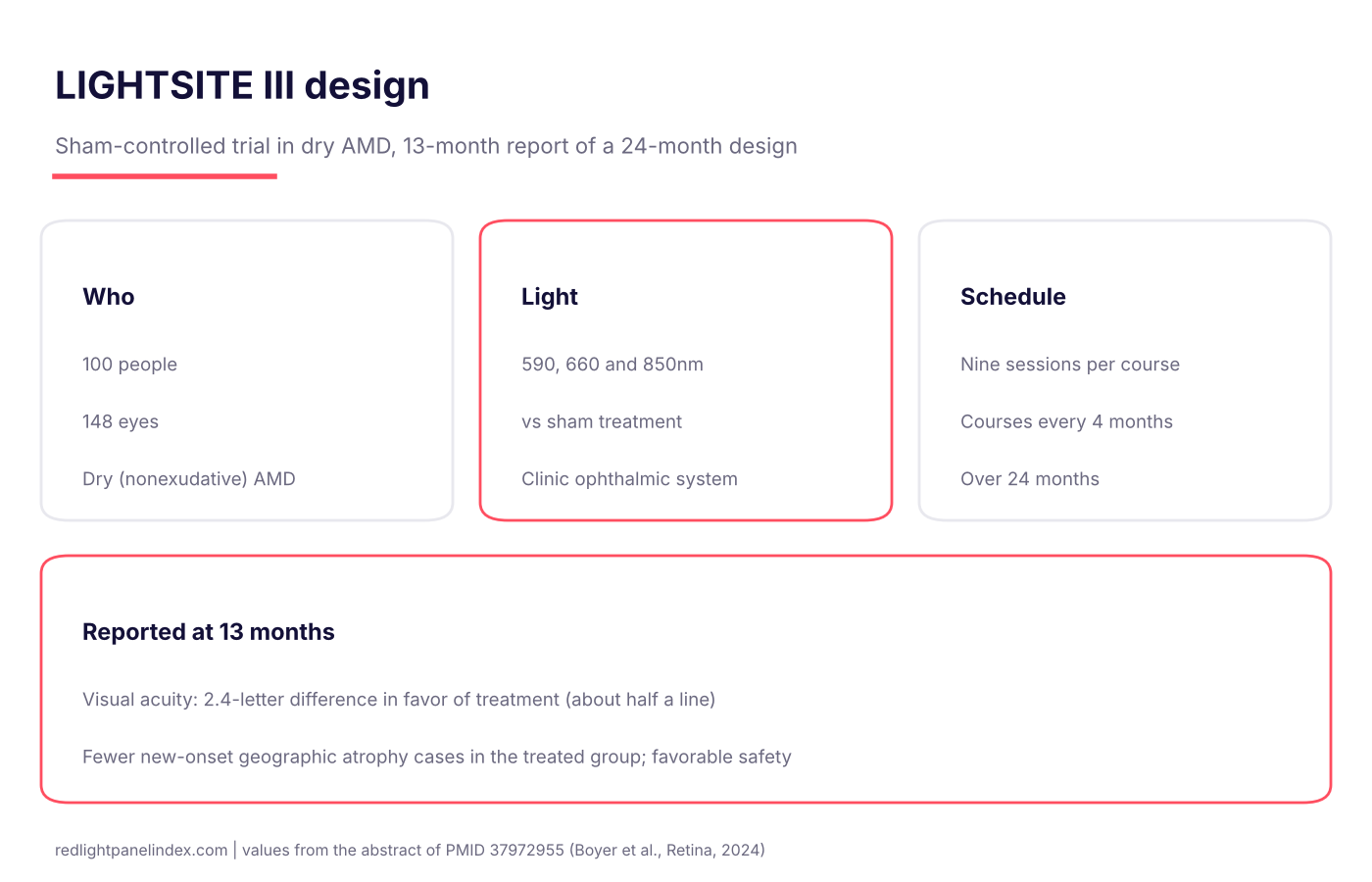
LIGHTSITE III is the most credible controlled trial of photobiomodulation in the eye: 100 people with dry age-related macular degeneration (AMD) were treated with 590, 660 and 850nm light or a sham, and the 13-month report found a 2.4-letter visual acuity advantage for the treated group (PMID 37972955). It was a clinic trial of a purpose-built ophthalmic system, so it says little about what a home panel would do.
Choosing a panel? Our ranking of the best red light therapy panels is computed from published, method-labeled specs across 188 devices. For eye questions, the spec that matters is not irradiance but whether any trial dose exists for a home device, and for AMD none does.
What the study asked
Boyer and colleagues asked whether a course of multiwavelength photobiomodulation, repeated over time, could improve vision and slow structural change in nonexudative (dry) AMD compared with a sham treatment. The report in Retina is the 13-month efficacy and safety evaluation of a trial designed to run 24 months, so it is an interim look and not the final word. The condition matters here: dry AMD is the slowly progressing form, and few treatments exist for it, which is why a controlled trial with an objective vision endpoint drew attention. The site's dry macular degeneration evidence page grades the whole question Limited, and this review looks at the key trial in more detail.
Who was studied
The trial randomized 100 participants, 148 eyes, with dry AMD. The unit of analysis was the eye, not the person, which is common in ophthalmology but means the two eyes of one participant are not fully independent observations. The abstract describes a randomized, sham-controlled design, so participants went through a treatment visit either way and the comparison is between real and sham light, not between light and nothing. The sham-controlled trials explainer describes why that distinction matters: in vision testing, people often score better on repeat tests whatever is done to them.
Device and parameters as stated
The device was the LumiThera Valeda Light Delivery System, a clinic ophthalmic instrument that delivers three wavelengths together: 590, 660 and 850nm. Treatment was given in nine sessions over a short course, and the courses were repeated every four months over the 24-month design. The 13-month report therefore covers the first stretch of that schedule. The abstract does not give an irradiance or a distance in the form a home user could reproduce, and a panel owner cannot match it, because the dose is set by a system built to deliver light to the eye through a controlled optical path. The three bands do appear on home panels, and the 660nm, 850nm and wavelengths pages describe what each band is. Having the same wavelengths is not the same as having the same treatment.
What was measured and what was found
The primary endpoint was best-corrected visual acuity, the number of letters a person can read on a standard chart with the best optical correction. The abstract reports a statistically significant between-group difference of 2.4 letters in favor of treatment at 13 months. The treated group also had a significant reduction in new-onset geographic atrophy, the advanced form of dry AMD in which areas of the retina are lost. The authors describe the safety profile as favorable.
Read the acuity result in proportion. A chart has five letters to a line, so 2.4 letters is about half a line. That is measurable and it is not nothing, but it is small, and the sham group also improved from baseline on the same chart. The between-group difference is the part that can be attributed to the light, and it is the 2.4 letters, not the change within the treated group. The geographic atrophy finding is the more clinically interesting signal because it is structural, not a chart reading, but it is a secondary finding in a trial that was powered around the acuity endpoint, and it needs replication before anyone leans on it.
Limitations
- Interim report. Thirteen of 24 months is the first part of the design. Effects that appear at 13 months may fade or grow, and the repeat-course schedule means the trial is testing a continuing therapy, not a single course.
- One device system. The evidence is for the Valeda system as configured. It does not show that any other light source, wavelength mix or dose would behave the same way.
- Small effect. A half-line difference is statistically significant here, but a trial of 100 people cannot pin down how large or durable the true effect is.
- Eyes as the unit. With 148 eyes from 100 people, some of the statistical weight comes from paired eyes.
- Population. The trial concerned dry AMD. It does not inform wet (exudative) AMD, other retinal disease, or healthy eyes.
- Not independently replicated. The sham-controlled evidence here is a single trial of a single system.
An older and weaker study sits alongside this one. A 2008 retrospective case series of 203 patients used a 780nm laser aimed at the macula and reported improved acuity in most treated eyes, with a control group of only ten people (PMID 18588438). It is a different wavelength, a different delivery method and a much weaker design, and it is covered on the condition page. It adds history, not confirmation.
What this means for a home panel
Almost nothing about the trial transfers directly, and that is the honest answer. The dose is a clinic schedule delivered by a purpose-built instrument. A home panel emits a broad beam that falls off with distance, as the irradiance page explains, and the dose calculator has no AMD entry because no trial supplies a home-panel dose to put in it. Nobody can responsibly work backward from this trial to a session length at 660nm or 850nm for a retina.
There is also a safety point. Trials like this deliver light to the eye under supervision, with vision and retinal imaging checked by trained staff. A panel is designed for skin and body use, and the eye protection guide explains why panels should not be aimed at open eyes. A person with AMD who is curious about photobiomodulation should raise it with their eye specialist, who can say whether a clinic system is available and appropriate for their stage of disease. Do not delay or replace standard AMD monitoring or treatment on the strength of this trial.
For a different eye question, the 670nm work in healthy older adults is reviewed in the 670nm vision study review, and the broader eye health evidence page puts both lines of research in context. The short version: LIGHTSITE III is a real controlled trial with a small effect on a clinic device, and the gap between that device and a panel is the main thing a buyer should take from it.