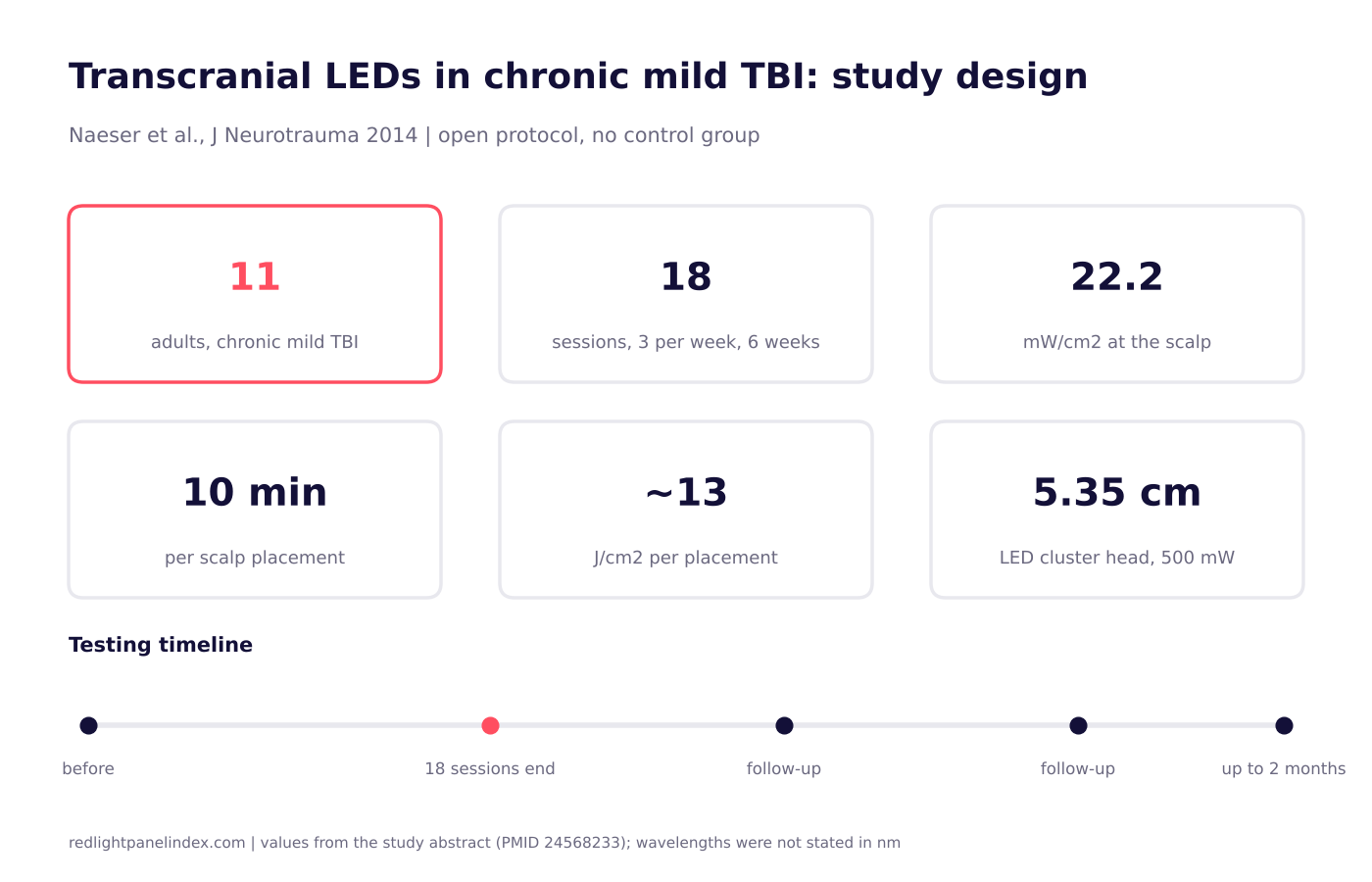
In 2014, Naeser and colleagues reported a pilot study in which 11 people with chronic, mild traumatic brain injury (TBI) had red and near-infrared LED clusters applied to the scalp for 18 sessions, and several memory and attention scores improved over the following weeks (PMID 24568233). There was no control group, so the study cannot tell us whether the light caused the change, and the authors say only that placebo-controlled studies are warranted.
Choosing a panel? Our ranking of the best red light therapy panels is computed from published, method-labeled specs across 188 devices. For brain questions, the spec that matters is verified irradiance at the distance you will actually use, because the trial applied its LEDs directly to the scalp.
What the study asked
The question was narrow: in people whose cognitive problems persisted long after a mild head injury, is a course of transcranial red and near-infrared LED treatment followed by measurable changes on standard neuropsychological tests? It was framed as an open-protocol pilot, which means everyone knew they were receiving the treatment and there was no sham comparison. That design suits a first look at feasibility and at whether a signal is worth chasing. It does not suit a claim about effectiveness.
This review sits beside the broader traumatic brain injury evidence page, which grades the whole question Limited and also covers a narrative review and a tissue-penetration paper. Here the focus is on this one study.
Who was studied
The abstract describes 11 adults with chronic, nonpenetrating mild TBI and persistent cognitive complaints. Chronic matters: these were people well past the early recovery period, which is when natural improvement is most likely to be fast. The condition page lists the full age range, sex split and time since injury; the point for a reader is that the group was small, selected, and not representative of everyone who has had a concussion.
Nothing in the abstract addresses acute injury, moderate or severe TBI, or children. The conclusions, such as they are, apply only to the narrow group that was studied.
Device and parameters as stated
The abstract gives these device and dose figures:
- Device: LED cluster heads applied to the scalp, each 5.35 cm in diameter.
- Output: 500 mW per cluster head.
- Irradiance: 22.2 mW/cm2.
- Time per placement: 10 minutes.
- Dose per placement: 13 J/cm2.
- Schedule: 18 sessions over 6 weeks.
- Wavelengths: described as red and near-infrared. The abstract does not give nanometer values, so this review does not either.
Those figures are internally consistent: 22.2 mW/cm2 for 10 minutes (600 seconds) works out to roughly 13 J/cm2. You can run the same arithmetic for any irradiance and time in the dose calculator. The key point is that this irradiance is measured at the scalp with the cluster head in contact. It is not a number you can carry over to a panel hanging on a door.
What was measured and found
Participants were tested before treatment and again at several points after the course ended, with follow-up running out to two months. The abstract reports significant improvements on several neuropsychological measures, including Stroop interference trials and the CVLT-II verbal learning and memory test. The condition page lists the specific measures and p values. Participants also reported better sleep and fewer PTSD symptoms, and the abstract does not quantify those self-reports.
Two features of the reporting are worth noting. First, the abstract is built around statistical significance and does not give effect sizes in the text that was read for this review, so no percentage improvement is quoted here. Second, the self-reported changes are exactly the kind of outcome most open to expectation effects.
Limitations
The authors' own conclusion is that the data suggest placebo-controlled studies are warranted, and that is the right reading. The main limits are these:
- No control group. Without a sham arm, improvement over time can come from the light, but also from practice effects on repeated cognitive tests, from natural recovery, or from the attention and routine of an 18-session program.
- Small sample. Eleven people cannot support a prediction about a population, and one or two unusual responders can move a trend.
- Self-reported outcomes. Sleep and PTSD symptoms were reported by participants who knew they were being treated.
- Short follow-up. Testing ended about two months after the last session, so durability is unknown.
- Unstated wavelengths. Without nanometer values the protocol cannot be reproduced exactly from the abstract, and it cannot be matched to the bands on a given panel.
- Harms. The abstract does not present an adverse event analysis.
None of this makes the study bad. It makes it a pilot, and a pilot is a reason to run a better trial.
Why a clinic LED head is not a home panel
The distance between this protocol and home use is large. The study used cluster heads placed at multiple scalp sites, treated one after another, each for 10 minutes. A home panel is typically used from a distance, aimed at the front of the body or the face, and delivers an irradiance that falls off with that distance. The irradiance explainer covers why a claimed figure and a measured figure at your distance can differ a lot.
Depth is the second gap. How much light reaches the brain through skin, skull and tissue depends on wavelength and power, as the penetration depth page explains. A 500 mW cluster in contact with the scalp is a very different source from a panel across a room. The 2014 study does not show that a panel can deliver a comparable dose to the brain, and it was not designed to.
What this means for a home panel
If you are managing a head injury, the practical conclusion is conservative. This study is a reason researchers should run controlled trials. It is not evidence that a home panel helps recovery, and it should not replace assessment and care from a clinician who knows your history.
For readers who are curious anyway, three points are worth keeping in mind:
- Use the dose calculator to understand what 22.2 mW/cm2 for 10 minutes means, and then compare it to the verified irradiance of any panel you are considering, at the distance you would use.
- Related transcranial work asks different questions. The depression trial review and the 1064 nm laser study in healthy adults test mood and cognition in other groups, and neither tests head injury. The brain and mood evidence page puts them side by side.
- Eyes and light-sensitivity symptoms are common after head injury. Read the eye protection guide before pointing any bright light at your face, and ask your clinician first if you are sensitive to light.
The honest summary is that the 2014 study is a promising pilot with a design that cannot establish cause, using a device and a dose that a home panel does not replicate.