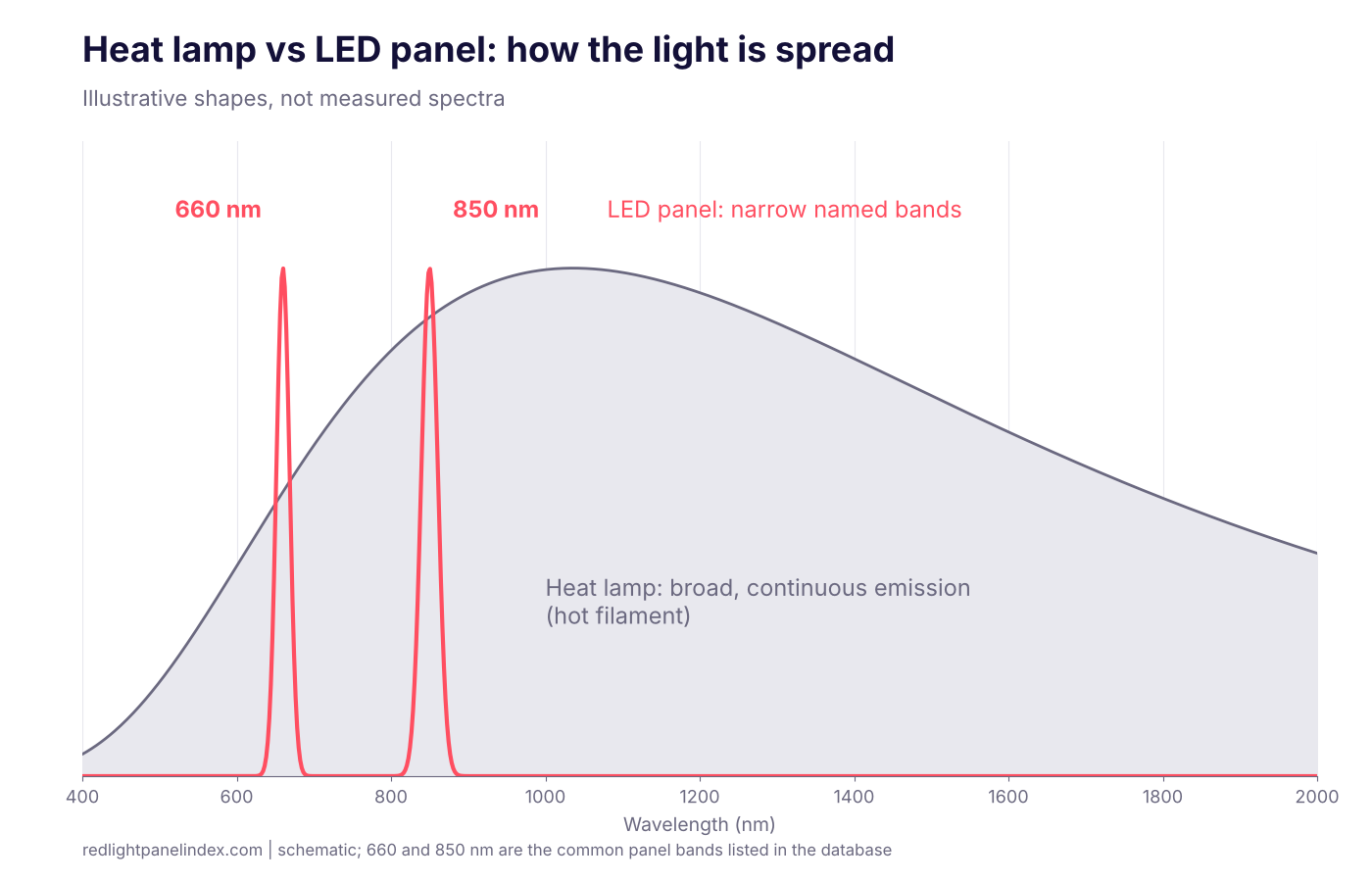
An infrared heat lamp and a red light therapy panel are different tools. A heat lamp is an incandescent bulb that glows because a filament is hot, so it emits a wide, smooth spread of wavelengths and is built to warm you. A panel uses LEDs that emit narrow bands, usually around 660 nm and 850 nm, and is judged by measured irradiance at a stated distance.
Choosing a panel? Our ranking of the best red light therapy panels is computed from published, method-labeled specs across 188 devices. For comparing against a heat lamp, the spec that matters is method-labeled irradiance at a stated distance, because a heat lamp publishes only a wattage.
How a heat lamp makes its light
A standard heat lamp bulb passes current through a filament until it is hot enough to glow. Any hot object radiates across a continuous range of wavelengths, and a filament radiates a large share of its output in the infrared, which is why the bulb feels warm from a distance. The red color of many bulbs comes from tinted glass over the top. That tint changes what your eye sees. It does not turn a broad emitter into a narrow one.
The wattage printed on the bulb is electrical input. As the optical vs electrical power page explains, input watts say little about how much light of a useful wavelength reaches your skin. For a heat lamp, most of that input leaves as heat, which is the point of the product.
How a panel makes its light
An LED emits light when current crosses a semiconductor junction, and the material sets the emission band. That is why panels cluster at a few named wavelengths. The LED chip design page covers single, dual and quad chip layouts, and the wavelength guide covers why 660 nm and 850 nm are common. A review of low-level light therapy describes the mechanisms of action and the dosimetry principles used with these sources (PMID 22045511).
Panels still warm up. The thermal vs photochemical page explains that "non-thermal" means the effect of interest is not driven by raising tissue temperature, not that a panel gives off no warmth.
Side by side
| Feature | Infrared heat lamp | LED panel |
|---|---|---|
| Light source | Heated filament | LED chips |
| Spectrum | Broad and continuous | Narrow bands at named peaks |
| Typical label | Bulb wattage | Wavelengths plus irradiance at a distance |
| Main purpose | Warmth | Dose-controlled light exposure |
| Dose can be calculated | Not from the label | Yes, from irradiance, distance and time |
Why the red glow is not the point
The research on photobiomodulation is built around specific wavelengths delivered at a measured dose. A heat lamp spreads its output over a wide range and gives no irradiance figure, so you cannot work out an energy dose from the box. With a panel you can: take a method-labeled irradiance at a stated distance, then use the dose calculator to turn a target dose into session minutes. Distance matters a great deal, which the distance guide covers.
For example, the Hooga HG300 is listed in the database with 660 and 850 nm and 73 mW/cm2 at 6 inches on the ranking page. That is a figure you can plug into a calculator. A lamp rated only as a number of watts offers no equivalent.
Also check what a number means. The irradiance explainer shows why figures from different instruments and distances are not comparable, and the claimed vs measured page shows how far label values can sit from measured ones.
Reading the two labels
A heat lamp box usually gives a wattage, a bulb size and sometimes a color. A panel listing in the database gives wavelengths, an irradiance in mW/cm2, the distance and the instrument. Those are different kinds of information. The first tells you how much electricity the product uses. The second tells you how much light lands on a surface, which is the number a dose depends on.
Here is why that matters in practice. Suppose you read a panel listing that says 73 mW/cm2 at 6 inches. Multiply irradiance by time and you get energy per square centimeter, and the dose calculator does that arithmetic for you. Suppose instead you read "250 W." There is no step that converts that number into a dose at your skin, because the label does not say how much of the input becomes light in any band, or how far from the bulb it was measured.
Heat is a confound, not a signal
Warmth is easy to feel, which makes it a poor guide. The thermal vs photochemical page makes the point that sham devices in trials must match warmth, and that you should compare measured irradiance, not how warm a device feels. A heat lamp maximizes the one thing that feels like a signal and tells you nothing about the dose. That is also why a session under a heat lamp can seem stronger than one under an 850 nm panel, which is invisible and may feel mild while still delivering a dose (see the 850 nm page).
The same page also notes that reduced skin sensation, for example with neuropathy, can hide heat buildup. That caution applies with extra force to a heat lamp, because heat is its main output.
A practical way to choose
- Decide what you want: warmth, or a measured light exposure.
- If you want warmth, a heat lamp or a heating pad does the job. Follow the manufacturer's distance and time limits.
- If you want a light exposure at 660 nm or 850 nm, shop on method-labeled irradiance at a stated distance, wavelengths, coverage and return terms, and ignore watts.
- Use the distance guide and the calculator to set a session. Start short and increase slowly.
- Stop if skin feels hot or looks irritated, and talk to a clinician if you have a skin condition or take photosensitizing drugs (see photosensitizing medications).
Where a heat lamp is still useful
Warmth is a real thing people want. A heat lamp can feel soothing on a stiff shoulder in a cold room, and nothing here says that is a bad reason to own one. If warmth is the goal, a heat lamp is a reasonable tool for it. The mistake is treating that warmth as if it were the same exposure studied in light therapy trials.
Where a heat lamp falls short
- No stated irradiance. You cannot compare it to a trial dose.
- No narrow band. The output is spread across wavelengths, so a specific wavelength cannot be targeted.
- Heat is the dominant output. Reduced skin sensation can hide a burn risk. The safety and side effects page covers cautions.
- Eye and hot-bulb hazards. Bulbs can run hot enough to cause burns on contact, and a lamp placed too close can overheat skin.
What no trial has tested
The site holds no trial that compares a hardware-store heat lamp against an LED panel on a clinical outcome. Any claim that one beats the other for a condition would go beyond the published evidence. What can be said is about design: one device is built for warmth and the other for a measurable light dose.
Verdict by use case
- You want warmth on a cold day: a heat lamp does that. Keep it at a safe distance and watch the clock.
- You want a measured light dose at 660 nm or 850 nm: use a panel with a method-labeled irradiance figure and the dose calculator.
- You are comparing sauna-type heat with panels: the panel vs infrared sauna guide covers that comparison.
- You are worried about UV: see red light vs tanning beds. The panel pages list the lowest band in the database as 480 nm blue, which is visible light, not UV.
- You are buying a panel: compare on measured specs through how rankings work, not on how warm the unit feels.