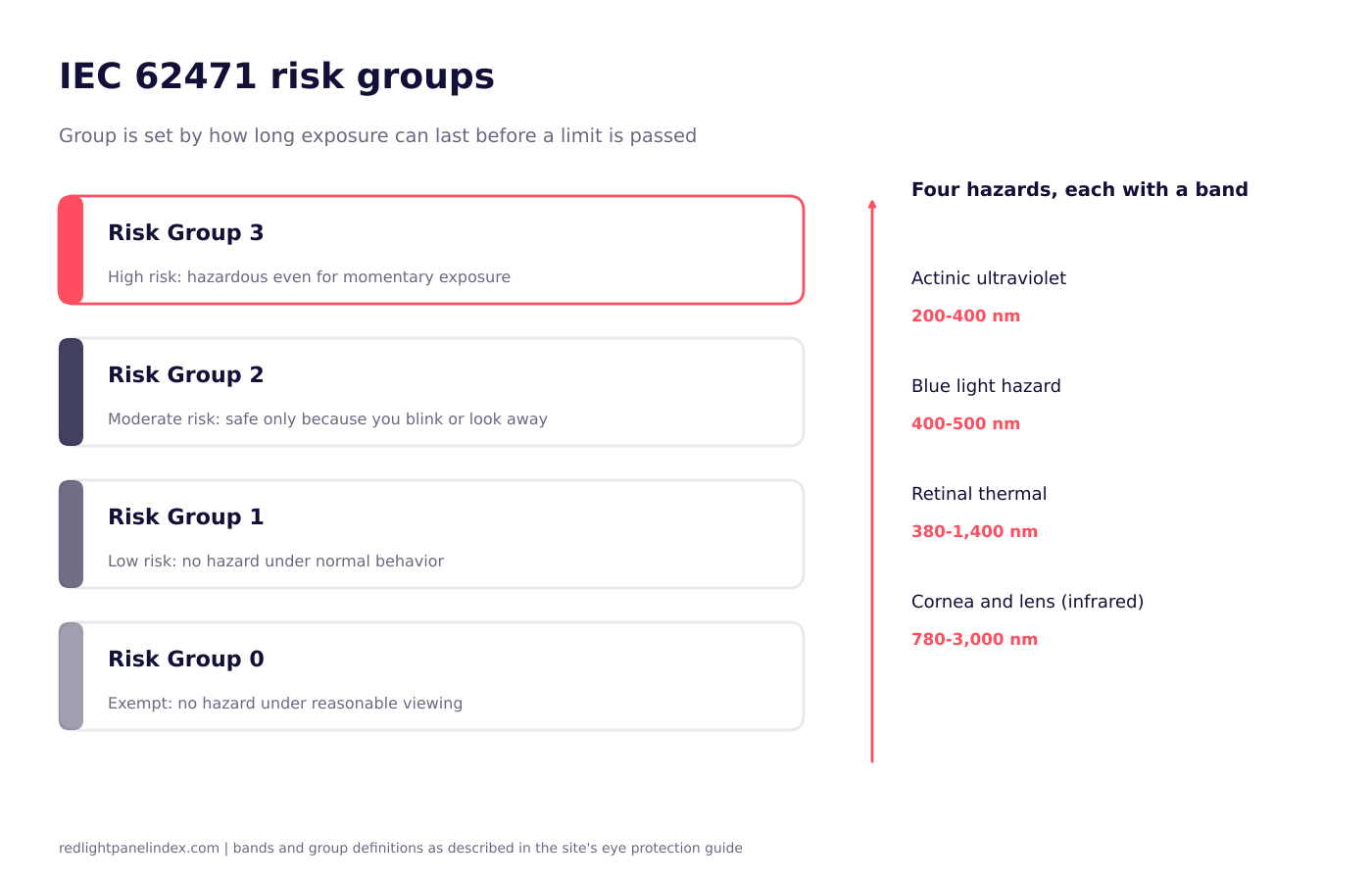
IEC 62471 is the international photobiological safety standard for lamps and LED products: it defines how to measure the light a product emits against several eye and skin hazards, then sorts the product into one of four risk groups from 0 (no hazard) to 3 (hazardous even briefly). A classification belongs to a measured product at a stated distance, which is why a home panel buyer rarely sees one: none of the 41 brands in our database publishes a risk group for its panels.
Choosing a panel? Our ranking of the best red light therapy panels is computed from published, method-labeled specs across 188 devices. For eye safety, the spec that matters is whether the panel emits anything below 500 nm, because that is where the blue light hazard band begins.
What the standard is for
Most safety labels on consumer electronics answer one question: did a lab test this product against a rule? IEC 62471 is different in an important way. It does not say a lamp is "safe" or "unsafe" in general. It describes a method: measure the spectrum the product emits, weight that output by how harmful each wavelength is to the eye and skin, and compare the result with exposure limits for set viewing times. The product's risk group is then read from how long you could be exposed before a limit is passed.
That makes it the standard that would actually settle the eye question for a red light panel. The eye protection guide uses it to explain why goggles are a judgment call today, and this page goes one level deeper into what the standard does and does not tell you.
The four hazards it separates
The standard does not use one combined number. It evaluates separate hazards, each tied to its own wavelength band:
| Hazard | Wavelength band | What it describes |
|---|---|---|
| Actinic ultraviolet | 200 to 400 nm | Damage to skin and the front of the eye from ultraviolet light |
| Blue light hazard | 400 to 500 nm | Photochemical injury to the retina from short-wavelength light |
| Retinal thermal hazard | 380 to 1,400 nm | Heating of the retina from a bright source |
| Infrared hazard to cornea and lens | 780 to 3,000 nm | Heating of the front of the eye by infrared radiation |
These bands are the same ones the eye protection guide lists. Read them against a panel's wavelength mix and you can see which hazards could apply at all. A panel built only from 660 nm red and 850 nm near-infrared LEDs emits nothing in the ultraviolet or blue bands, so those two hazards have nothing to evaluate. The retinal thermal and infrared hazards still apply, because both of those wavelengths fall inside their bands. A panel with a 480 nm channel adds the blue light hazard to the list. You can check which bands a given device emits on its database page and on the wavelengths reference.
The four risk groups
After measurement, the product is placed in the lowest group that fits across all the hazards:
- Risk Group 0 (exempt): no photobiological hazard under any reasonable viewing condition.
- Risk Group 1 (low risk): no hazard under normal behavior. It is safe unless you deliberately stare at the source for a long time.
- Risk Group 2 (moderate risk): no hazard because of the natural aversion response. You blink, look away or find the light too bright to keep watching, and that behavior is what keeps you under the limit.
- Risk Group 3 (high risk): hazardous even for momentary exposure.
The diagram at the top of this page shows the ladder. Two points matter for a home user. First, the groups are about viewing time, not about whether the product does anything useful. Second, Group 2 products are classed as acceptable only because people look away, and that assumption does not hold for light you cannot see. Near-infrared at 850 nm is invisible, so nothing prompts you to turn your head. This is one reason the eye protection guide gives the rule "do not look at the LEDs while the panel is running, at any distance."
Why the same panel can have different results
A classification depends on how much light reaches the eye, which depends on output and distance. Two facts from this site show why that matters.
First, output claims are not comparable by default. The claimed versus measured study compares brand claims with spectrometer readings for 44 panels and finds the claim averages 2.11 times the spectrometer figure, with a range from 1.36 to 2.60. A hazard assessment built on an unlabeled brand number would inherit that gap. The standard requires an actual measurement of the product, not a spec sheet figure.
Second, distance changes everything. Database irradiance figures are quoted at a stated distance, usually 6 inches, and output falls as you move away. The inverse square law explainer describes the geometry, and the irradiance page explains how method and distance should always travel with the number. A classification is only meaningful with the measurement distance attached, in the same way an irradiance figure is.
A worked example with database figures
The BlockBlueLight PowerPanel MID publishes two figures at 6 inches: 158 mW/cm2 on a solar meter and 61 mW/cm2 on a spectrometer. For a treatment dose, the spectrometer figure is the working value. Entering 61 mW/cm2 and a 20 minute session into the dose calculator gives 73.2 J/cm2.
For a hazard classification the lesson is different. A risk group would need the standard's own measurement of the panel's radiance and irradiance at the viewing distance, weighted by wavelength. Neither the solar meter figure nor the spectrometer figure on the page is that measurement. Both are treatment-dose numbers, and neither can be converted into a risk group by arithmetic from the page. That is the gap in the category: the data a buyer needs for eye safety does not exist on any product page we track.
What the 41 brands do instead
Because no risk group is published, brands answer the eye question in their own words. The eye protection guide records the pattern across the database: 30 of 41 brands list eye protection in the box, 7 do not include it or sell it as an add-on, and 4 publish nothing about it. Some brands state their products are not harmful to the eyes; others recommend glasses for the near-infrared mode. All of that is the brand's own judgment, not a classification under the standard.
Goggles and risk groups also do different jobs. A risk group describes the product. Goggles are an accessory that reduces what reaches the eye, and their value depends on the filter. Red and near-infrared blocking glasses protect the retina while leaving the skin exposed, whereas blackout goggles block everything and make a face session pointless. A pair of goggles does not change a panel's classification, and a good classification does not make staring into a panel a good idea.
How it relates to FDA status and "medical grade"
IEC 62471 is a measurement standard, not a regulatory clearance. It is separate from FDA registration or a 510(k) clearance, which the site's FDA-cleared versus registered explainer covers. A brand could hold either one without publishing a risk group, and a product could in principle be tested to the standard without any FDA status. The audit of "medical grade" claims found that phrase has no regulatory definition. If a brand ever pairs a "medical grade" claim with a test report to this standard, the report is the part worth reading.
What to ask a brand
If you want an answer rather than a marketing sentence, these questions are specific enough to get one:
- Has the panel been tested to IEC 62471, and can you share the report?
- Which risk group did each hazard fall into, and at what distance was it measured?
- Does the report cover the blue light hazard, and does the panel have any channel below 500 nm?
- Is the tested product the same model and driver as the one sold?
A brand that has the report can answer in a sentence. A brand that answers with "medical grade" or "no ultraviolet" has told you something, but not what the standard measures. Until reports are published, follow the habits in the eye protection guide: do not look at the LEDs, use the supplied eyewear for face sessions, and treat any blue or violet channel as the reason to be stricter. The safety and side effects page covers the wider caution list.
What is not known
No source we hold reports a risk group for a consumer red light panel, so this page cannot say which group the panels you can buy fall into. Nor does the evidence we cite show that the red and near-infrared bands at typical home distances injure the eye. What exists is a standard that can answer the question, a category that has not applied it publicly, and a set of habits that cost nothing to follow.