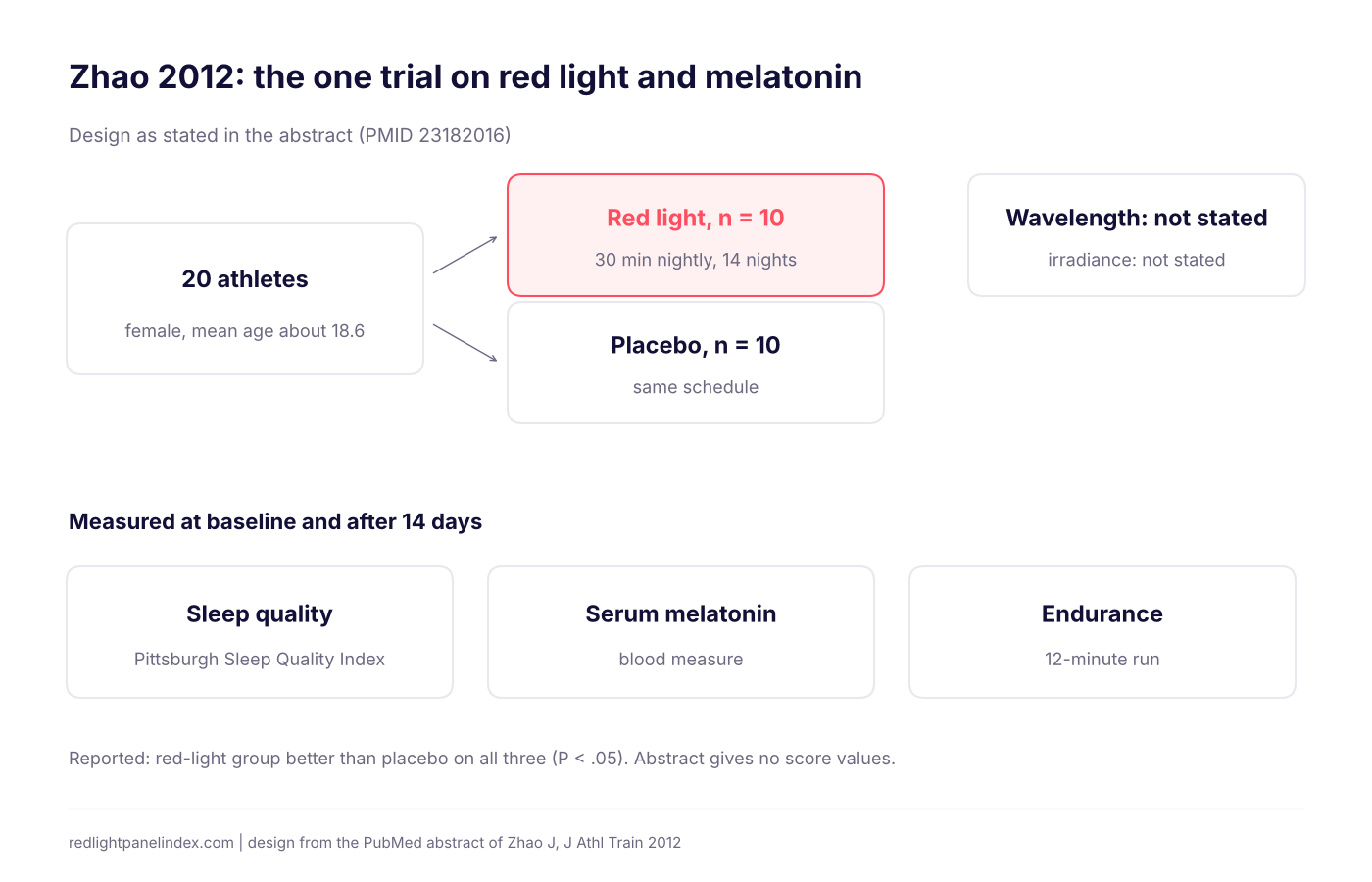
The evidence grade for red light and melatonin is Limited: a single small placebo-controlled trial of 20 young elite athletes reported higher serum melatonin and better sleep quality after 14 nights of whole-body red light, and nothing else directly tests the question in people. Red light is not a circadian light in the way bright white or blue-enriched light is, so using a red panel in the evening is plausible and low in risk, but it is not proven to help sleep or to shift the body clock.
Choosing a panel? Our ranking of the best red light therapy panels is computed from published, method-labeled specs across 188 devices. For evening use, the spec that matters is whether the red and near-infrared channels can run without any blue output.
Why the grade is Limited
The site's grades run from Strong through Moderate and Limited to Insufficient. Limited means there is a direct human signal, but it is small, narrow and unreplicated. Here the signal is one randomized, placebo-controlled study with 10 people per arm, in a population (young, heavily trained female athletes) that does not resemble most home users. The broader sleep evidence page carries the same grade for the same reason.
What red light does and does not do to the body clock
The body clock is set mainly through the eyes. Specialized cells in the retina respond most strongly to blue-enriched light and relay timing signals to the brain, and bright light at the wrong hour can delay the clock and suppress melatonin. That is the pathway SAD lamps are built around, as explained in our comparison of red light panels and SAD lamps. A red panel is built for a different job: delivering red and near-infrared light to tissue, measured in mW/cm2 rather than lux.
Two separate ideas often get blended together, and they should be kept apart:
- Red light is a poor circadian signal. Longer red wavelengths do not suppress melatonin the way blue-enriched light does. That is a property of the wavelength, not a sleep benefit. It means a red-only panel in a dim room is unlikely to work against sleep the way a bright screen or a white light can.
- Red light might affect melatonin through tissue, not eyes. This is the idea the athlete trial tested: whole-body irradiation at night, with melatonin measured in blood. It is a hypothesis with one small study behind it, not an established mechanism.
For more on how wavelength bands differ, see the wavelength guide and the page on 480 nm blue light on red light panels.
The one trial: Zhao 2012
The study is described in a full review of the Zhao 2012 athlete trial; the key points are below.
Who was studied. Twenty athletes from a Chinese military team, mean age about 18.6, split into a red-light group of 10 and a placebo group of 10 (PMID 23182016).
Device and dose as stated. Whole-body red light for 30 minutes, nightly, for 14 days. The abstract available to the review does not state a wavelength, an irradiance or a J/cm2 dose, so the protocol cannot be matched to a specific home panel. The dose calculator can work out what a panel delivers at a given distance, but there is no trial figure here to aim for.
What was measured. The Pittsburgh Sleep Quality Index (a questionnaire), serum melatonin and a 12-minute run, each at baseline and after the 14 days.
What was reported. Compared with placebo, the red-light group was reported to have better sleep quality, higher serum melatonin and better run performance, with differences described as statistically significant. The change in sleep quality was reported to track the change in melatonin. The abstract gives direction and significance; the figures are not reproduced here because they are not in the portion of the abstract the site could read.
Limits that matter. The arms were tiny. The participants were elite athletes in training, whose sleep and hormones respond to training load in ways the general public's do not. The PubMed record itself labels the design in two different ways, which is a reminder to read the full paper before leaning on it. Only 14 nights were studied, and the paper does not tell us whether any effect lasts after the light stops. Finally, a whole-body setup is not the same thing as a panel aimed at one area from a set distance.
What was not studied
- Ordinary adults with sleep complaints. No controlled trial of a home panel in people with insomnia or poor sleep is listed on this site.
- Timing. Nobody has compared evening with morning sessions; our morning vs evening guide covers what is and is not known.
- Dose. No trial has tested different doses, durations or distances for sleep or melatonin.
- Wavelength. No trial has compared red with near-infrared, or red with blue, for sleep outcomes.
- Circadian timing. No study listed here measures whether red light shifts the phase of the body clock.
- Long-term effects. Nothing is known beyond the 14-night window.
Practical use if you try it anyway
Because the downside is small and the upside unproven, evening use is a reasonable personal experiment as long as it is treated as one.
- Keep blue off. If a panel has a 480 nm blue band, only use it in the evening if that band can be switched off on its own. Among the models on the sleep panel ranking, the Hooga HG300 has two bands (660 and 850 nm) and no blue channel. The RLT Home Total Spectrum COMPACT includes a 480 nm band at about 6% of output and its database entry does not state channel control, so confirm with the brand before relying on it. Our methodology page explains how rankings work.
- Keep sessions short. The sleep evidence page suggests 10 to 20 minutes, 30 to 90 minutes before bed. Longer or brighter is not shown to help, and the dose-response in this field can be biphasic, meaning more is not automatically better.
- Dim the room. The panel should be one of the few light sources on, not an addition to bright overheads or a phone screen.
- Protect your eyes. Panels are not meant to be stared at; see the eye protection guide.
- Run a two-week comparison. Note bedtime, wake time and how you feel, with and without sessions. This is not a study, but it keeps expectations honest.
The session length guide covers general timing for panels, and the irradiance explainer shows why two panels with the same label can deliver different amounts of light.
Cautions
- Red light is not a treatment for insomnia, sleep apnea or any diagnosed sleep disorder. Persistent sleep problems belong with a clinician.
- A red panel does not replace the standard behavioral approaches to sleep, or a SAD lamp for seasonal low mood.
- If you take photosensitizing medication, check with a clinician first.
- Bright panels are not for staring into, and evening sessions should not turn into a bright-room habit.
- This page is general information, not medical advice.
Bottom line
Red light does not behave like a body-clock light, which is why a red-only evening session is unlikely to interfere with melatonin the way blue-enriched light can. Whether it actively raises melatonin or improves sleep rests on one 20-person athlete trial from 2012. Treat that as a reason for further research, not a result to plan a routine around, and choose a panel on controllability rather than promises.