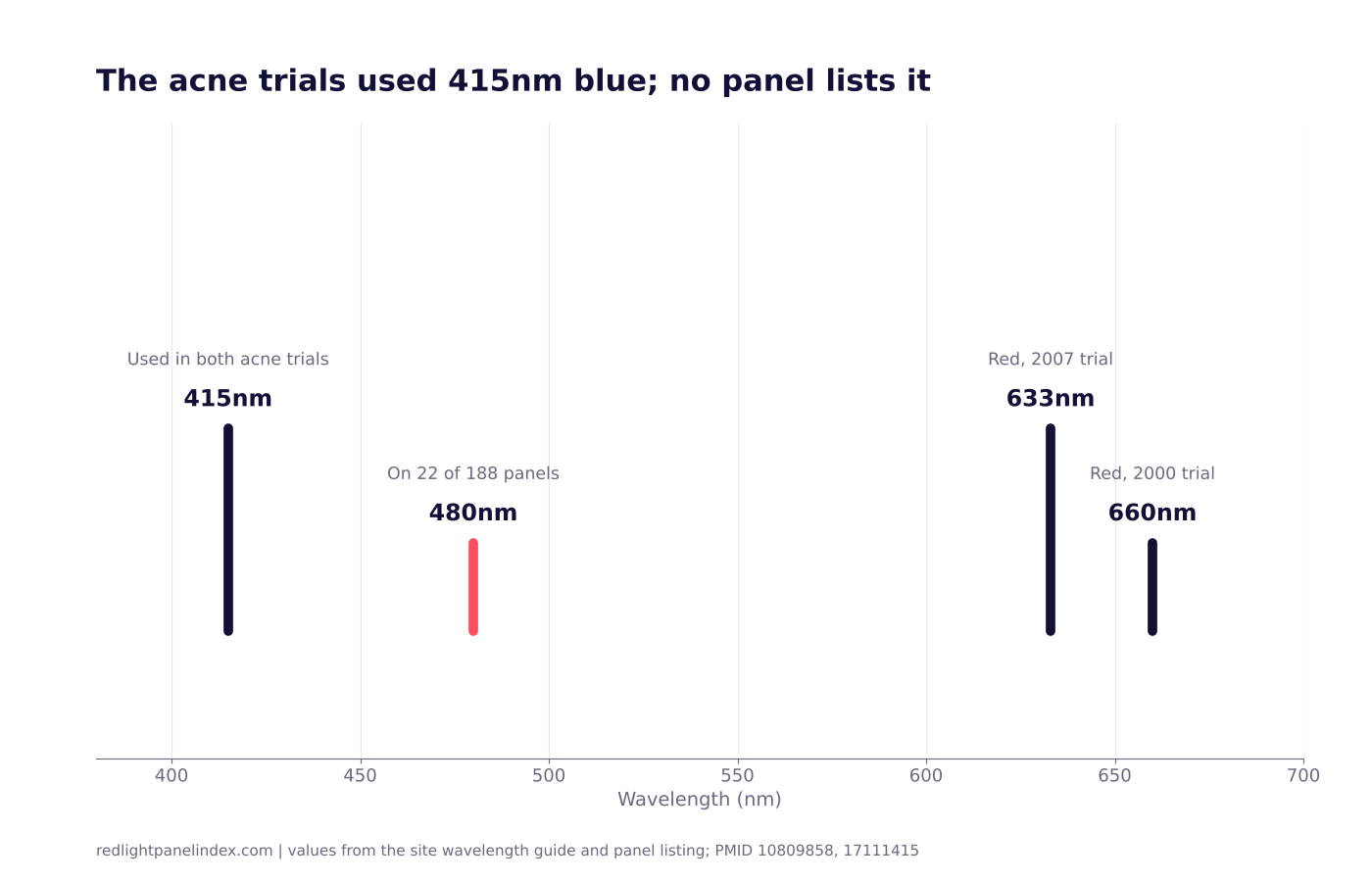
The 480nm channel is a blue LED wavelength that a minority of red light panels add alongside their red and near-infrared bands, and the site's wavelength guide lists its role as "Surface skin, acne." It is rare: 22 of the 188 panels in the database list it, or 12 percent, and none of them lists 415nm, the blue wavelength the acne trials actually used.
Choosing a panel? Our ranking of the best red light therapy panels is computed from published, method-labeled specs across 188 devices. For a blue channel, the spec that matters is how much of the output it takes and whether it can be switched off, because most brands do not publish either.
What the 480nm channel is
Most red light panels emit nothing below 600nm. They are built around red (630 to 660nm) and near-infrared (810 to 940nm) bands chosen to reach tissue under the skin. A 480nm channel sits at the opposite end of the visible range. The wavelength guide places it at the surface of the skin, notes that it is "rare on panels; useful for surface protocols, switch it off for evening use," and gives no penetration figure for it, so nothing on this site supports a claim that it reaches deeper tissue.
That is a short entry for a wavelength that changes the eye-safety picture, and this page fills in what the database does and does not say. For the red and near-infrared bands it sits beside, see the 660nm explainer and the 940nm page.
Which panels have it
The panel listing at /panels/ shows the wavelengths for each model. Matching on the numbers (the listing does not label any channel "blue"), 22 models include 480nm:
- RLT Home Total Spectrum MINI, COMPACT, MAX, ULTRA and ELITE
- PlatinumLED BioMax 300, 450, 600 and 900 (classic 9th gen), and the BioMax Pro Nano, Midi, Grande and Ultra
- Orion One and Orion One Plus
- RedLife Pro 100, 200, 300 and 600
- Vital Pro 2.0 and Vital Elite 2.0
- Vellgus Elite V2
That is six brands out of the 41 tracked. No model in the listing shows 415nm. For the one sham-controlled blue light trial in eczema, which used 415nm and 450nm, see the eczema evidence page. BlockBlueLight, despite the name, appears in the database for its own panel line and not for a blue wavelength.
Worked examples from the database
The published detail about the blue channel varies a lot, and the examples below show how. Prices are as shown on each model page on the verification date given; they change, so confirm with the brand.
RLT Home Total Spectrum COMPACT. The page lists seven channels that total 100 percent: 480nm at 6 percent, 630nm and 660nm at 19 percent each, 810nm at 19 percent, 830nm at 14 percent, 850nm at 9 percent and 1064nm at 14 percent. It is one of the few models that publishes a split at all. The page lists 9 modes but does not describe them, so whether 480nm can be run alone is not stated. Price $1,095, verified 2026-09-12. The page lists 99.0 mW/cm2 at 6 inches from a lab test, with a note that the published lab tests were commissioned by the brand, so read it with the guidance in the irradiance explainer.
PlatinumLED BioMax 300. The page gives an array-level blend, not a per-model one: the red array is 630nm at 20 percent and 660nm at 80 percent, the near-infrared array is 810, 830, 850 and 1060nm, and 480nm is about 2 percent. Switchable control is described only for the red and near-infrared arrays, so a separate 480nm control is not stated. Price $659, verified 2026-08-13.
Orion Orion One. The page counts LEDs rather than percentages: of 60 LEDs, 30 are red, 28 are near-infrared and 2 are blue, about 3.3 percent. The One and One Plus are described as having a "Blue light mode," but the page does not tie it explicitly to 480nm. Price $949, verified 2026-08-13.
RedLife Pro 100. The page lists 10 wavelengths including 480nm and says the brand does not publish how output is split across them. Price $1,063, verified 2026-08-13.
Vital Pro 2.0. Here 480nm appears only inside multi-wavelength preset modes, described as "blue 480nm / yellow 590nm" presets. The brand does not publish the wavelength allocation. Price $599, verified 2026-08-13.
Vellgus Elite V2. Six wavelengths (480, 630, 660, 810, 830 and 850nm) with the allocation not published. Only "Pulsing+" and "Dimming+" modes are described. Price $549, verified 2026-08-13.
Three things follow from these six pages. First, where a share is published, the blue channel is small: about 2 percent, about 3.3 percent by LED count, and 6 percent. Second, four of the six brands do not publish a share at all. Third, none of the six pages states that the blue channel can be switched off on its own, although the wavelength guide's advice is to switch it off for evening use. If you plan to use a panel at night, ask the brand how.
Why the acne trials used 415nm
The reason the 480nm channel is tied to acne is two trials that combined blue and red light, one randomized and one open. Papageorgiou and colleagues randomized 107 patients with mild to moderate acne into blue (415nm), mixed blue and red (415 and 660nm), white light, or 5 percent benzoyl peroxide, with daily 15-minute sessions over 12 weeks (PMID 10809858). The combined group had a mean 76 percent reduction in inflammatory lesions at 12 weeks. Lee and colleagues treated 24 patients with skin phototype IV using alternating 415nm and 633nm LED light twice a week for four weeks and reported mean improvements of 77.93 percent in inflammatory lesions and 34.28 percent in non-inflammatory lesions (PMID 17111415). The full designs are in the Papageorgiou study review and the Lee phototype IV study review.
Both trials used 415nm. A 480nm channel is a different wavelength, 65nm away, and neither trial tested it. Neither trial reported an irradiance or dose either, so the dose calculator cannot turn their protocols into a session time. The honest reading is that the acne evidence, graded Limited on the acne evidence page, supports a blue-plus-red combination at 415nm, and a panel with a small 480nm channel is a different device from the one tested. A panel that lists 480nm has not been shown to reproduce those results.
What a blue channel changes for safety
The eye protection guide says the clearest published harm from a consumer LED skin device has come from the blue end of the spectrum, in a single case report of retinal injury from a blue LED face mask, and that 480nm falls within the blue light hazard band. Its advice is to wear the goggles the brand supplied for any face session and for any panel with a blue or violet channel, and never to look at running LEDs at any distance. Closed eyes and a turned head are described as adequate for most red and near-infrared-only body sessions, but a blue channel is the reason to go further. The guide also notes that no brand publishes a photobiological risk group for its panels, so "safe for the eyes" is unverified for all of them.
Two other cautions apply. The wavelength guide says to switch the blue channel off for evening use, so a panel that cannot do that is a poor fit for a night routine. And some acne medicines, including tetracycline-class antibiotics and retinoids, are photosensitizing, as covered in the photosensitizing medications guide. Skin tone matters for dose as well; see skin phototype and dosing.
What to check before you buy
- Is 480nm actually listed, and as what share? Look for a published percentage or LED count. "Includes blue" with no share tells you little.
- Can it be switched off separately? The model pages above mostly do not say.
- Is eye protection included? Per the eye protection guide, 30 of 41 tracked brands include it in the box.
- Does the irradiance have a method? Use the irradiance explainer and the claimed vs measured data page to see how figures were measured.
- Is your goal one the evidence supports? For acne, the trials used 415nm plus red. If acne is the main goal, the sensible comparison is the evidence page, not a spec sheet.
For how panels are scored on the criteria that are published, see how rankings work. RLT Home is one of six brands in the database that lists a 480nm channel, and it is held to the same standard as the others: a published share is better than none, and none of them has trial data for its own blue channel.
The short version
A 480nm channel is a small, rarely documented blue band on 22 panels. It is listed for surface skin and acne use, but the trials behind that association used 415nm, and no panel in the database lists 415nm. It raises the eye-safety bar, it should be switchable for evening use, and a buyer should treat a published share, a clear off switch and included goggles as the specs that matter.