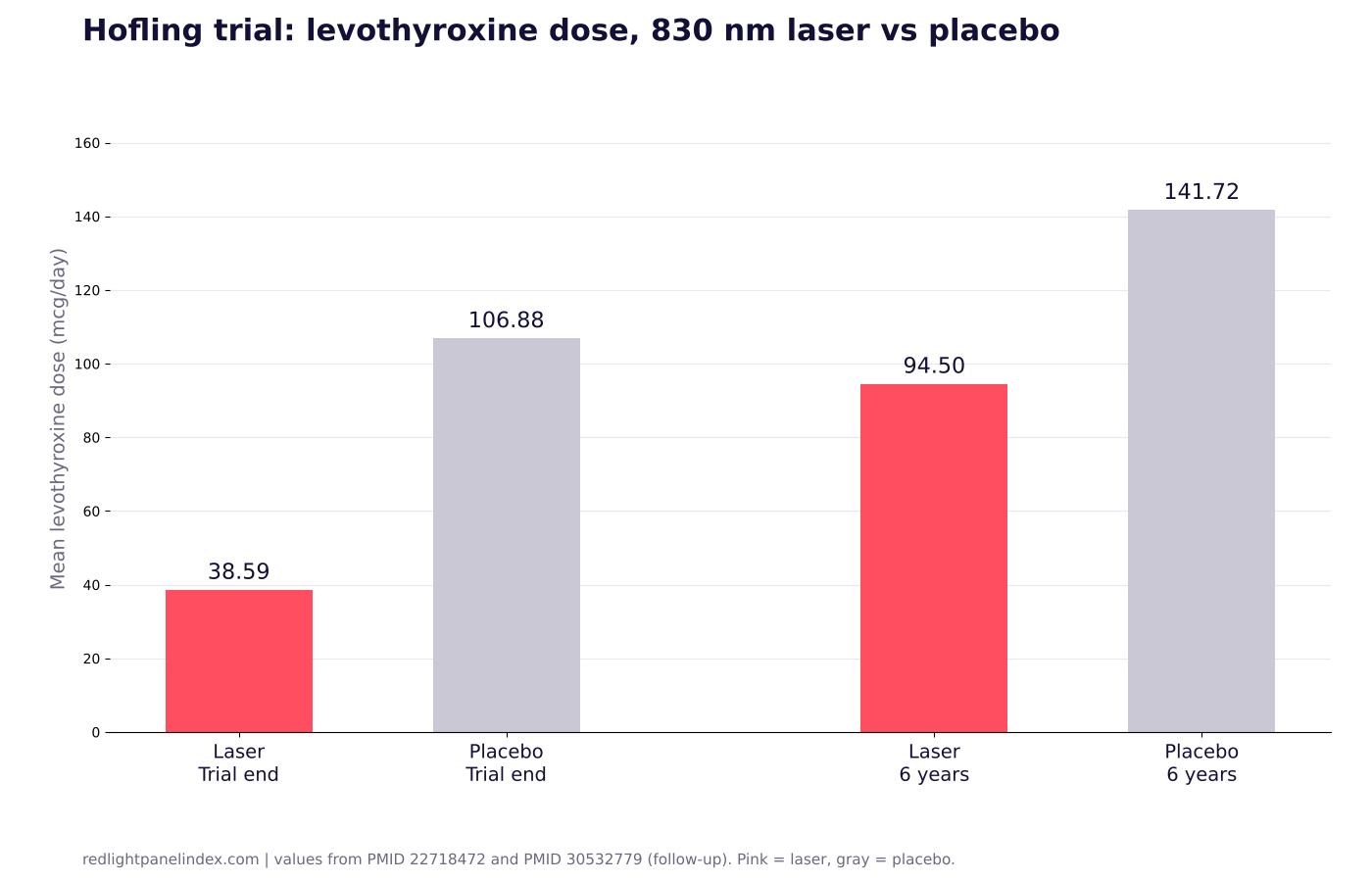
Hofling and colleagues randomized 43 people with hypothyroidism caused by autoimmune thyroiditis to ten sessions of an 830 nm laser or a placebo light over the thyroid, and reported that the laser group later needed a much lower levothyroxine dose (PMID 22718472). It is the only placebo-controlled trial of its kind that we found, which is why our thyroid evidence page grades the topic Limited.
Choosing a panel? Our ranking of the best red light therapy panels is computed from published, method-labeled specs across 188 devices. For a study like this one, the spec that matters is delivered irradiance at the target, because the trial laser concentrated far more power into a small spot than a panel does.
This review describes published research. It is not medical advice, and thyroid medication should only be changed by a physician.
What the study asked
The trial asked whether low-level laser therapy applied over the thyroid could change thyroid function in people whose gland had been damaged by chronic autoimmune thyroiditis (Hashimoto's disease). All participants were already on levothyroxine replacement. The measure of thyroid function was the levothyroxine dose needed to keep thyroid blood tests normal after the medication was withdrawn under supervision, rather than a symptom score. The paper was published in Lasers in Medical Science in 2013.
Who was studied
Forty-three adults were randomized: 23 to laser and 20 to placebo. They had hypothyroidism from chronic autoimmune thyroiditis and were taking levothyroxine at study entry. The trial ran from 2006 to 2009 at a single center in Sao Paulo, Brazil. Companion reports on the same cohort described no dropouts in the first phase (PMID 23316383), and the long-term follow-up listed the participants by group as 25 and 18 because two former placebo patients later received the laser (PMID 30532779).
Device and parameters as stated
The parameters below come from the papers on this cohort, and we report them as the authors do:
- Device: continuous-wave diode laser, 830 nm, infrared.
- Output: 50 mW.
- Energy per point: 2 J, delivered over 40 seconds per application point.
- Fluence: 707 J/cm2 at the point; irradiance 17.68 W/cm2.
- Application: contact mode, probe perpendicular to the skin, positioned through a template over the thyroid.
- Schedule: 10 sessions, twice a week, for five weeks.
- Placebo: the same equipment with ordinary red light at 0.1 mW and 1.41 J/cm2, which the authors described as indistinguishable from the laser beam.
Because the laser beam is invisible and the placebo light was visible red, the design depended on the sham being hard to tell apart in practice. For why that matters, see our explainer on sham-controlled trials.
What was measured and found
Levothyroxine dose. The main outcome was the mean levothyroxine dose needed after the trial. The reported figures were 38.59 micrograms a day (standard deviation 20.22) in the laser group and 106.88 micrograms a day (standard deviation 22.90) in the placebo group, reported as significant at p below 0.001 (PMID 22718472).
Antibodies and ultrasound. The same paper reported lower thyroid peroxidase antibodies in the laser group (p = 0.043) and greater echogenicity of the gland on ultrasound (p below 0.001). Thyroglobulin antibodies did not differ between groups.
Blood flow. The companion paper on Doppler ultrasound reported that normal vascular patterns were more frequent after laser, with a parenchymal vascularization score of 1.87 against 2.30 for placebo (p = 0.033), measured one month after treatment (PMID 23316383).
Six years later. The follow-up reported mean levothyroxine doses of 94.50 micrograms a day in the laser group and 141.72 in the placebo group (p = 0.003), with no significant differences in TSH, thyroid peroxidase antibodies or thyroglobulin antibodies (PMID 30532779). Nodule rates were similar, at 3 of 25 and 3 of 18, and no malignant nodules were found.
The gap between the two time points matters. The difference in dose was smaller in absolute terms at six years, and the authors suggested the effect may be transient and that repeat sessions might be needed. We cannot say from the papers how much of the later dose reflects the laser and how much reflects ordinary changes in the disease and in prescribing.
Limitations
- One center, one group. The trial was run by the team that developed the protocol. No independent replication turned up in our search.
- Small sample. With 43 people, a few unusual cases can move averages. The follow-up authors themselves note the sample limits the safety analysis.
- A laboratory-guided outcome. The main result is a dose, not how people felt. The trial does not report whether symptoms improved, and we do not draw a conclusion about that.
- Subjective imaging. The follow-up authors state that vascularization was judged subjectively, with possible variation between readings.
- Changed assay kits. Different antibody kits were used in the trial and the follow-up, which prevents comparing antibody levels across time points.
- Internal inconsistencies. The follow-up abstract gives the dose p value as 0.002 while its table gives 0.003, a minor discrepancy but a reminder to read primary tables, not just summaries.
- Not a panel. Everything here concerns a focused laser, not LEDs.
What this means for a home panel
The honest answer is that the trial does not tell us what a panel would do. The laser put 17.68 W/cm2 into a small contact spot. Our 830 nm page estimates about 15.5 mW/cm2 of 830 nm light at six inches for one popular multi-wavelength panel, labeled there as an estimate and not a measurement. The trial irradiance is therefore about a thousand times higher. At that panel figure, delivering 707 J/cm2 would take roughly 12 to 13 hours, so the two are not comparable by simply running a panel longer. Try your own numbers in the dose calculator.
Other differences are also unquantified: contact versus distance, focused versus diffuse light, and the use of a template to place the beam. The neck is also an area where light near the eyes should be avoided, so see our safety review before any experiment of your own.
For a sense of how another body-focused laser literature compares, see our review of body contouring low-level laser trials, which also depends on devices that differ from home LED panels.
Bottom line
The Hofling trial is a carefully built, small, single-center study that reported a lower levothyroxine requirement after an 830 nm laser, with a follow-up pointing the same way. It is a reason for independent trials, not a reason to put a panel on the neck or to change a prescription.