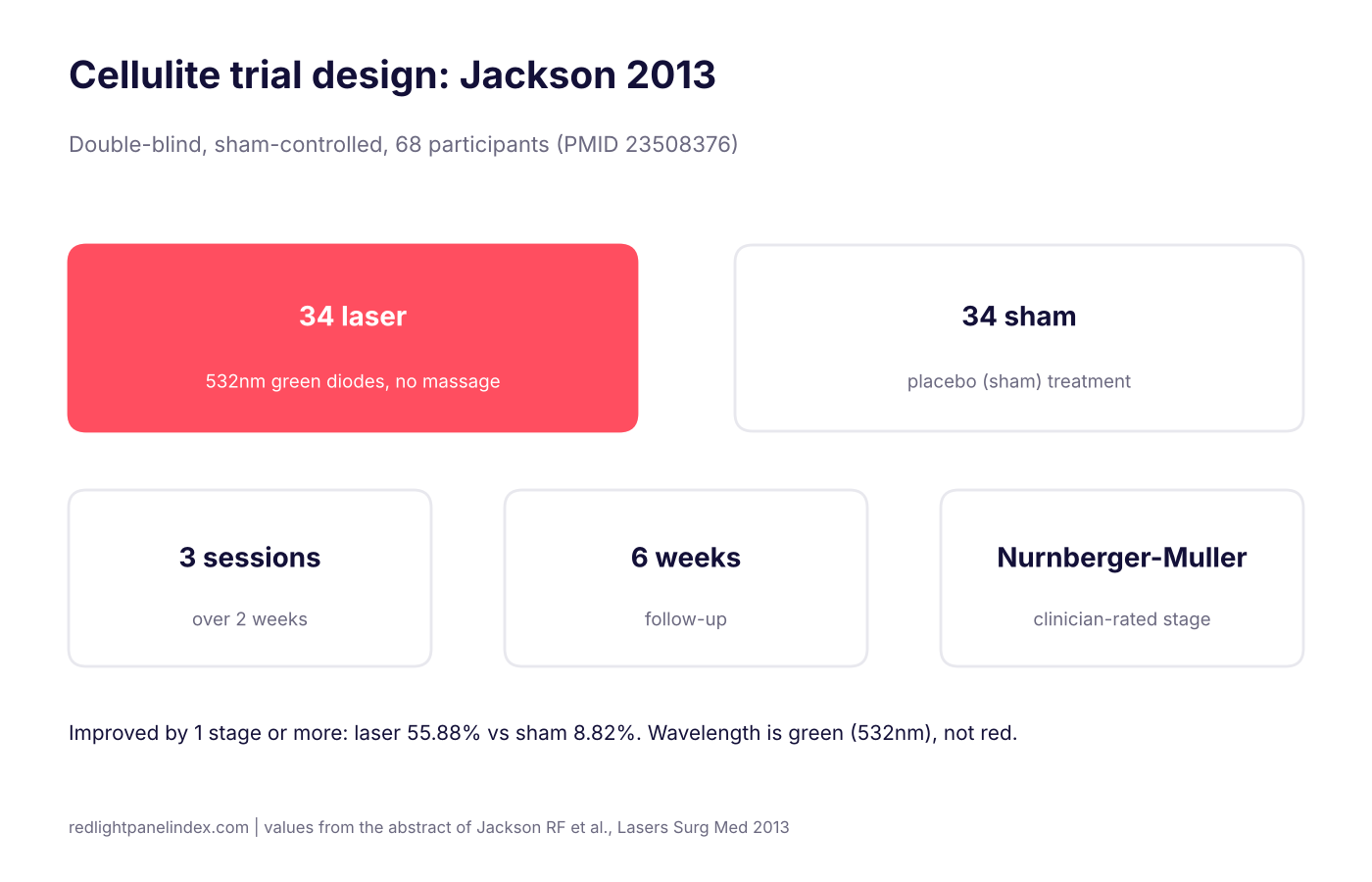
The evidence grade for red light therapy and cellulite is Limited: the one placebo-controlled trial this index relies on reported a clear improvement in cellulite stage, but it tested a clinic laser at 532nm (green light, not red), it is a single study with 68 participants, and no home LED panel has been tested for cellulite. The result is worth knowing about, and it is not a result that a red light panel can claim.
Choosing a panel? Our ranking of the best red light therapy panels is computed from published, method-labeled specs across 188 devices. For cellulite, the spec that matters is wavelength, because the only controlled trial used 532nm green diodes and almost no home panel emits that band.
What the trial asked
Jackson, Roche and Shanks published a double-blind, placebo-controlled randomized trial in Lasers in Surgery and Medicine in 2013 (PMID 23508376). The question was whether low-level laser therapy could improve the visible appearance of cellulite as a standalone procedure, without the massage that many cellulite treatments add. That detail matters because massage alone can change how skin looks, and a design that removes it makes the light the main variable.
The same research group had earlier published a body-contouring trial that measured circumference after 635nm laser sessions (PMID 20014253). The cellulite study is a different question with a different outcome: not how big an area measures, but how a clinician stages the surface appearance of the skin. If you came here from the weight loss question, the study review of the two laser body-contouring trials and the weight loss evidence page cover that literature separately.
Who was studied
The trial randomized 68 women and men, 34 to the laser and 34 to a sham treatment. The abstract summary available for this review gives the split and the design but not ages, body mass index or skin phototype, so those are not described here. A sample of this size can show a large difference between arms, and it cannot say much about how the result varies by skin type, age or starting stage.
Device and parameters as stated
The device used green 532nm diodes. That is the single most important fact for anyone reading this with a home panel in mind. Green light at 532nm sits well below the red band, which starts around 600nm, and well below the near-infrared range most panels add. The wavelength reference shows where the common panel bands fall, and 532nm is not one of them. Green light also behaves differently in tissue: the optical window page explains why red and near-infrared reach deeper than shorter wavelengths, and the penetration depth page shows the trend by wavelength.
Participants received three sessions over two weeks, with follow-up at six weeks. The summary available for this review does not report irradiance in mW/cm2, energy per point, spot size or distance from the skin. Without those, the site's dose calculator cannot convert the protocol into a session length for a panel, since a dose in J/cm2 needs an irradiance and an area. A clinic laser and a panel LED also differ in beam, power and spot, which the LED vs laser explainer covers.
What was measured and found
The primary outcome was cellulite stage on the Nurnberger-Muller scale, a clinician-rated grading of cellulite severity. In the laser group, 55.88 percent of participants improved by at least one stage, compared with 8.82 percent in the sham group (PMID 23508376). Those percentages correspond to 19 of 34 against 3 of 34.
The laser group also showed significant reductions in thigh circumference, body weight, body mass index and the body surface area affected by cellulite. The authors reported no adverse events and concluded that the treatment is safe and effective as a standalone procedure, while noting that long-term benefits need further study.
Two readings of that result deserve equal weight. The first is that a sham-controlled trial found a difference between arms that is hard to explain by expectation alone, which is why the page is graded Limited and not Insufficient. The second is that the trial reported a drop in body weight and BMI over a two-week treatment course, which is an unusual outcome for local light and sits uneasily with the weight findings on the weight loss page, where the Caruso-Davis trial held weight stable by design and still reported girth change. An unexpected secondary result is a reason to want replication, not a reason to set the finding aside or to accept it.
What was not studied
Another condition where the research is built on clinic lasers and no home panel was tested is breast cancer-related lymphedema.
- Red or near-infrared light for cellulite. The controlled trial used 532nm. This index found no sham-controlled trial of a 630nm to 850nm panel with cellulite stage as the outcome.
- Home LED panels. No trial in the register tested a consumer panel at a working distance for cellulite.
- Durability. Follow-up ended at six weeks. Nothing reviewed here shows whether the improvement lasted months.
- Independent replication. This index has not reviewed an independent replication of the cellulite trial.
- Photographic or ultrasound outcomes. Stage on a clinical scale is a rater's judgment. The summary available here does not describe blinded photographic or imaging confirmation.
- Skin tone and age. The abstract summary does not break results out by phototype or age, and the skin phototype and dosing page explains why dose can matter differently across skin tones.
Practical section for a home panel
The honest practical read is short. If your goal is cellulite, the best-supported light in the literature is not the light in your panel. Pointing a 660nm or 850nm panel at the thighs is a different intervention from the one that was tested, and the trial gives no basis for matching a session length or distance to it.
If you use a panel for another reason and happen to include the thighs, the standing guidance applies: choose a session length from a method-labeled irradiance and a published dose range using the dose calculator, and keep to it, because the biphasic dose response page explains that more minutes is not more benefit. Judge any cellulite marketing against the evidence grades explained page: a Limited grade means one reasonably controlled signal, not a consensus. For a sense of how another clinic-laser trial with a sham arm is reported when the outcome is not skin, see the Hashimoto hypothyroidism study review, and for why a sham arm carries so much weight, see the explainer on sham-controlled trials.
Questions to ask of any cellulite claim: which wavelength was tested, whether there was a sham arm, how cellulite was staged and by whom, and whether the result was measured at a point later than a few weeks.
Cautions
- A green 532nm laser is a different hazard class from a red panel. Eyes need protection from clinic lasers; the eye protection guide covers panels, and a clinic laser should only be used under the clinic's own protocol.
- Do not read a tape-measure or weight change as fat loss. The body-contouring review explains why circumference is a limited outcome.
- Heat, skin conditions and medications that increase light sensitivity are covered on the safety and side effects page. Ask a clinician before treating skin that is broken, inflamed or newly treated.
- One trial can be wrong, or right for a device you will never own. Treat the 55.88 versus 8.82 percent figure as a reason for more trials, not as a promise.