Pulse frequency, measured in hertz (Hz), is how many times per second a panel's LEDs switch on and off, and duty cycle is the percentage of each cycle the LEDs are actually emitting. A panel set to 10 Hz with a 50 percent duty cycle turns on ten times a second and is lit for half of each tenth of a second, so its average output is half of its peak output.
Choosing a panel? Our ranking of the best red light therapy panels is computed from published, method-labeled specs across 188 devices. For a panel with pulse modes, the spec that matters is the average irradiance at the mode you will use, not the peak figure printed on the box.
Two numbers, two jobs
The two settings are easy to blur together, but they control different things.
- Frequency (Hz) sets the rhythm. At 10 Hz there are ten on-off cycles every second, and each cycle lasts 0.1 second. At 40 Hz each cycle lasts 0.025 second.
- Duty cycle (percent) sets how much of each cycle is "on." Continuous wave is the limiting case: 100 percent duty, no off time.
Average output follows from both: average power equals peak power times duty cycle. Frequency alone does not change the average. A 10 Hz pulse and a 40 Hz pulse at the same peak and the same duty cycle deliver the same average light; they only divide it into more or fewer flashes.
The diagram: same peak, different average
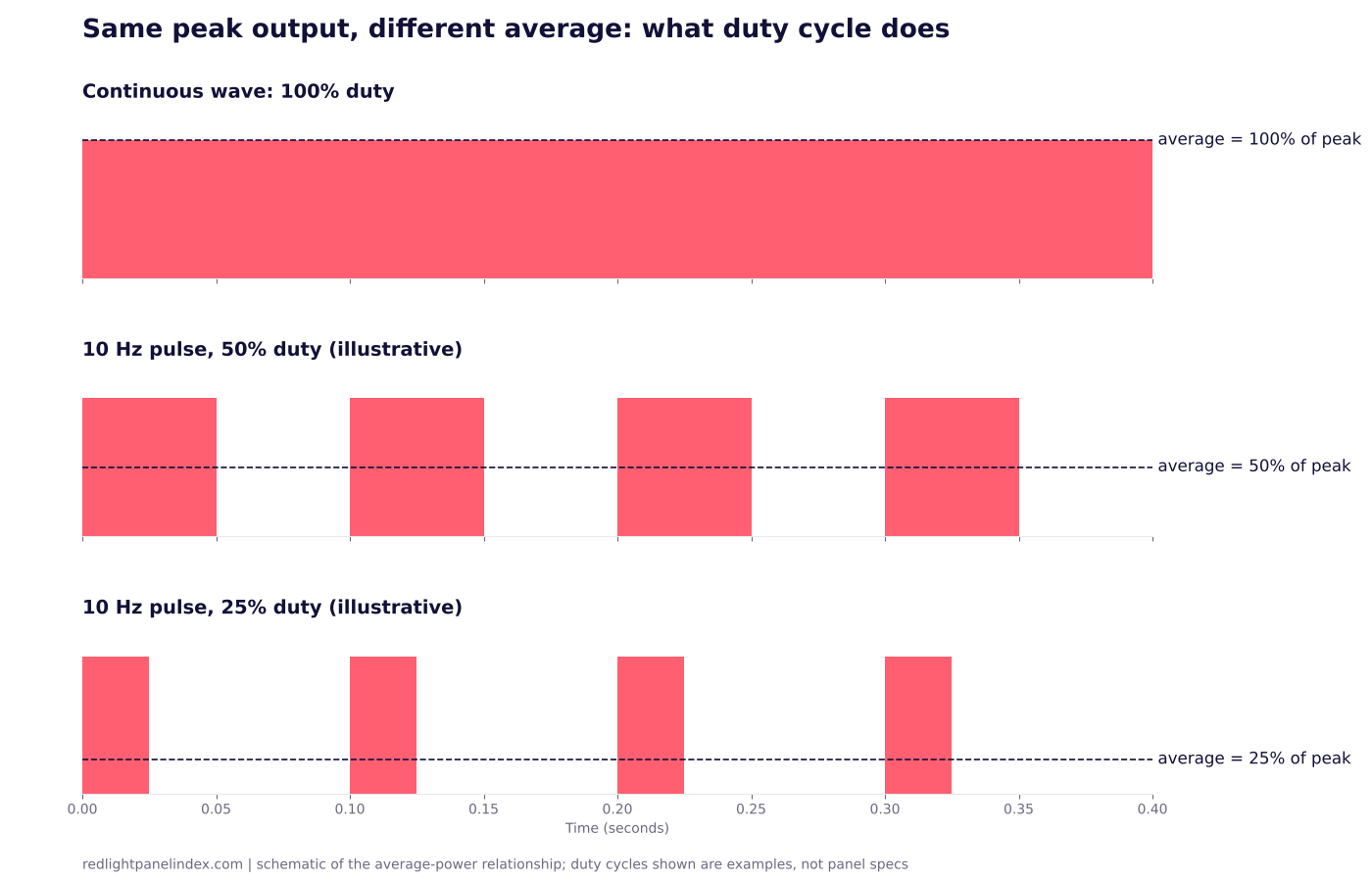
The strips show a 10 Hz pulse train at two example duty cycles next to continuous light. The peak height is identical in all three. The dashed line is the average: full height for continuous, half for a 50 percent duty cycle, a quarter for 25 percent. The duty cycles in the diagram are examples to show the arithmetic, not specs of any panel.
Why the average is what counts for dose
Dose in photobiomodulation is energy per area, in joules per square centimeter, and it comes from irradiance multiplied by time. The joules per cm2 explainer walks through that product, and the irradiance page explains how the irradiance figure itself is measured. A pulsed panel adds one wrinkle: the number that goes into the product must be the average irradiance over the session, not the peak while the LEDs are on.
That matters because a spec sheet may quote the peak. If a panel advertises a high figure and then runs a pulse mode at a low duty cycle, the light that reaches your skin per minute is lower than the headline number suggests.
Worked example with database figures
The database lists two pulse-capable models from one brand, and both are good illustrations because they publish the frequencies but not the duty cycle.
- The Red Therapy Co RedRush 840 PULSE offers selectable pulsed-wave modes at 10 Hz (labeled Alpha), 20 Hz (Beta) and 40 Hz (Gamma), plus continuous wave. Its brand-stated irradiance is 160 mW/cm2 at 6 inches, with no measurement method named. Price in the database is $1,195, verified 2026-08-13. Duty cycle is not stated.
- The RedRush 400 PULSE lists the same three pulse modes, the same 160 mW/cm2 at 6 inches (method also unnamed), and a database price of $675, verified 2026-08-13. Duty cycle is not stated there either.
Now the arithmetic, using the dose calculator logic. Take the brand's 160 mW/cm2 at face value and a target of 10 J/cm2, which is a round number chosen only to make the math easy, not a recommended dose.
- Continuous wave: 10 J/cm2 divided by 0.160 W/cm2 is 62.5 seconds.
- If a pulse mode were 50 percent duty and the 160 figure were its peak: average irradiance is 80 mW/cm2, so the same 10 J/cm2 takes 125 seconds.
- If it were 25 percent duty: average is 40 mW/cm2, and the session takes 250 seconds.
Whether the 160 mW/cm2 on these pages is the continuous figure, a peak figure or a pulse-mode average is not stated, which is the reason the question matters. Because the duty cycle is unpublished, a buyer cannot compute pulse-mode session time from the listing alone. The database page also notes that a method-unstated figure is better treated at roughly half its face value, which compounds the uncertainty; the claimed vs measured page shows why.
Why does a panel offer pulse modes at all?
The honest answer is that the evidence for pulsing is narrow. A 2010 review of low-level light therapy found studies where pulsed light did better for specific conditions, studies where continuous light did better, and studies where the two tied, with no general advantage for pulsing (PMID 20662021). The pulsed vs continuous evidence page goes through that review in detail, including why most of its source studies used lasers and animal models rather than home panels.
Three ideas are commonly offered for why pulsing might matter. They are hypotheses, not established findings for home panels:
- Heat. Off time lets tissue cool, which could allow a higher peak without warming the skin.
- Nitric oxide. Repeated on-off cycles might change how often nitric oxide is released and rebinds in the mitochondria; see the photobiomodulation overview for the underlying mechanism.
- Brainwave-range frequencies. Labels such as Alpha, Beta and Gamma borrow names from brainwave bands. The labels describe the Hz range of the setting; they are not evidence that the setting produces a matching effect in your brain.
The frequencies the 2010 review covered ran from about 2.5 Hz to 10,000 Hz, and it did not identify a single frequency or duty cycle that works best across conditions. A 10, 20 or 40 Hz button on a panel is therefore a choice among settings, not a validated protocol.
Pulse frequency is not flicker
Flicker is an unintended ripple from a poorly filtered power supply. Pulsing is a selectable feature. A continuous-wave panel can flicker if its driver is poor, and a well-built driver can run a clean pulse program. The flicker explainer covers how percent flicker is calculated and why no brand in the database currently publishes a measured figure. When you read "pulsed" on a product page, it describes a mode, not the driver quality.
How to read a pulse spec
Use this checklist when a listing mentions pulsing (the ranking of panels with pulse modes and app control applies it to the listings that publish them):
- Is continuous wave offered? Most trial doses were delivered with continuous light, so a continuous mode lets you match published numbers.
- Is the irradiance figure for continuous or pulsed output? If the listing does not say, assume the continuous figure.
- Is the duty cycle published? If not, you cannot compute a pulsed session time. Ask the brand, or stay on continuous.
- Is the measurement method named? A figure without a named instrument is hard to compare; the irradiance page explains the differences.
- Is the claim tied to a condition? A pulse mode marketed for a specific outcome should point to a specific study. If it does not, treat it as an extra setting.
What this does not tell you
This page defines terms and shows arithmetic. It does not show that any pulse frequency or duty cycle improves an outcome on a home panel, and no study found for this page compared a panel's continuous mode against its own pulsed mode on a matched outcome. Peak versus average is a statement about how much light is delivered, not about whether more or less of it is better; the biphasic dose-response idea means more light is not always more effective. Check the dose calculator with the average irradiance for your mode, keep session lengths within what the brand and your clinician advise, and treat pulsing as a deliberate choice rather than an upgrade.
A ranked list of pulse-capable and app-controlled panels is planned for this site; until it is live, the database pages above are the place to compare published pulse specs. This is general wellness information, not medical advice.