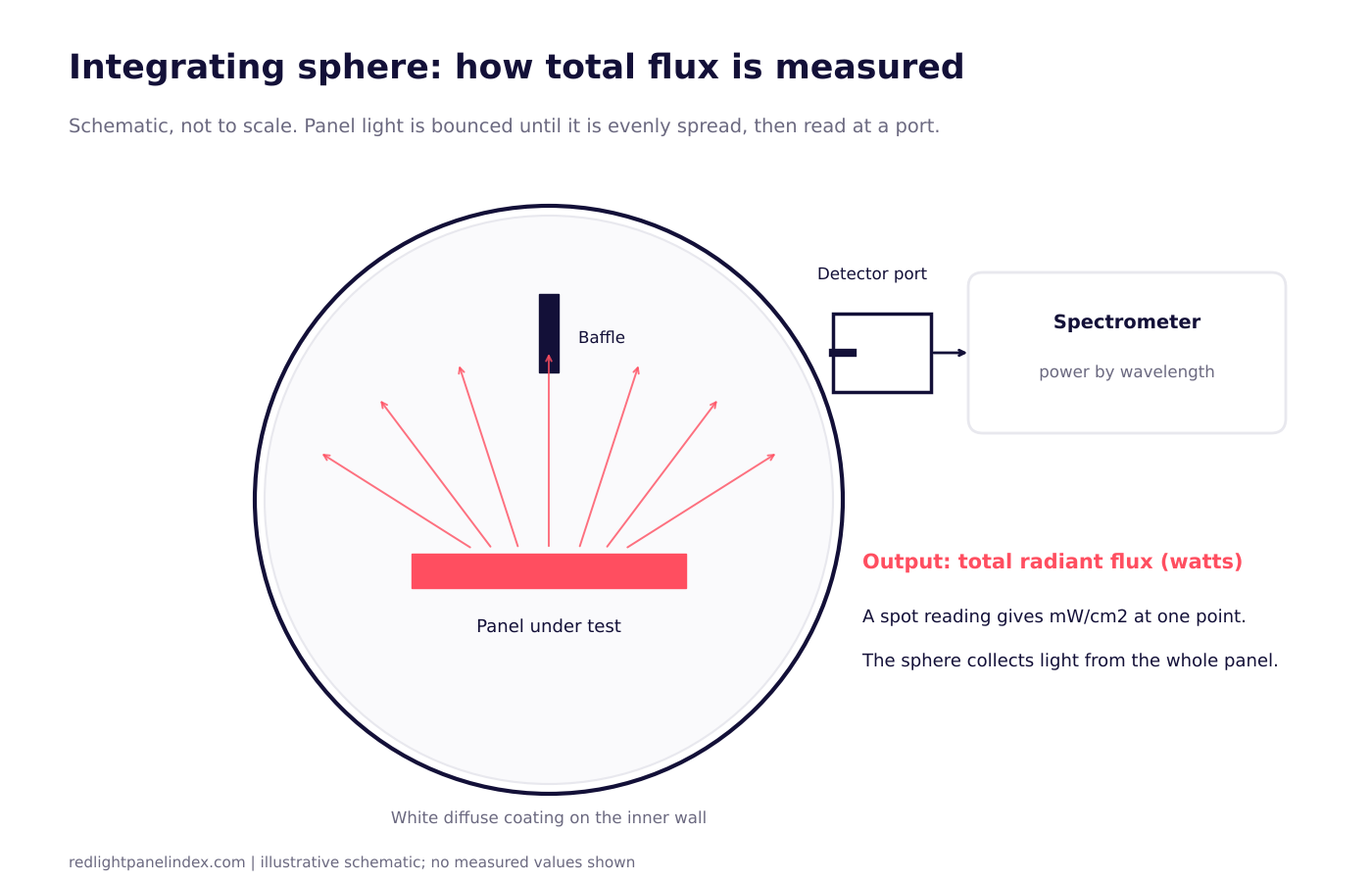
An integrating sphere is a hollow ball with a white, diffusely reflecting inner wall that collects all the light a source emits, bounces it until it is evenly spread, and lets a detector read the total, which is called radiant flux and is reported in watts. A spot reading with a spectrometer or solar meter answers a different question, how strong the light is on one square centimeter at one distance, so the two kinds of number are not interchangeable and a lab report should say which one it gives.
Choosing a panel? Our ranking of the best red light therapy panels is computed from published, method-labeled specs across 188 devices. For lab test reports, the spec that matters is whether the report names its instrument, its distance and whether it reports a spot irradiance or a total flux.
How an integrating sphere works
Inside the sphere, the source sits where all of its light stays in the chamber. Light leaving the panel hits the wall, scatters off the matte white coating in every direction, and hits the wall again. After many bounces the light is spread so evenly that a small detector at a port in the wall sees a level that is proportional to the total light emitted, no matter which direction any given ray first left the panel. A small baffle, a shield placed between the source and the detector port, stops direct light from reaching the detector, so only the scattered light is read.
The result is a measurement that does not depend on where the light went. A spot reading depends on exactly where the sensor sits and how far away it is. A sphere reading collects light from the whole emitting face and from every angle at once. That is the reason sphere testing is the standard way a lab reports total output for lighting products, and why it answers a question a spot reading cannot.
The detector at the port can be a spectrometer, in which case the report gives power by wavelength and the total is the sum across wavelengths, the same logic described on the spectrometer page. A published review of radiometry in the photobiomodulation literature recommends spectrometers coupled with optical fibers and either cosine correctors or integrating spheres, calibrated to a recognized standard, as an accurate measurement system (PMID 26964800).
Spot irradiance versus total flux
These two numbers describe different things.
- Irradiance is power per unit area at one place, in mW/cm2. The database lists it with an instrument and a distance, usually 6 inches. See the irradiance page for how to read it.
- Total radiant flux is the power the whole panel emits in all directions, in watts. It has no distance, because it is the output at the source.
Two panels can post the same spot irradiance and emit very different total power, because irradiance says nothing about area. The irradiance versus total power page works through that with database panels: the PlatinumLED BioMax 900 lists an independently measured peak of 113 mW/cm2 at 6 inches over about 432 square inches, and the RLT Home Total Spectrum ULTRA lists 119.28 mW/cm2 at 6 inches over about 759 square inches. The peaks differ by about 6 percent while the face area differs by a ratio of nearly 1.8 to 1.
That page also builds a rough stand-in for total power by multiplying peak irradiance by area, and it labels the result an illustrative ceiling rather than a measurement, because a peak reading is the brightest spot, not the average. An integrating sphere is the instrument that would replace that estimate with a measured number. If a sphere report existed for each of those panels, it would give a figure in watts that no arithmetic from a spot reading can reproduce exactly.
What a sphere cannot tell you
A total flux figure is valuable, but it is not a dose.
- It says nothing about distance. Light from a flat panel spreads, so how much lands on your skin depends on where you stand. The inverse square law page and the treatment area page cover that, and the dose calculator turns an irradiance and a time into joules per square centimeter.
- It says nothing about how the light is spread over the face. Two panels with the same total can have a bright center and dim edges, or an even field.
- It is not electrical power. A panel draws watts from the wall and emits fewer watts of light, as the optical versus electrical power page explains. A sphere report measures the emitted side.
- It is not a treatment claim. A measured number describes the device. Whether any dose helps with a condition is a question for the studies on the evidence pages.
Why labs use spheres, and why spot tests are still common
A sphere is a fixed instrument in a lab. It must be large enough relative to the source, and the panel must sit inside it, which makes testing a large panel harder than testing a small one. Spot testing with a spectrometer at a stated distance is simpler and is the method most brands and third-party testers publish. The site's database therefore lists mostly spot irradiance with its method label, and it shows "method not stated" when a brand gives a figure without one. The ranking approach is laid out in how rankings work on the methodology page.
None of that makes a spot reading wrong. It makes it a different quantity. The practical point for a reader is to match the number to the question. If the question is how much light lands on a knee at 6 inches, a spot irradiance with a named instrument and distance is the right tool. If the question is how much light the whole panel produces, a sphere flux figure is the right tool, and a spot reading can only estimate it.
How to read a sphere test report
A report that is worth trusting shows the details that let a reader judge it. Check these:
- The instrument is named. The spectrometer or detector model, and the sphere's make or size if given.
- A calibration is stated. A recognized standard, and when it was done. A number from an uncalibrated instrument is a guess.
- The quantity is labeled. Total radiant flux in watts, or a spot figure in mW/cm2. A report that mixes them without saying which is which is a warning sign.
- The operating condition is stated. Warm-up time, input voltage, and whether the panel was run at full output. LED output can change as the panel heats, so a reading taken cold and one taken warm may differ.
- A spectrum or band table is shown. A single total with no breakdown tells you less than a wavelength-by-wavelength table, because a seven-band panel can put most of its output in two bands.
- Who ran it is stated. An in-house test, a lab commissioned by the brand, and an outside tester are all different levels of independence. The database labels which is which; for example, its page for the RLT Home Total Spectrum MAX notes that its spectrometer test was commissioned by the brand.
- The sample is described. One unit tested, or a batch, and whether it was a production unit.
A report missing most of these is a marketing document, not a measurement. The guide to reading irradiance labels walks through the same habits for spot readings, and the claimed versus measured study shows how large the gap between a brand's claim and an independent reading can be.
A worked example using database figures
Take the Total Spectrum MAX, whose database page lists 100.53 mW/cm2 at 6 inches from a named spectrometer test. That figure is a spot reading. Multiplying a spot reading by an area, as the irradiance versus total power page does, gives an illustrative ceiling and nothing more. If a sphere report for the same panel existed, three things could be checked against the spot figure: whether the total flux in watts is in the same range as the illustrative ceiling, whether the band shares match the published percentages, and whether the output holds steady as the panel warms.
Each check answers a different doubt. The first tests whether the area-based estimate was reasonable. The second tests the brand's wavelength claims. The third tests whether the headline reading survives a normal session. A reader who has only the spot figure can do the first by arithmetic and cannot do the other two.
Bottom line
An integrating sphere measures total radiant flux in watts, a quantity a spot irradiance reading cannot give. Neither number is a dose, and neither says whether a panel helps with any condition. When a brand publishes a test PDF, ask four things: what was measured, with what instrument, under what conditions and by whom. A report that answers all four is worth far more than a bigger number with none of them.