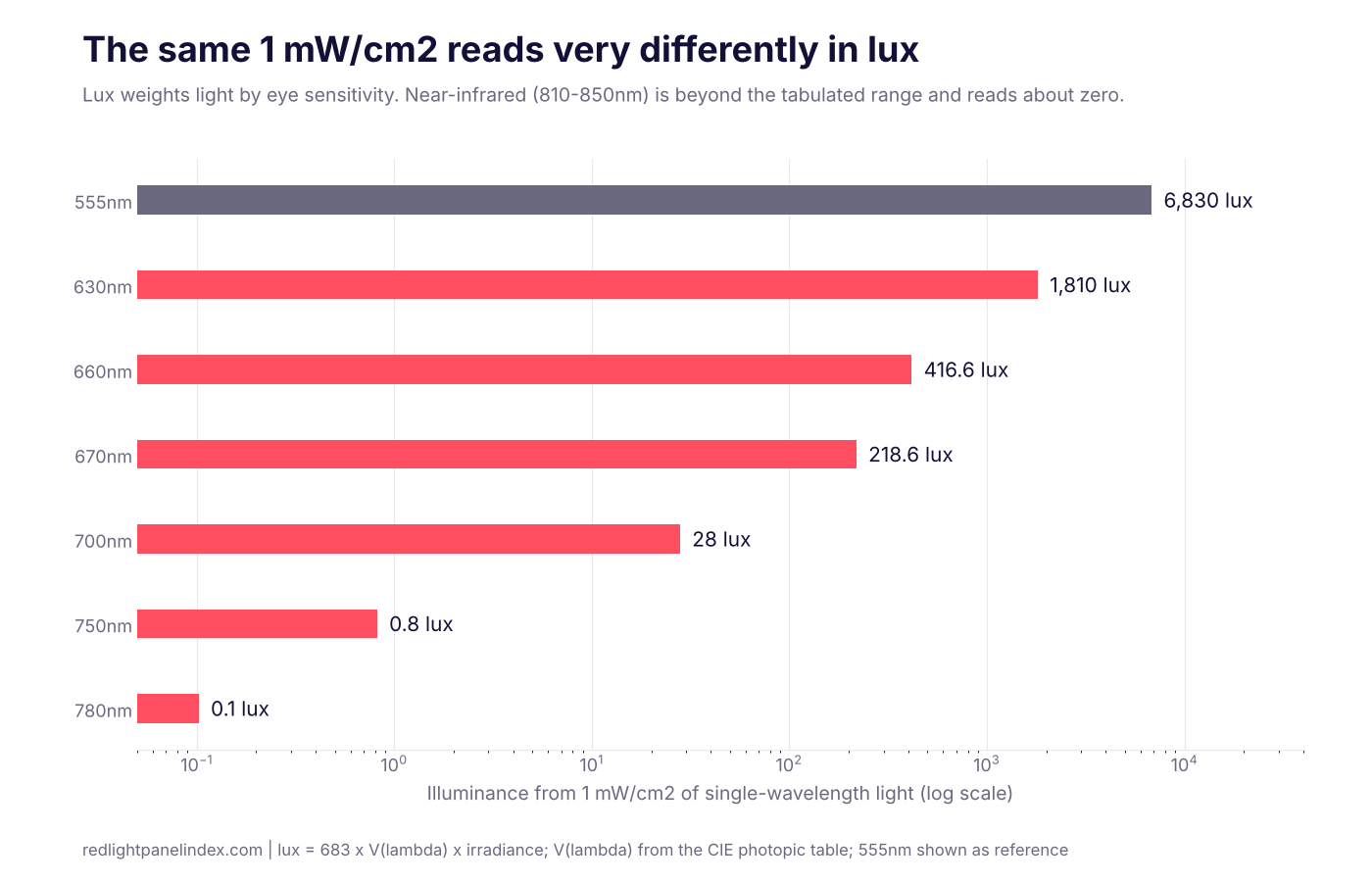
Lux measures how bright light looks to a human eye, while mW/cm2 measures how much optical power lands on each square centimeter regardless of whether the eye can see it. A red and near-infrared panel is specified in mW/cm2 because the dose a tissue receives depends on power and time, not on what an eye perceives.
Choosing a panel? Our ranking of the best red light therapy panels is computed from published, method-labeled specs across 188 devices. For units, the spec that matters is irradiance in mW/cm2 at a stated distance with the measuring instrument named, never a lux reading.
What each unit counts
Irradiance, in mW/cm2, is radiometric: it adds up the power in the light, wavelength by wavelength, with every wavelength counted equally per milliwatt. The irradiance page explains how this site labels each figure with its method and distance.
Illuminance, in lux, is photometric. It multiplies the power at each wavelength by the eye's sensitivity at that wavelength, called the photopic luminous efficiency function, V(lambda), then by a constant of 683 lumens per watt. Sensitivity is 1.0 at 555nm (green-yellow) and falls steeply into the deep red. For a single wavelength:
lux = 683 x V(lambda) x irradiance in W/m2
One mW/cm2 equals 10 W/m2, so 1 mW/cm2 of 555nm light reads 6,830 lux.
The same milliwatt, very different lux
V(lambda) values below come from the CIE photopic table. The lux column applies the formula to 1 mW/cm2 of light at a single wavelength.
| Wavelength | V(lambda) | Lux from 1 mW/cm2 |
|---|---|---|
| 555nm (reference) | 1.0 | 6,830 |
| 630nm | 0.265 | 1,810 |
| 660nm | 0.061 | about 417 |
| 670nm | 0.032 | about 219 |
| 700nm | 0.0041 | about 28 |
| 750nm | 0.00012 | about 0.8 |
| 780nm | 0.000015 | about 0.1 |
The table stops at 780nm. The near-infrared bands panels use, 810 to 850nm and 1064nm, lie beyond it, where the eye's response is effectively nil, so a lux meter credits them with essentially nothing. The chart at the top of this page shows the same numbers on a log scale. See the wavelengths page for which bands panels carry and photon energy and wavelength for why the bands differ.
A worked example with real database figures
The RLT Home Total Spectrum MAX lists 100.53 mW/cm2 at 6 inches, measured by Electropossible Ltd with a spectrometer (the brand commissioned the test). Its published wavelength mix is 480nm 6%, 630nm 19%, 660nm 19%, 810nm 19%, 830nm 14%, 850nm 9% and 1064nm 14%. Treat those percentages as shares of the 100.53 mW/cm2, which is an assumption for illustration, and treat each band as a single wavelength.
- 630nm: 19% of 100.53 is about 19.1 mW/cm2, which an ideal meter would read as roughly 34,600 lux.
- 660nm: also about 19.1 mW/cm2, roughly 8,000 lux.
- 810nm, 830nm, 850nm and 1064nm: 56% of the output, about 56 mW/cm2, which reads about zero lux.
- 480nm: 6%, left out because the table above does not include it.
So an ideal lux meter would report something above 40,000 lux and miss more than half of the delivered power. Two things follow. A lux figure can look large for a red panel, which is why it is no basis for comparing a panel with another panel or with a lamp. And the same panel with its near-infrared bands removed would read almost the same lux while delivering far less power.
Real lux meters only approximate V(lambda), and the error is largest in the deep-red tail, so treat the numbers above as illustrations of the arithmetic, not predictions of what a meter would show.
For the dose side of the same panel, the dose calculator divides a target in J/cm2 by irradiance: at 100.53 mW/cm2, one J/cm2 takes about 10 seconds. No lux figure enters that calculation.
Why the units do not convert
There is no single factor from lux to mW/cm2, because the factor depends on the wavelength mix. 1 mW/cm2 is 6,830 lux at 555nm, 417 at 660nm and about zero at 850nm. Converting without knowing the spectrum gives an answer anywhere across that whole range. A spectrum measurement, as described on the spectrometer page, is what makes a lux-to-power conversion possible at all, and at that point the radiometric figure is already in hand.
A related mistake runs the other way: reading a watt rating as light output. See optical vs electrical power for why a 300W name is not 300W of light, and irradiance vs total power for the difference between a per-area and a total figure.
A second example: what 10,000 lux means in power
Run the formula backward for a bright-light lamp. If all of its light sat at 555nm, 10,000 lux would be 10,000 / 683, or about 14.6 W/m2, which is about 1.5 mW/cm2. A real white lamp spreads its output across the spectrum, so its power would be higher than that floor, but the order of magnitude shows the gap: a lamp that looks very bright can deliver a few mW/cm2, while the Total Spectrum MAX figure above is about 100 mW/cm2 at 6 inches. The two products are built for different jobs and neither number ranks them on the other's task.
Common mix-ups
- "More lux means a stronger panel." Lux follows eye sensitivity. Two panels with the same irradiance but different red-to-near-infrared splits read very different lux.
- "No lux means no light." Near-infrared is invisible and reads about zero lux while still delivering power.
- "A lux meter can check a panel's claim." It cannot; use a spectrometer or a labeled solar-meter reading, and see the guide to checking an irradiance claim yourself.
- "Lux converts to mW/cm2 with a factor." It converts only for a known single wavelength or a measured spectrum.
Where lux does belong
Lux is the right unit for bright-light lamps built to act through the eye on the body clock. The red light panel vs SAD lamp guide describes the usual SAD regimen of about 10,000 lux for about 30 minutes a day, and explains why that figure says almost nothing about photobiomodulation dose and an irradiance figure says nothing about clock reset. The circadian and melatonin evidence page covers what has been studied on timing.
How to read a panel spec sheet
- Look for irradiance in mW/cm2, a distance (6 inches is the standard here) and a named instrument. See how to read the irradiance labels.
- If the instrument is a solar power meter, expect it to read roughly twice as high as a spectrometer on LED panels, per the solar power meter page.
- If a brand gives lux for a red or near-infrared panel, treat it as uninformative about dose.
- For lab-grade totals, the integrating sphere page explains how total optical power is measured.
Cautions
- A bright red panel can read a very high lux figure at close range. Lux does not tell you whether a session is comfortable or safe for your eyes; follow the eye protection guidance.
- The worked example assumes the published percentages are shares of irradiance and that each band is one wavelength. Real LEDs have a spread around their peak.
- This page is about units. It makes no claim about what any dose does for health.