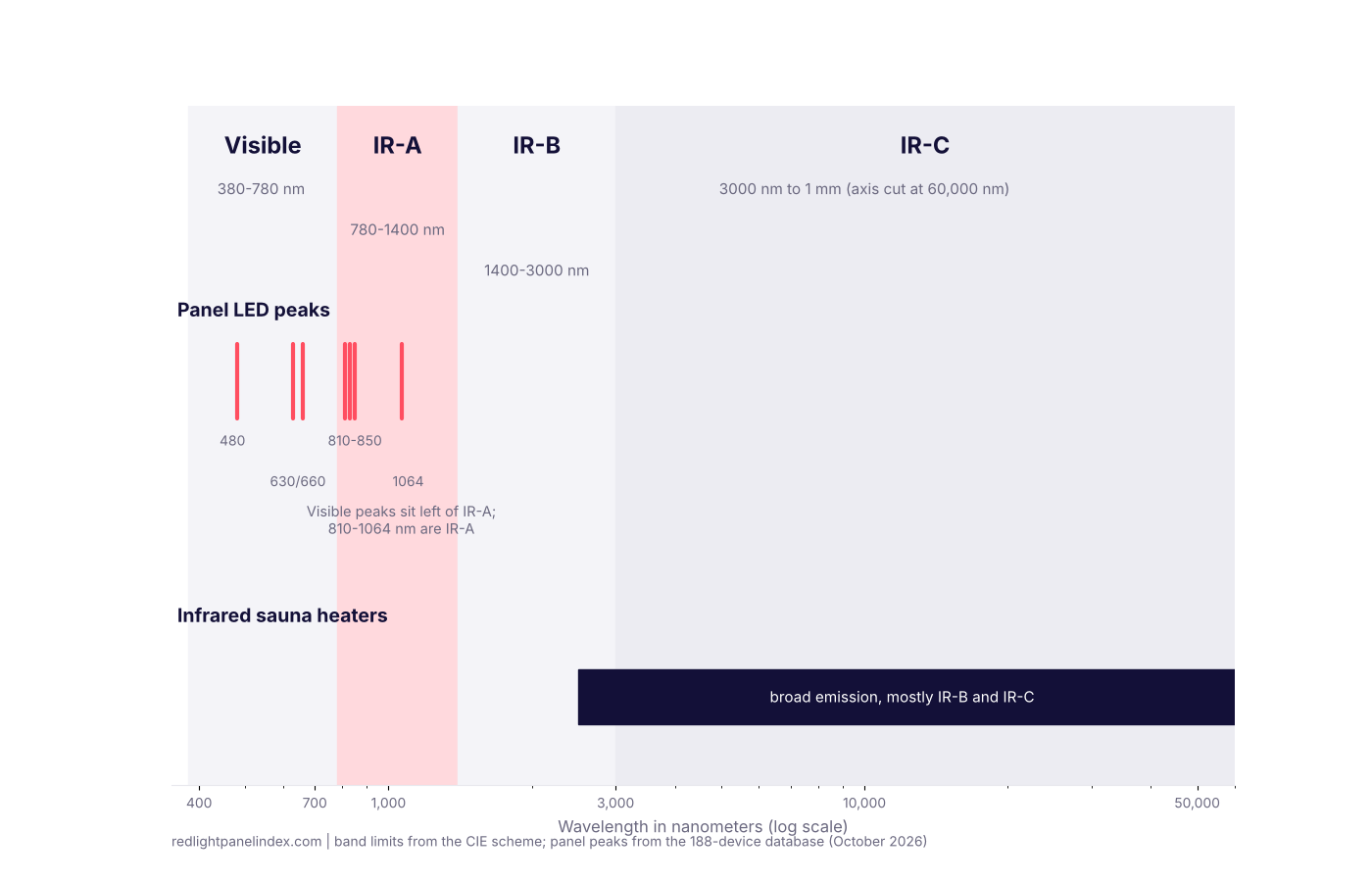
IR-A, IR-B and IR-C are the three sub-bands of infrared light defined by the International Commission on Illumination (CIE): IR-A runs from about 780 to 1,400 nanometers, IR-B from 1,400 to 3,000 nanometers, and IR-C from 3,000 nanometers to 1 millimeter. Red light therapy panels use LEDs whose near-infrared peaks (810, 830, 850 and sometimes 1064 nanometers) all fall inside IR-A, while infrared saunas heat with much longer wavelengths in IR-B and IR-C, which is why two products that both say "infrared" are not interchangeable.
Choosing a panel? Our ranking of the best red light therapy panels is computed from published, method-labeled specs across 188 devices. For infrared bands, the spec that matters is the peak wavelength in nanometers, because it tells you which band a device actually emits in.
What the three bands are
The CIE scheme divides the infrared range by wavelength so that people in lighting, photobiology and optics can describe a source without arguing about where "near" ends. The chart at the top of this page shows the layout on a logarithmic axis, which is the only way to fit visible light and the far-infrared on one picture. Energy per photon falls steadily across all of these bands, as the photon energy and wavelength page works out with the formula and worked values.
| Band | Wavelength range | Where you meet it |
|---|---|---|
| Visible | about 380 to 780 nm | 480 nm blue and 630 and 660 nm red LEDs on panels |
| IR-A | about 780 to 1,400 nm | 810, 830, 850 and 1064 nm LEDs on panels |
| IR-B | about 1,400 to 3,000 nm | Shorter-wavelength heater output |
| IR-C | 3,000 nm to 1 mm | Most of the output of far-infrared heaters, and the heat your own body radiates |
Two points about the table matter in practice. First, the boundaries are conventions rather than physical cliffs: nothing changes abruptly at 1,400 nanometers. Second, other fields draw the lines slightly differently. Photobiomodulation papers and many spec sheets use "near-infrared" to mean roughly 700 to 1,100 nanometers, which starts a little earlier than the CIE IR-A boundary and stops well before its upper edge. Our red vs near-infrared explainer uses that photobiomodulation convention, and this page uses the CIE bands. The wavelengths are the same either way; only the label differs.
Which band do red light panels use?
Almost every panel in the database mixes visible red with IR-A. Across the 188 devices tracked on the wavelengths page (updated October 2026), 175 panels (93 percent) list 660 nanometer red and the same 175 list 850 nanometer near-infrared. Another 114 (61 percent) list 630 nanometer red, 98 (52 percent) list 810 nanometers, 103 (55 percent) list 830 nanometers, and 33 (18 percent) list a 1060 to 1064 nanometer band. A further 22 panels (12 percent) add 480 nanometer blue.
Sorted into the CIE bands, that gives a simple picture:
- Visible (480, 630, 660 nm): not infrared at all. The red bands are the part you can see glowing.
- IR-A (810, 830, 850, 1064 nm): the invisible near-infrared that a panel adds for deeper reach. All four sit between 780 and 1,400 nanometers.
- IR-B and IR-C: not used by the LEDs on the panels in the database, which is the point of the next section.
Because IR-A is invisible, a panel can be delivering a full near-infrared dose while looking dim. The 850 nm page and the penetration depth guide explain why the band is chosen: light in this range is absorbed less strongly by water and hemoglobin than light farther out in the spectrum, so more of it can travel past the skin surface. For what that means for dose, see the optical window explainer.
Which band do infrared saunas use?
Infrared sauna heaters work on a different principle. A heating element glows because it is hot, and its output spreads across a broad range of wavelengths rather than clustering at one narrow LED peak. The hotter the element, the shorter the wavelength where its output peaks, a relationship physicists call Wien's displacement law (peak wavelength in micrometers is roughly 2,898 divided by the temperature in kelvins). As a worked example, an element at about 700 kelvins would peak near 4.1 micrometers, which is 4,100 nanometers and squarely in IR-C. Your own skin, at roughly 305 kelvins, radiates mostly near 9.5 micrometers, also IR-C. These are physics-textbook illustrations rather than measurements of any particular product, and sauna makers rarely publish a peak wavelength at all.
That is why the panel vs infrared sauna guide frames the two as different tools. Long-wavelength infrared is absorbed within a very thin layer of skin and ends up as heat, while a panel's IR-A is chosen to reach cellular targets with little surface warming. For a closer look at how absorbed light becomes either a chemical signal or heat, see thermal vs photochemical.
Worked example: reading two spec sheets
Suppose you are comparing two products.
Product one lists "660 nm and 850 nm LEDs." Using the table, 660 nm is visible red and 850 nm is IR-A. Both are narrow LED peaks, so you would then check the published irradiance and its measurement method on the irradiance page to see how much light it actually delivers.
Product two lists "far-infrared heating, 3 to 15 micrometers." Converting to nanometers, that is 3,000 to 15,000 nanometers, which is IR-C. It is a heater, and a panel-style dose calculation does not apply to it. The dose calculator is built for panels with a published irradiance in mW/cm2 at a stated distance, not for heaters.
The mix-up usually happens when a seller writes "infrared" with no number. A spec given in nanometers below 1,400 is IR-A or visible; a spec given in micrometers is almost certainly IR-B or IR-C.
Common mix-ups
- "Near-infrared" and "far-infrared" are not the same product line. Near-infrared in the photobiomodulation sense sits in IR-A. "Far-infrared" in sauna marketing generally means the longer bands.
- 660 nm is not infrared. It is visible red. Many people call a red and near-infrared panel an "infrared panel," which blurs this.
- 1064 nm is still IR-A. It is called "deep" because it is the farthest-out band on many panels, but it sits well inside the 780 to 1,400 nanometer range. The 1064 nm page covers it, and the 850 vs 1064 comparison sets the two bands side by side.
- A longer wavelength is not a stronger one. IR-C is not "more infrared" in a useful sense. Band names describe where light sits on the spectrum, not how much effect it has.
- Heat lamps are a third category. Many consumer heat lamps emit mostly IR-A and visible red, but they are built for warmth and rarely publish a narrow peak or irradiance figure.
Other light sources, for context
The same sort of band labels are used for ultraviolet light, which sits at the opposite end of the visible range and is classed as UV-A, UV-B and UV-C by wavelength. Phototherapy and tanning devices work in UV, and their risks are of a different kind from those of red and near-infrared LEDs; our red light vs UV phototherapy page covers the contrast. Knowing the bands on both sides of the visible range is the quickest way to tell which category a product belongs to.
What this means when you shop
- Look for nanometers. A narrow peak in nanometers tells you the band; a vague "infrared" does not.
- Check the band against your goal. If you want what the photobiomodulation literature describes, that is red and IR-A. If you want heat, that is a different device and a different evidence base.
- Do not use sauna logic for panel dosing. Panel dose is irradiance times time, set out in the dosing guide, not a matter of how warm a session feels.
- Compare panels on published density per band. A wavelength on the label does not mean much output at that wavelength, as the peak wavelength and FWHM page explains. Our methodology page describes how rankings work and which fields they use.
Knowing which infrared band a product occupies will not tell you whether it is any good, but it will tell you what kind of product it is, and that is the first filter worth applying.