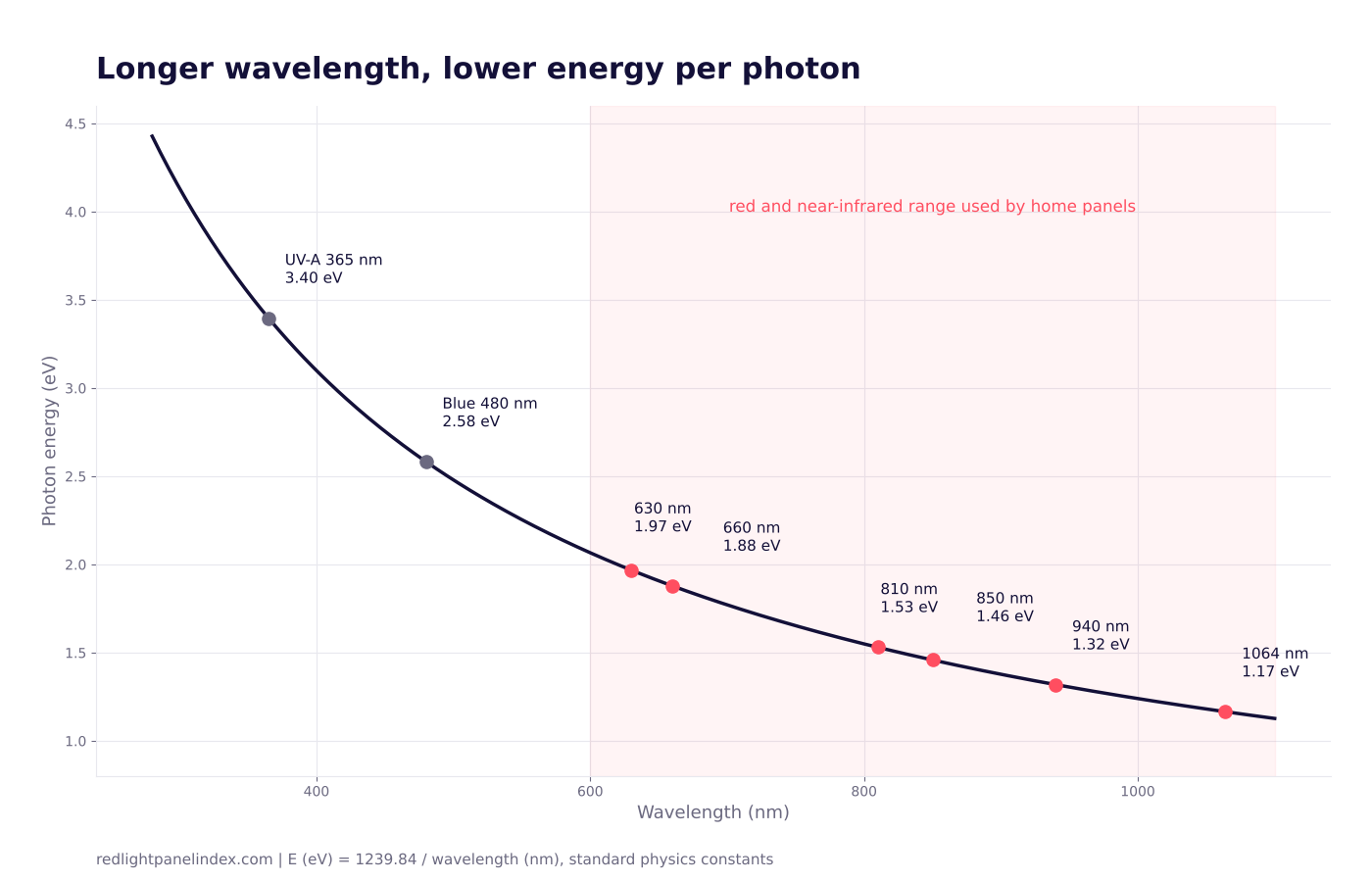
The energy of a single photon is inversely proportional to its wavelength, so a near-infrared photon at 850 nm carries less energy than a red photon at 660 nm, and both carry far less than an ultraviolet photon. For red light therapy that is not a drawback: the goal is to deliver a measured dose of light that tissue can absorb, not to pack the most energy into each photon.
Choosing a panel? Our ranking of the best red light therapy panels is computed from published, method-labeled specs across 188 devices. For understanding photon energy, the spec that matters is the list of peak wavelengths, because wavelength sets the energy of each photon and the irradiance sets how many arrive.
The one formula
Photon energy in electron volts is approximately 1239.84 divided by the wavelength in nanometers. That constant is the product of Planck's constant and the speed of light, expressed in convenient units. Double the wavelength and you halve the energy per photon. Nothing about this is specific to red light therapy; it is standard physics that applies to radio waves, visible light and X-rays alike.
The chart above plots the relationship. The curve drops steeply through the ultraviolet and blue, then flattens across the red and near-infrared range where home panels operate.
Worked values for common panel wavelengths
These figures come from the formula, applied to the wavelengths named on the site's wavelength guide and in the database.
| Wavelength | Band | Photon energy (eV) |
|---|---|---|
| 365 nm | UV-A (not a panel wavelength) | 3.40 |
| 480 nm | Blue | 2.58 |
| 630 nm | Red | 1.97 |
| 660 nm | Red | 1.88 |
| 810 nm | Near-infrared | 1.53 |
| 850 nm | Near-infrared | 1.46 |
| 940 nm | Near-infrared | 1.32 |
| 1064 nm | Deep near-infrared | 1.17 |
Moving from 660 nm to 850 nm lowers the energy per photon by roughly a fifth. Moving from 660 nm to the 365 nm of a UV-A source nearly doubles it. The jump at the short end is the reason ultraviolet behaves so differently, which the next sections cover.
Why the same joules mean different photon counts
Light doses are quoted in joules per square centimeter, not photons. Because a 850 nm photon carries less energy than a 660 nm photon, the same joule dose contains more photons at 850 nm.
A worked example makes this concrete. One 660 nm photon carries about 3.0 x 10^-19 joules, and one 850 nm photon about 2.3 x 10^-19 joules. A dose of 10 J/cm2 therefore contains about 3.3 x 10^19 photons at 660 nm and about 4.3 x 10^19 photons at 850 nm. These are arithmetic illustrations of the formula, not study results, and they say nothing about which wavelength works better for a given goal.
This is also why the dose calculator works in energy, not photon counts: irradiance multiplied by time gives joules per square centimeter regardless of wavelength. As an example, the Hooga HG300 is listed with 73 mW/cm2 at 6 inches on the ranking page, so 10 J/cm2 corresponds to about 137 seconds at that figure and distance (10 divided by 0.073). Check the irradiance method label on the irradiance explainer before comparing figures across devices.
Why energy per photon is not the goal
It is tempting to assume that more energetic photons must do more. Photobiomodulation does not work that way. The proposed starting point is absorption of a photon by a chromophore in the cell, and absorption depends on wavelength matching the chromophore, not on photon energy being as large as possible. The wavelength guide lists the bands that panels use and the tissue each is generally associated with.
Two practical points follow:
- Absorption is selective. Tissue absorbs some wavelengths much more than others. The optical window page explains why red and near-infrared light penetrate further than blue or ultraviolet, even though their photons carry less energy. Lower energy per photon and deeper reach go together here, because less of the light is absorbed near the surface.
- Dose still matters. A narrow band delivered at too low a dose and a narrow band delivered at too high a dose are not equivalent. Wavelength decides what can be absorbed; irradiance and time decide how much arrives. The dose calculator covers the second half.
Why this matters for the no-UV point
Ultraviolet photons carry enough energy per photon to alter molecules in skin cells, which is why tanning beds and unprotected sun exposure carry well-documented skin risks. Red and near-infrared photons sit at roughly half the energy of UV-A and well below UV-B, and panels built from red and near-infrared LEDs do not emit in the ultraviolet band. The red light vs tanning bed page and the red light vs UV phototherapy page compare those technologies directly.
This is a statement about photon energy and about what a panel's LEDs emit, not a blanket safety guarantee. A panel can still cause problems when it is used badly: bright light can stress the eyes, and heat from a panel at close range can warm the skin. The eye protection guide and the thermal vs photochemical page cover those points.
Where the infrared bands begin
Photon energy keeps falling past the near-infrared. The IR-A, IR-B and IR-C bands page lays out where near-infrared ends and longer infrared bands begin. At the long end, photons carry so little energy that their main effect on tissue is heating, which is the territory of heat lamps and sauna heaters rather than red light therapy panels. The heat lamp comparison explains how those devices differ from a panel.
Worked reading of a panel listing
Suppose a database listing shows 660 nm and 850 nm. From the table above you can say the red photons are about 1.88 eV and the near-infrared photons about 1.46 eV, and that neither is anywhere near the UV range. What you cannot say from wavelength alone is how much light the panel delivers. For that you need the irradiance figure, its measuring distance and its method, all of which sit on the listing. The peak wavelength and FWHM page adds one more detail: an LED does not emit exactly one wavelength, but a narrow spread around a peak, so a "660 nm" chip emits photons slightly above and below that value.
Two common misreadings
"Higher energy means stronger treatment." Photon energy and dose are separate quantities. A source can emit high-energy photons at a trivial irradiance or low-energy photons at a high one. Neither number alone tells you how much light reaches the skin, so read the wavelength and the irradiance together.
"Longer wavelength means weaker light." Lower energy per photon does not mean a dimmer or less useful panel. A near-infrared band at a high, method-labeled irradiance can deliver far more total energy than a red band at a low one. Compare panels on measured irradiance at a stated distance, as how rankings work explains.
Summary
- Photon energy in eV is about 1239.84 divided by wavelength in nm.
- Near-infrared photons carry less energy than red photons, and both carry less than blue or UV.
- The same joule dose contains more photons at longer wavelengths.
- Lower photon energy is not a weakness: absorption depends on wavelength matching the tissue chromophore, and dose depends on irradiance and time.
- Panels using red and near-infrared LEDs do not emit UV, but eye and heat cautions still apply.