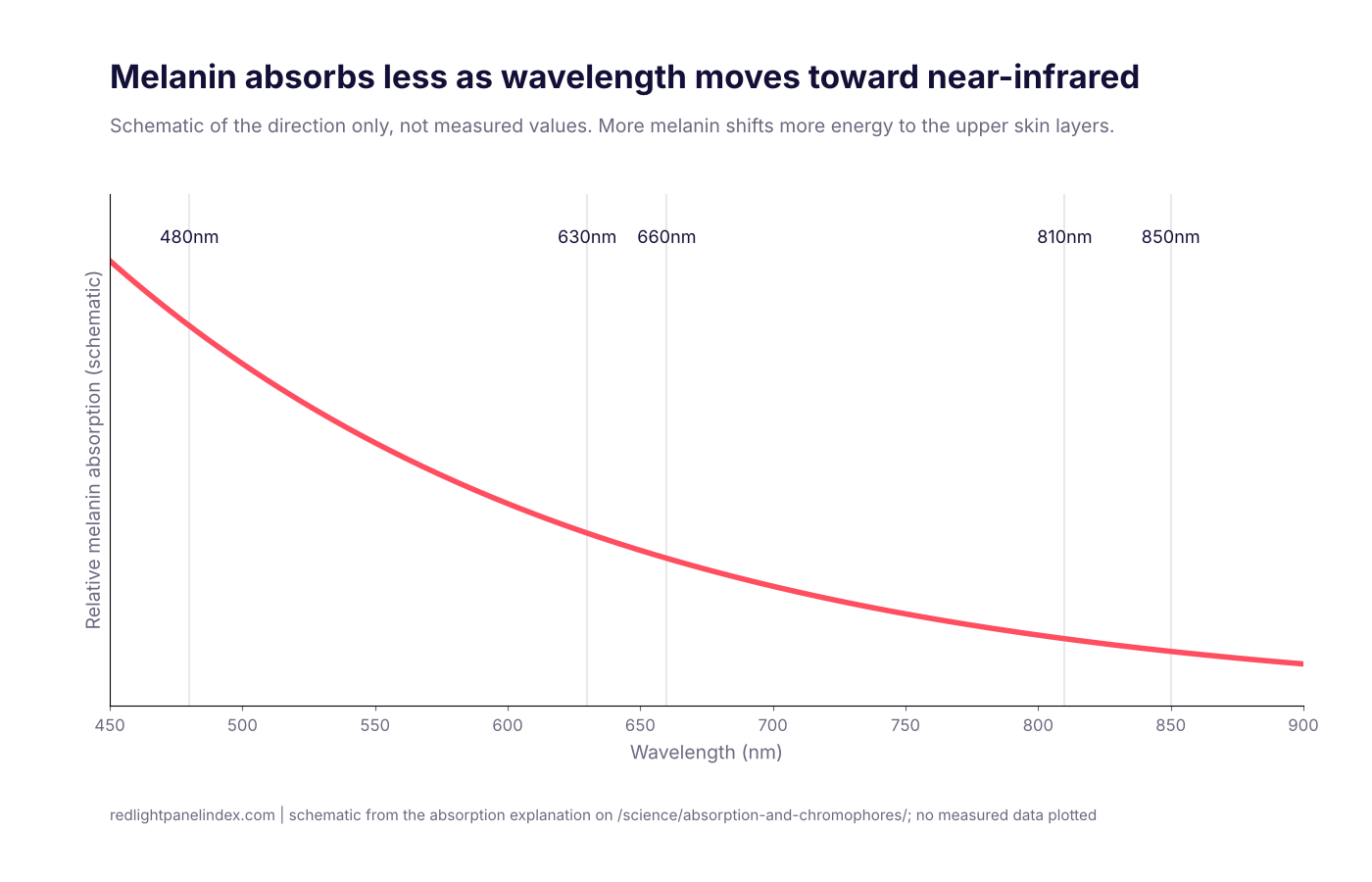
Skin phototype is a Fitzpatrick-scale rating from I to VI of how skin reacts to sun, and it matters for red light because melanin, the pigment that sets skin tone, absorbs light in the upper skin layers before it can travel deeper. In theory, darker skin therefore passes less red light to deeper tissue and turns more of it into surface warmth, but this site has found no published correction factor that tells a panel owner how much to change the dose.
Choosing a panel? Our ranking of the best red light therapy panels is computed from published, method-labeled specs across 188 devices. For darker skin, the spec that matters is the share of output in the near-infrared band, because melanin absorbs red more strongly than near-infrared.
The term, and why melanin is in the way
The Fitzpatrick scale classifies skin from type I (burns easily, tans rarely) to type VI (rarely burns, deeply pigmented). Our page on absorption and chromophores explains the mechanism: melanin is one of the molecules in skin that absorbs light, and like hemoglobin it absorbs shorter wavelengths more than longer ones. More melanin means more light absorbed in the top layers and less delivered below.
For a panel owner the consequence is directional, not numeric. Near-infrared bands such as 810nm and 850nm lose less to melanin than red bands such as 630nm and 660nm, as the optical window page lays out. A darker-skinned user on a red-only panel has a reason to expect more of the energy to stay near the surface than a lighter-skinned user would, and a reason to prefer a panel with a meaningful near-infrared share when the target is deeper tissue.
What the research says
The skin review. A review of low-level light in skin by Avci and colleagues describes the working idea behind the field: photons are absorbed by mitochondrial chromophores in skin cells, followed by changes in cellular signaling (PMID 24049929). It is a summary of mechanism and applications. We read it as support for the general principle that absorption, not just emission, decides what a tissue receives. It is not a source of a dose adjustment by skin tone, and this page does not attribute one to it.
The phototype IV acne trial. Lee and colleagues treated 24 patients with mild to moderately severe facial acne, all with skin phototype IV, using a device alternating blue (415nm) and red (633nm) LED light twice a week for 4 weeks, and the authors reported no significant adverse events (PMID 17111415). The trial has its own study review, and the full detail is on our acne evidence page. What it shows for this question is narrow: a combination LED device was used in medium-dark skin, over a short course, without significant adverse events reported. It had no comparison group, it did not test different skin tones against each other, and it does not say whether the dose would have been better or worse for another phototype.
Worked example with the dose formula
Dose in joules per square centimeter equals irradiance in mW/cm2 times seconds, divided by 1,000. Our dose calculator does the arithmetic. As an illustration, take an irradiance of 100 mW/cm2 at the skin and a 10 minute session: 100 x 600 / 1,000 = 60 J/cm2 at the surface. That is the dose arriving at the skin surface. It is not the dose reaching a tendon or a joint, and for a user with more melanin the share that makes it past the epidermis is expected to be lower, by an amount no source here quantifies. The 100 mW/cm2 figure is a round illustrative number, not a measurement of any device.
Real device figures show why the label on a number matters. On the database, Hooga ULTRA360 lists a brand-stated 132 mW/cm2 at 6 inches while an independent spectrometer test measured 74, which is why our irradiance explainer and claimed-vs-measured page insist on method labels. A skin-tone adjustment applied on top of an inflated claim compounds the error in the same direction.
Why the scale is a rough guide
The Fitzpatrick scale was built to describe sun reaction, not light absorption. Two people of the same phototype can differ in how much melanin sits in the treated area, and pigment varies across one body: the face, forearms and torso often differ, and a recent tan raises the melanin content of skin that is normally lighter. That is one more reason a single phototype-based dose multiplier would be unreliable even if a source offered one. The honest framing is that phototype tells you which direction to be careful in, not how far to adjust.
It also means the same caution applies at every skin tone. A pale-skinned user who sits very close to a high-output panel can overshoot a comfortable dose just as easily, and the inverse-square relationship shows how quickly irradiance rises as the distance shrinks.
What was not studied
- No panel dose by phototype. We found no source that tests the same panel protocol across Fitzpatrick types and reports a different dose for each.
- Darker skin in most trials. The phototype IV acne trial is the one skin-tone-specific study cited here, and the Papageorgiou acne trial on this site reports no phototype breakdown.
- Surface heating by tone. The idea that darker skin warms more is a mechanistic expectation from absorption, not a measured outcome in the sources above.
- Safety thresholds. No source here defines a skin-temperature or comfort limit by phototype.
Cautious practical guidance
- Start low and build up. With more melanin, more of the light is absorbed near the surface, so begin with shorter sessions or a greater distance and increase gradually, watching skin comfort. This is a precaution derived from the absorption mechanism, not a studied protocol.
- Do not chase more. More light is not automatically better, a point covered on the biphasic dose response page. Clinical laser dosing guidance, explained in our WALT dosing recommendations page, is written per treated point and does not convert directly to panel minutes.
- Lean on near-infrared for depth. If the goal is tissue below the skin, check a panel's near-infrared share and how its irradiance was measured, and see the skin and anti-aging evidence page for what the surface-level skin evidence does and does not cover. How we compare models is described in how rankings work.
- Judge by response. Warmth, redness lasting beyond a few hours, or discomfort are signals to shorten sessions.
Cautions
- Skin that is irritated, broken, or recently treated with a laser or chemical peel should be assessed before light sessions.
- People with a history of skin cancer over the treated area, who are pregnant, or who take photosensitizing medication should speak with a clinician first.
- Eye protection matters with bright sources, including near-infrared, which is invisible.
- Any new pigmentation change, mole change or lasting skin reaction after a session is a reason to stop and see a clinician.