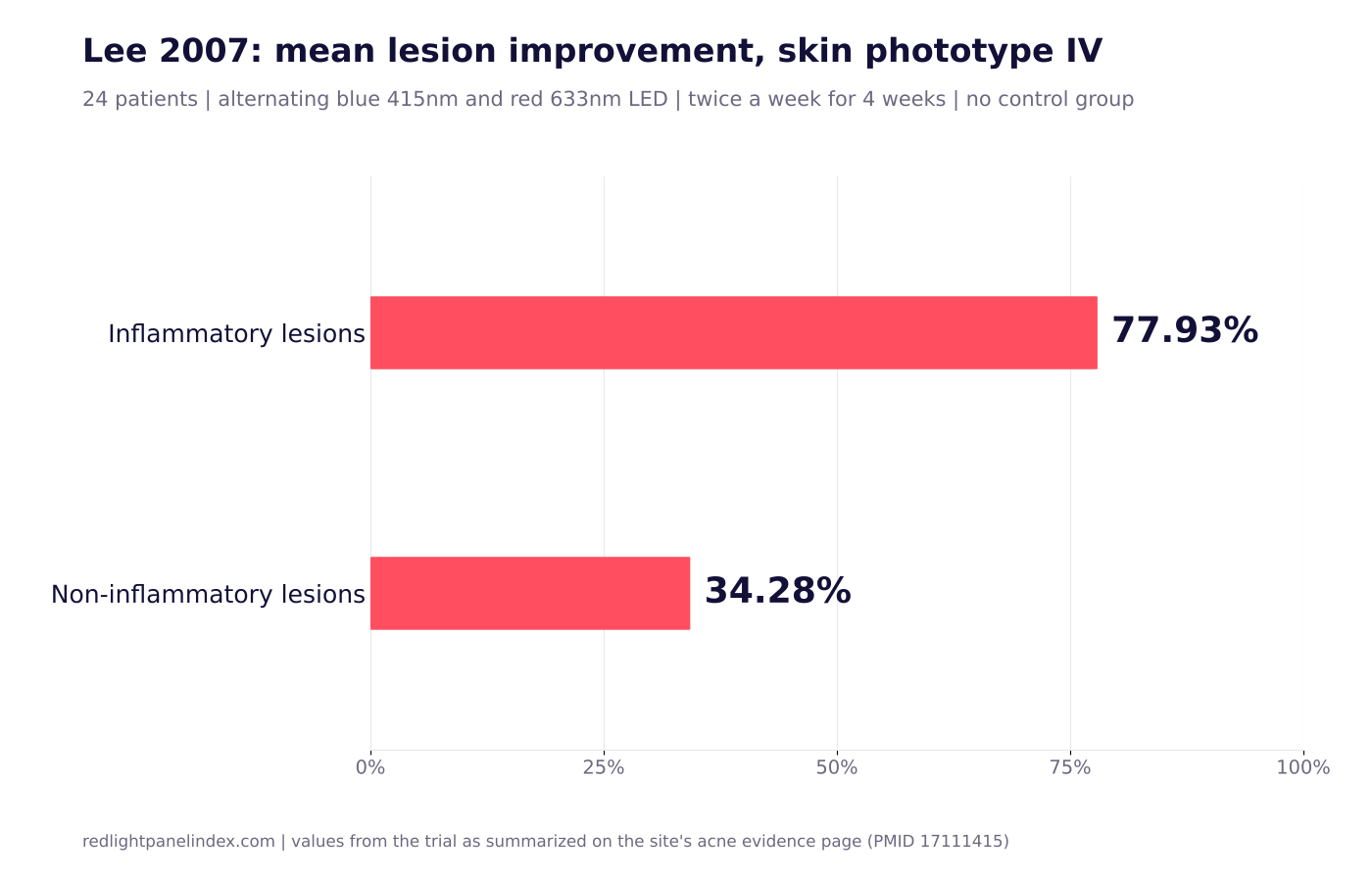
A 2007 open trial of 24 patients with mild to moderately severe facial acne, all with skin phototype IV, alternated blue (415nm) and red (633nm) LED light twice a week for four weeks and reported mean improvements of 77.93 percent in inflammatory lesions and 34.28 percent in non-inflammatory lesions, with no significant adverse events (PMID 17111415). It is the one acne trial on this site that enrolled a single, darker skin type on purpose, which is why it matters for a reader asking whether light therapy results carry over beyond the lightest skin tones.
Choosing a panel? Our ranking of the best red light therapy panels is computed from published, method-labeled specs across 188 devices. For this trial, the spec that matters is whether a panel has a blue channel at all, since the protocol alternated blue and red rather than using red alone.
What the study asked
Most early LED acne work, including the four-arm trial reviewed in our Papageorgiou study review, did not report results by skin type. Darker skin carries more melanin, which absorbs light in the upper layers of the skin and raises a fair question: does a blue and red LED protocol still work, and is it still tolerated, when the skin absorbs more of that light? This trial asked that question for phototype IV on the Fitzpatrick scale, the type that tans easily and burns rarely. The question was feasibility and safety as much as efficacy, which shapes how far the findings can be pushed.
Who was studied
The trial enrolled 24 patients with mild to moderately severe facial acne, all phototype IV. There was no comparison group in the design as the site's pages describe it, and the trial did not compare phototypes against each other. Our skin phototype and dosing explainer makes the same point: this is the only skin-tone-specific study the site cites for acne, and it speaks only to type IV, not to types V and VI or to lighter skin.
Device and parameters as stated
The device alternated blue light at 415nm and red light at 633nm from LED sources. Patients were treated twice a week for four weeks, and follow-up continued for eight weeks after the last session. Assessments were made before treatment, after the second, fourth and sixth sessions, and then at two, four and eight weeks after treatment ended.
The abstract material available to this review does not state an irradiance in mW/cm2 or a dose in J/cm2. That gap matters: the dose calculator turns irradiance and time into a dose, but it needs the irradiance figure first. Without it, the only transferable details are the schedule (two sessions a week) and the length of the course (four weeks), not a session length or a distance.
What was measured and what was found
The primary readouts were lesion counts split into inflammatory lesions (papules and pustules) and non-inflammatory lesions (comedones). At the final assessment, mean improvement was 77.93 percent for inflammatory lesions and 34.28 percent for non-inflammatory lesions (PMID 17111415). The gap between the two is the finding to hold on to: the combined light was associated with a large reduction in inflamed lesions and a much smaller one in comedones, which fits the idea that the blue and red pair acts mainly on the inflammatory side of acne.
The authors reported no significant adverse events. This site's acne evidence page also records that several patients noticed brighter skin tone and better texture, and that instrument readings tied this to lower measured melanin. That is a secondary observation from a small open trial and is not evidence that light therapy lightens or evens skin tone in general.
Limitations
- No control group. Acne fluctuates on its own, and an open design cannot separate a treatment effect from natural variation, regression to the mean or expectation. The 77.93 percent figure is a before-and-after change, not a difference against placebo.
- Small sample. Twenty-four patients, one clinic setting, one device.
- One skin type. The result says nothing directly about phototypes V and VI, or about lighter skin.
- No dose. With no irradiance or energy density reported, the protocol cannot be reproduced to a number.
- Two wavelengths changed at once. Because blue and red were alternated, the trial cannot say which one drove the result, or whether red alone would have done anything.
- Dedicated facial device. The light source was a purpose-built acne LED, not a whole-body or multi-panel unit.
For how these limits fit the broader literature, the LED dermatology systematic review summarizes the controlled trials, and the site's acne grade of Limited reflects that the evidence is a few small trials with mixed controls.
What this means for a home panel
Most panels in the database are built around red and near-infrared output, not a blue channel. A red-only panel at 660nm applies, at most, half of what this trial delivered, and the trial did not test red on its own. If you are comparing panels for facial acne, the first thing to check is whether a blue band is listed in the wavelength mix (the 480nm blue light explainer covers the panels that have one), then how the brand labels its irradiance (see how irradiance is measured and labeled). Our 660nm explainer covers what the red band does and does not reach.
Skin tone adds a second consideration. Melanin absorbs shorter wavelengths more strongly than longer ones, so a red or blue dose that suits one phototype may deliver a different effective dose to another, and no published correction factor exists. The phototype and dosing page suggests a cautious start: shorter sessions or more distance first, then build up while watching how the skin responds. Redness that lasts more than a few hours, warmth or discomfort are reasons to shorten sessions, and the biphasic dose-response explainer explains why more light is not automatically better.
Safety points that apply to any blue and red protocol: blue and violet light call for more eye protection than red (see the eye protection guide), and some acne medicines, including tetracycline-class antibiotics and retinoids, are photosensitizing (see the photosensitizing medications guide). Moderate to severe acne, cysts and scarring risk are matters for a dermatologist, and a light panel is not a replacement for that care.
The bottom line
This trial is a small, uncontrolled study that reported large improvements in inflammatory acne lesions in phototype IV skin and no significant adverse events after eight sessions of alternating blue and red LED light. It is useful as a signal that the blue and red approach was tolerated in a darker skin type. It cannot show that the improvement exceeds what no treatment would have produced, it cannot be converted to a panel session length, and it does not test red light alone. Read it alongside the acne evidence page and the sibling LED photorejuvenation trial from the same year, which tested wrinkles rather than acne.