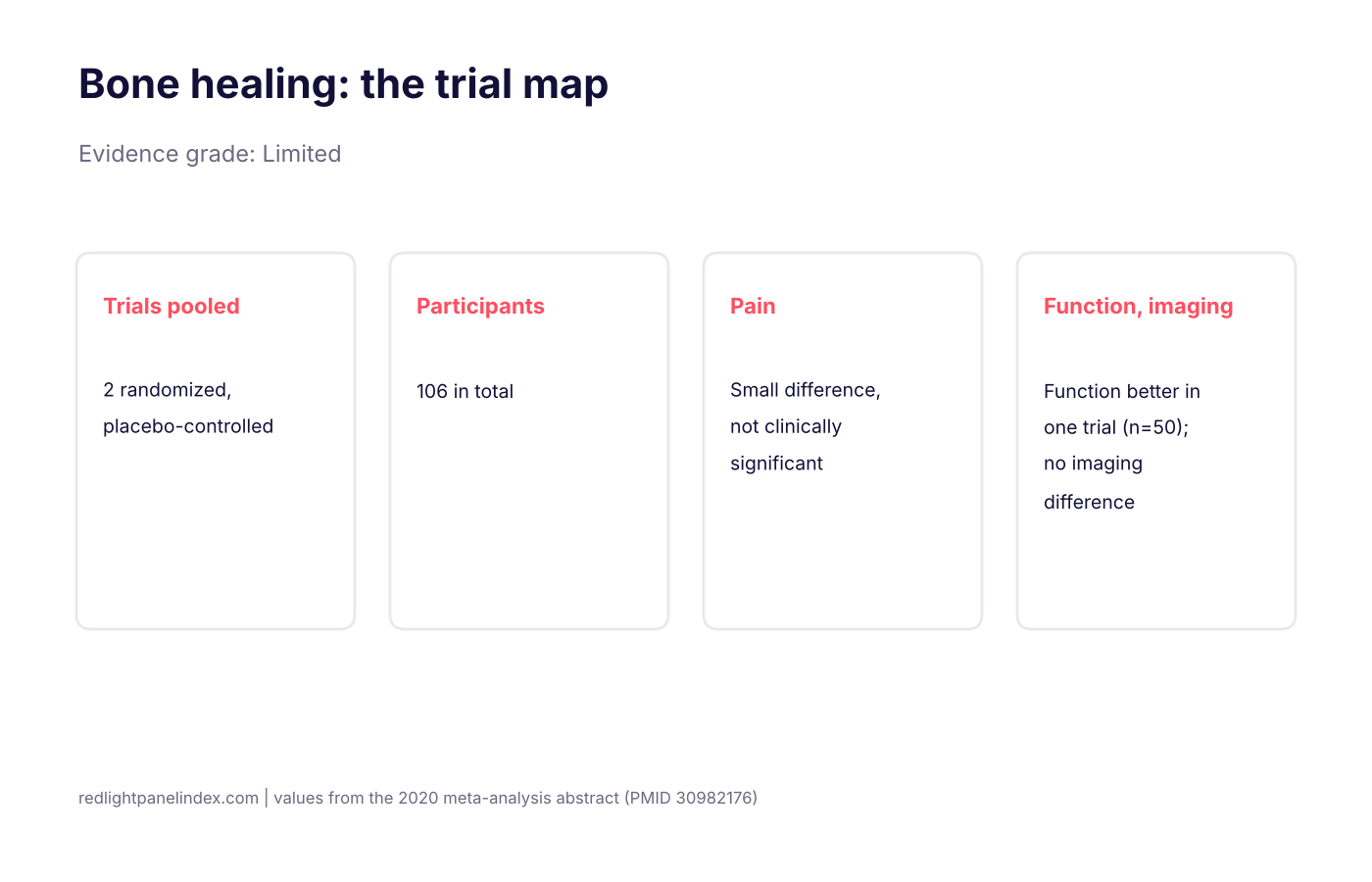
The evidence grade for red light therapy and bone healing is Limited: the best human summary we found pooled only two placebo-controlled randomized trials, and its authors rated the certainty of the evidence as low to very low (PMID 30982176). That is enough to say the question has been studied, and not enough to say a home panel does anything for a broken bone.
Choosing a panel? Our ranking of the best red light therapy panels is computed from published, method-labeled specs across 188 devices. For bone, the spec that matters is how much near-infrared output reaches the skin over the area, since bone sits well beneath it.
How we grade this topic
The grades on this site (Strong, Moderate, Limited, Insufficient) are explained on the evidence grades page. A Limited grade means human trials exist, but they are few, small or hard to interpret, so the findings should be read as hints and not as established effects. Bone healing earns Limited and not Insufficient only because there is a systematic review of randomized trials with a placebo comparison. It does not earn Moderate because that review found just two trials.
What the review pooled
The review, by Neto and colleagues, was published in 2020 in Lasers in Medical Science and searched the literature through October 2018 (PMID 30982176). It looked for randomized clinical trials of photobiomodulation applied to people with fractures. Two trials met the criteria, and both compared photobiomodulation with a placebo. Together they enrolled 106 participants.
The outcomes the review reported were:
- Pain. Pooling both trials, the difference favored photobiomodulation (mean difference 1.19, 95% confidence interval 0.61 to 1.77, 106 participants). The authors judged this difference not clinically significant. A result can be statistically real and still too small for a patient to notice.
- Physical function. One of the two trials, with 50 participants, reported an improvement in physical function that the review described as both clinical and statistical.
- Radiographic healing. The same single trial found no difference between groups in healing as seen on imaging.
The authors' overall reading was that photobiomodulation seems to be associated with improvement in pain and function, with low to very low certainty, and that more rigorous trials are needed. For a longer walk through the paper, see our study review of the fracture meta-analysis.
Why the imaging result matters
When people ask whether light helps a fracture, they usually mean one thing: does the bone knit faster or better? The only radiographic outcome in this review came from a single trial, and it showed no difference. The pain and function signals are worth following up, but they are not the same as faster bone repair. A heading that implied otherwise would overstate the data, which is why this page does not use one.
What was not studied
Several things a reader might assume are covered are not covered by the evidence we reviewed:
- Home LED panels. The review is about photobiomodulation as delivered in the trials. We did not find in the abstract the device details that would let us map the trials onto a consumer panel, so we state no wavelength, dose or session schedule for bone.
- Stress fractures, nonunions and surgical fixation. The review does not give us a basis to say anything about these specific situations.
- Long-term outcomes. The abstract does not report follow-up beyond the trials themselves.
- Healthy bone density. Nothing here concerns osteoporosis or bone density in people without a fracture.
- Comparison with standard care alone. Both trials used a placebo comparison, which tells us about light against sham light, not about whether light adds anything beyond a well-managed cast, surgery or rehabilitation.
Why depth is a real question for bone
Bone is covered by skin, fat and muscle, and the thickness of that cover varies by site. Light weakens gradually as it moves through tissue, and published depth figures disagree because studies use different methods and thresholds. Our penetration depth page walks through the modeled and measured numbers and explains why a bare depth figure should be read with care. The optical window page explains why red and near-infrared wavelengths are used at all, and the wavelengths guide lists what each band is used for.
The practical point is modest. A superficial bone such as the shin or the collarbone sits under less tissue than the hip or the femur, and a panel's output is measured at the skin, not at the bone. Our irradiance explainer covers how that skin-level figure is measured and why claimed and measured values differ.
A practical section for panel owners
Nothing in the review supports using a home panel to try to speed up a fracture. If a clinician has told you light is part of your care, ask which device, which wavelength and which schedule they mean, and whether it is the same kind of device you own. Then use the dose calculator to see what a given panel delivers at a given distance and session length, so you can compare it with what the clinician described instead of guessing.
If your goal is general recovery around an injury once you are cleared to be active, the more relevant pages are the wound healing evidence page, which covers skin repair, and the two foot ulcer pages, diabetic foot ulcers and the study review of two foot ulcer meta-analyses. They share the same limits: trials with clinic devices, and a gap between those devices and a home panel. For wavelength background, see photobiomodulation basics.
Reading a Limited grade without over- or under-reading it
A Limited grade is not a verdict that light does nothing. It says the human data are too thin to rely on. Two trials with 106 participants between them cannot tell us whether the small pain difference would hold in a larger group, in other fracture types, or with other devices. They also cannot rule out a benefit. What would change the grade is straightforward: more randomized trials with a placebo arm, device parameters stated in full, imaging outcomes read by blinded assessors, and follow-up long enough to see whether the bone ended up healed.
Questions worth asking a clinician
- Which device and wavelength do you mean, and is it a laser, an LED or a panel?
- How many sessions, how often, and over how many weeks?
- What outcome would tell us it is working, and when would we stop?
- Does this change anything about my cast, brace or activity limits? (It should not.)
Cautions
- A suspected fracture needs medical assessment. Light therapy is not a substitute for imaging, immobilization, surgery or rehabilitation.
- Do not place a panel over a cast and assume it does anything; plaster and fiberglass block or scatter light, and the review gives no support for it.
- Heat can build up over an injured area with altered sensation. Stop if the skin feels hot.
- Protect your eyes with high-output panels; see the eye protection guide.
- Photosensitizing medications and active cancer call for a conversation with a clinician first.
- This page is general information, not medical advice.
Bottom line
One 2020 meta-analysis of two small placebo-controlled trials reported a statistically significant but not clinically significant pain difference, a function improvement in one trial, and no radiographic healing difference, all at low to very low certainty (PMID 30982176). That supports a Limited grade. We will revisit it when larger trials with stated device parameters are published. Our methodology page explains how grades are assigned.