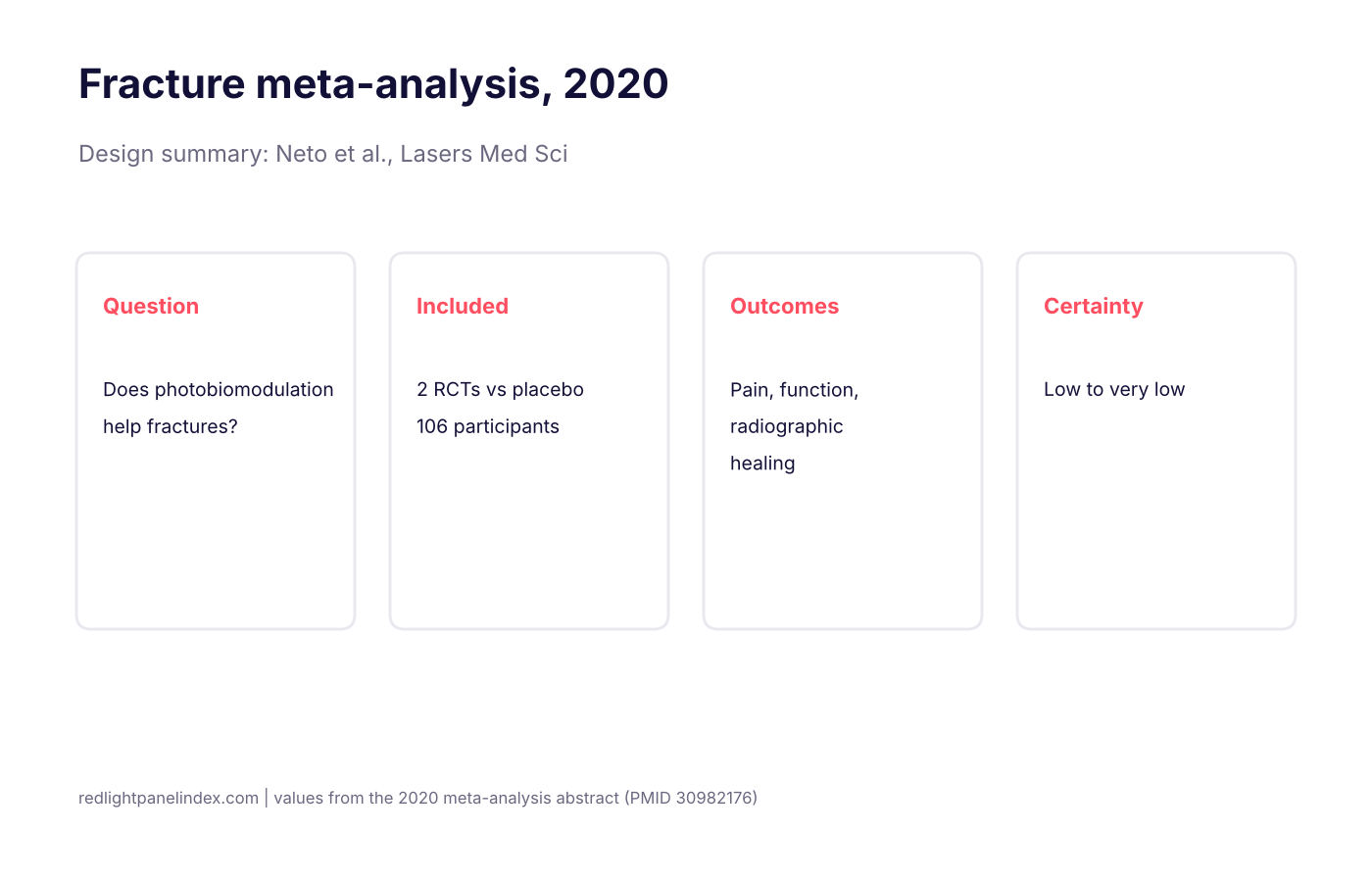
A 2020 systematic review and meta-analysis of randomized trials found only two placebo-controlled studies of photobiomodulation for fractures, reported a statistically significant but not clinically significant pain difference, and rated the certainty of the evidence as low to very low (PMID 30982176). It is the main source behind our bone healing evidence page, which carries a Limited grade.
Choosing a panel? Our ranking of the best red light therapy panels is computed from published, method-labeled specs across 188 devices. For a deep structure like bone, the spec that matters is skin-level near-infrared irradiance with a stated measurement method.
What the study asked
The paper, by Neto and colleagues in Lasers in Medical Science (2020), asked whether photobiomodulation helps people with bone fractures. It was a systematic review, so the authors searched the literature (their search ran in October 2018) and pooled randomized clinical trials that compared photobiomodulation with a placebo (PMID 30982176).
Who was studied
Two randomized trials qualified. Together they enrolled 106 participants. The abstract we read does not break down the fracture sites or the ages in a way we can restate, so we do not.
Device and parameters as stated
The abstract does not give wavelength, irradiance, dose or session counts, so this page states none. That is itself a finding for readers: the summary you can read freely does not tell you what to buy or how to use it. Anyone who wants those details needs the full text of each trial, and even then they describe a clinical device, not a consumer panel. For the difference between the two, see the dose calculator and our explainer on irradiance methods.
What was measured and what was found
- Pain. The pooled difference favored photobiomodulation: mean difference 1.19, 95% confidence interval 0.61 to 1.77, across 106 participants and two trials. The authors considered it not clinically significant.
- Physical function. One trial, with 50 participants, showed a clinical and statistical improvement.
- Radiographic healing. The same trial showed no difference between groups.
- Certainty. The authors rated the certainty of evidence as low to very low and called for more rigorous trials. Their conclusion was that photobiomodulation seems to be associated with improvement in pain and function.
Read together, the signals concern how people felt and moved, not how quickly the bone mended on imaging.
How to read the numbers
A mean difference is on whatever pain scale the trials used, and the abstract summary we read does not restate the scale, so the 1.19 should not be converted to a percentage. A confidence interval of 0.61 to 1.77 excludes zero, which is why the result is called statistically significant. The authors' separate judgment that it is not clinically significant means the size of the difference is probably smaller than what patients would notice or care about.
Limitations
- Only two trials. Pooling two studies gives a fragile average, and the function result rests on one trial of 50 people.
- Low to very low certainty. The authors' own rating means future trials could change the picture in either direction.
- Search date. The search ended in October 2018, so later trials are not included.
- Unreported parameters. Without wavelength, dose and schedule in the abstract, we cannot compare the trials with each other or with a panel.
- Placebo comparison only. The trials tell us about light against sham light, not about whether light adds to standard fracture care.
A related note: the same logic applies to our review of two foot ulcer meta-analyses, where pooled results also came with small trial counts and unreported parameters. For how deep light travels, see penetration depth.
Questions the abstract leaves open
Several practical questions cannot be answered from the abstract. Were the treated fractures surgically fixed or casted? How soon after injury did sessions begin? Were sessions delivered over the fracture directly or through a dressing? Did the placebo group receive the same visits and attention? Each of these can shape pain and function scores, and none is stated in the summary we read, so they stay open here.
What a stronger test would look like
The review's call for more rigorous trials points to a clear list. A convincing fracture trial would randomize enough people to detect a difference in healing on imaging, not only in pain. It would use a sham device that participants cannot tell from the real one, which is the point of our explainer on sham-controlled trials. It would state wavelength, irradiance, dose and number of sessions in the abstract, so readers can reproduce the exposure. And it would follow people long enough to see whether the fracture united, with assessors who do not know which group each person was in.
Where this fits in our grading
Our evidence grades weigh the number of trials, their size, the quality of the comparison and the certainty reported by the authors. A review of two trials with low to very low certainty lands at Limited. It would move up only if new randomized trials replicated the function signal and added a radiographic benefit. Until then, the practical reading is that the question is open, the pain signal is small, and the imaging result is neutral.
What this means for a home panel
The honest gap is wide. The trials used clinical photobiomodulation devices under supervision, applied to a fracture in a person with a defined injury. A home panel is a different device, used without imaging or clinical follow-up, and its output is measured at the skin, not at the bone. Nothing in this meta-analysis shows that a panel speeds bone repair, and the one radiographic outcome showed no difference.
If you own a panel and are recovering from a fracture, treat the evidence as a reason to ask your clinician rather than a reason to self-treat. Use the dose calculator to see what your panel delivers at a given distance, compare it with what your clinician describes, and keep the cautions on the bone healing page in mind. For how studies like this are weighed, see how rankings work.
This page is general information, not medical advice.