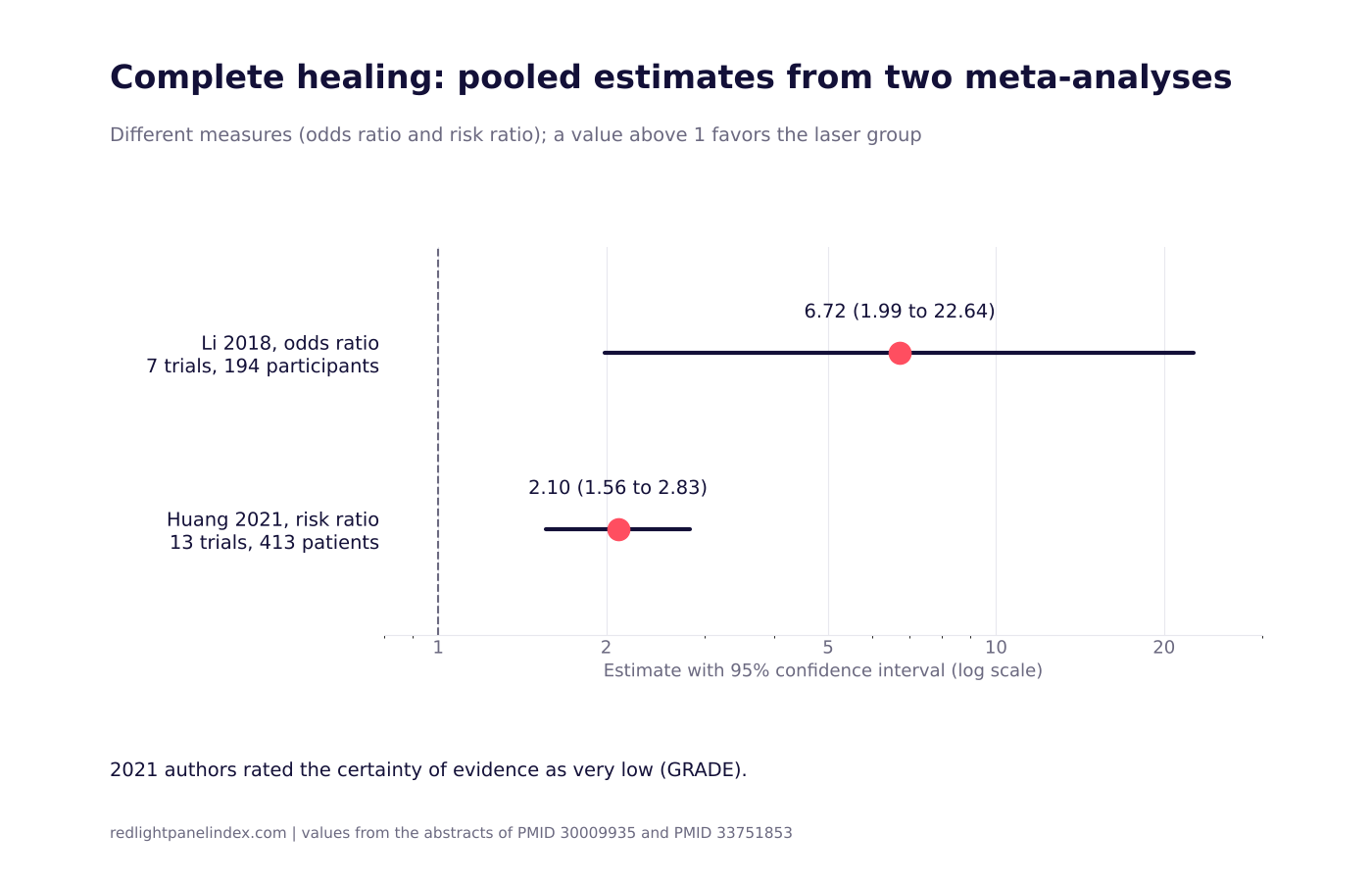
Two meta-analyses, one published in 2018 (PMID 30009935) and one in 2021 (PMID 33751853), pooled randomized trials of low-level laser therapy for diabetic foot ulcers and both reported better healing in the treated groups. The later and larger one rated its own evidence as very low certainty. Neither shows what a home LED panel would do, and ulcers are wounds that clinicians manage.
Choosing a panel? Our ranking of the best red light therapy panels is computed from published, method-labeled specs across 188 devices. For wound research like this, the spec that matters is the delivered dose, which the trials controlled and a panel buyer has to check.
Where this fits
This review supports the grade on the diabetic foot ulcer evidence page. It is a review of two secondary analyses and not of a single trial, so it reads the papers' summaries rather than the individual trials behind them. The abstracts are the only source used for numbers.
What the studies asked
Both reviews asked whether adding low-level laser or light therapy to usual care changes healing in people with diabetic foot ulcers, compared with control groups. The 2018 paper, by Li and colleagues in Diabetes Research and Clinical Practice, was a systematic review and meta-analysis of randomized controlled trials. The 2021 paper, by Huang and colleagues in the International Wound Journal, asked the same question with a larger and more recent pool of trials.
Who was studied
- 2018 review: seven randomized controlled trials with 194 participants in total (PMID 30009935).
- 2021 review: 13 randomized controlled trials with 413 patients, found by searching eight databases through August 2020 (PMID 33751853).
The abstracts do not report the age, ulcer grade or diabetes type of the pooled participants, so none of that appears here. The two pools may overlap, because the later review covers the same field with a later search date, so the two should not be counted as independent confirmation.
Device and parameters as stated
The abstracts describe the intervention as low-level light or laser therapy. Neither abstract gives a wavelength, irradiance, energy density, session count or course length, and the 2021 abstract reports no subgroup analysis by wavelength, dose or duration. Those details sit in the full texts of the individual trials. For that reason this review states no dose, and the 2021 authors themselves say the best parameters remain to be identified.
What was measured and found
| Outcome | 2018 review (7 trials, 194 participants) | 2021 review (13 trials, 413 patients) |
|---|---|---|
| Complete healing | Odds ratio 6.72 (95% CI 1.99 to 22.64) | Risk ratio 2.10 (95% CI 1.56 to 2.83) |
| Ulcer area | Weighted mean difference 34.18 (95% CI 19.38 to 48.99) | Reduction favored laser (standardized mean difference 3.52, 95% CI 1.65 to 5.38) |
| Healing time | Shorter time to closure suggested | Shorter (standardized mean difference -1.40, 95% CI -1.90 to -0.91) |
| Adverse events | None treatment-related reported | Not summarized here |
The two complete-healing figures are different measures, an odds ratio and a risk ratio, so the 6.72 and the 2.10 cannot be compared by size. They point the same way: more ulcers closed in the treated groups. The 2018 abstract also reports faster granulation tissue formation and less foot ulcer pain in the included trials, and does not state the units for its area figure.
How to read the numbers
A pooled estimate combines trials weighted by size and precision. A confidence interval that excludes 1 for a ratio, as both complete-healing results do, means the pooled data favored the treated groups at the conventional threshold. It does not say how large the benefit would be for one person, and it does not repair weaknesses in the underlying trials. That is the reason the GRADE rating matters here: a very low rating signals that new trials could move the estimate a long way.
The area figures deserve extra care. The 2018 abstract reports a weighted mean difference of 34.18 without stating units, so it is a direction of effect here and not a size, and the 2021 standardized mean difference of 3.52 is a unitless measure that combines differently scaled trials. Healing time, similarly, is reported as a standardized difference and not a number of days.
Limitations
- Very low certainty. The 2021 authors rated the quality of evidence as very low under GRADE. In plain terms, they say the true effect could differ substantially from the estimate.
- Small trials. Pooling 7 or 13 small trials can produce wide intervals; the 2018 odds ratio interval runs from 1.99 to 22.64.
- Mixed methods. Pooled trials differ in device, dose and care routines, which the abstracts do not break down. See why sham controls matter.
- Authors' call. Both sets of authors call for larger, higher-quality trials.
- Overlap. As above, the reviews draw on a shared literature.
What this means for a home panel
The evidence supports one narrow statement: in clinic trials, low-level laser added to care was associated with better ulcer outcomes, and the authors call it a promising adjunct. It does not say that a consumer panel produces the same result. The trial devices were lasers delivered under clinical conditions, and a panel differs in beam, distance and dose; see LED versus laser for the differences.
If a clinician suggests light as an add-on, the dose calculator can turn a panel's measured irradiance, distance and time into a dose to compare with what the clinic proposes. Check the irradiance claim itself against the irradiance explainer first. Reduced sensation in a diabetic foot can hide excess heat, and an ulcer needs dressings, offloading and infection control that light does not replace.
The grade this site assigns, and what it leaves out, are on the diabetic foot ulcer evidence page. For the related question of nerve symptoms, see neuropathy, and for wounds more broadly, wound healing.