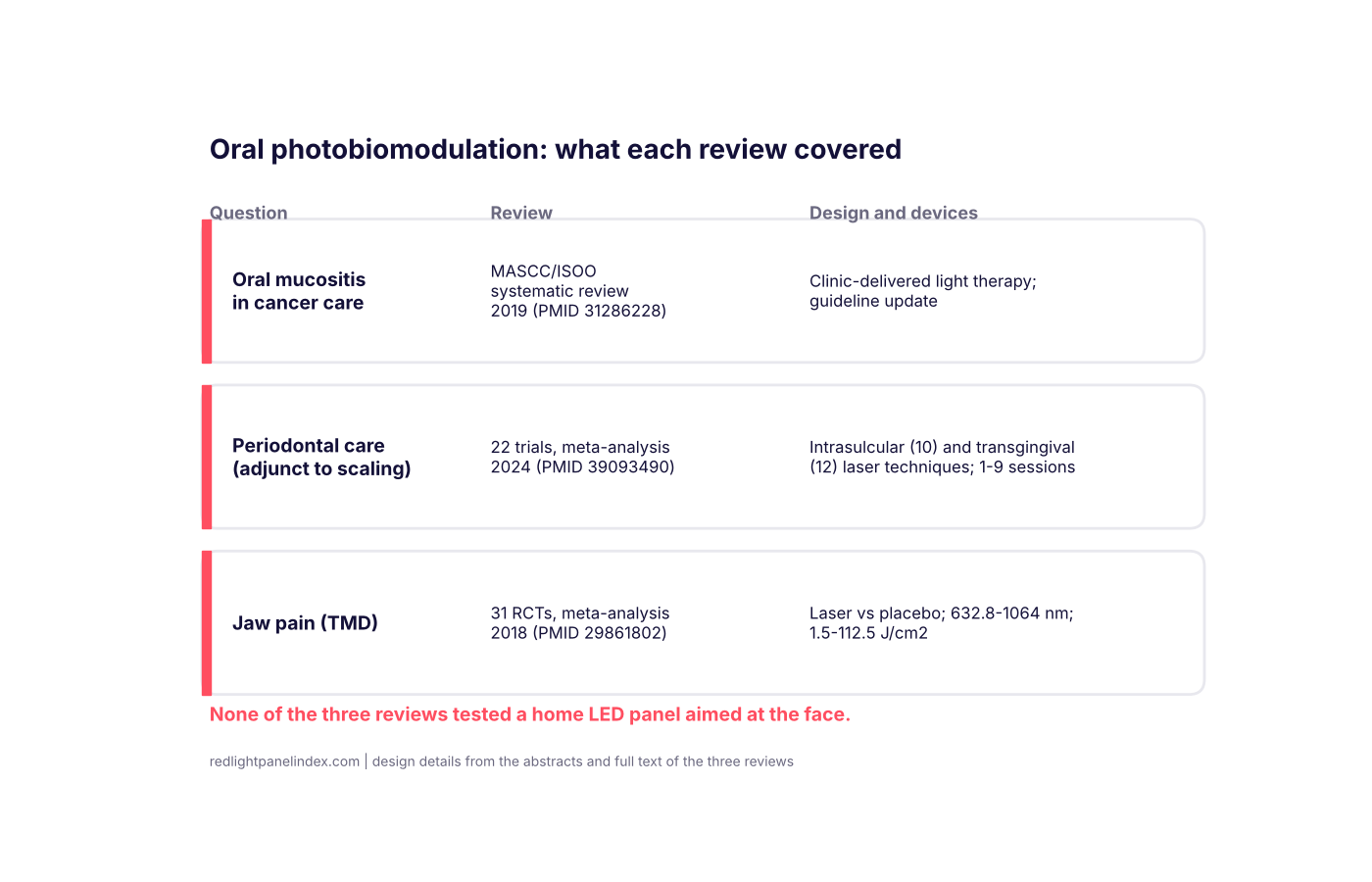
The evidence grade for red light and near-infrared light in the mouth is Moderate for clinic-delivered treatment of specific conditions and Insufficient for general gum or dental health with a home panel: the published reviews cover lasers and clinic devices applied inside or directly against the mouth, and none of them tested a wall or stand panel aimed at the face. That split matters, because a headline that says "light therapy helps gums" can be true of a dental laser and say nothing about the panel you can buy.
Choosing a panel? Our ranking of the best red light therapy panels is computed from published, method-labeled specs across 188 devices. For oral health, the spec that matters is whether a device is built and labeled for intraoral or perioral use at all, because the trials below used clinic equipment, not panels.
How this page grades the evidence
This site grades each condition as Strong, Moderate, Limited or Insufficient, and explains the scale on its evidence grades page. For the mouth, one grade would hide more than it shows, so the page grades three separate questions. The studies below are systematic reviews, which pool many trials, so they sit higher on the evidence ladder than any single study, but they are only as good as the trials inside them and the devices those trials used.
Oral mucositis in cancer care
Oral mucositis is the painful sores and inflammation that chemotherapy and radiation can cause in the mouth lining. The Multinational Association of Supportive Care in Cancer and the International Society of Oral Oncology (MASCC/ISOO) mucositis group reviewed photobiomodulation for this problem in a systematic review published in 2019 (PMID 31286228). Its stated aim was to assess the literature and update evidence-based clinical practice guidelines, searching PubMed and Web of Science and assigning each intervention a level of evidence in each cancer treatment setting (the oral mucositis page goes through that review and its tumor safety companion in more detail).
What that review covered is clinic care: the light is delivered in a clinic by trained staff, in patients receiving cancer treatment, with protocols set by the care team. It is a different situation from a healthy person using a panel at home, and it is why the guideline work does not translate into advice to point a panel at your face. If you or someone you know is in cancer treatment, ask the oncology team about the protocols their clinic uses.
For a related supportive-care topic where the site found trials on a home-style device, see the page on chemotherapy-induced neuropathy. The mouth and the hands and feet are separate questions with separate evidence.
Periodontal care: an adjunct to standard treatment
Periodontitis is gum disease that damages the tissue and bone around teeth, and its standard first-line care is basic periodontal therapy such as scaling and root planing. A 2024 systematic review and meta-analysis in Lasers in Medical Science asked whether adding photobiomodulation to that therapy changes outcomes (PMID 39093490); our periodontitis evidence page covers that review in full.
From the abstract: the authors searched PubMed, Cochrane and Scopus for trials published from January 2013 to August 2023 that used photobiomodulation alongside basic periodontal therapy and described the laser technique clearly. Of 947 references retrieved, 22 studies were included. Ten used intrasulcular techniques (the fiber placed inside the gum pocket), and 89 percent of those used an infrared wavelength. Twelve used transgingival techniques (light applied through the gum surface), and 61.5 percent of those used a red wavelength. The number of photobiomodulation sessions after basic therapy ranged from 1 to 9, and follow-up ranged from 5 days to 12 months. Risk of bias was low in 16 studies and moderate in six.
The abstract text available for this page did not include the pooled effect sizes, so this page reports none. What the review does establish is the shape of the evidence: the light was an add-on to a dentist's standard treatment, delivered by a laser with a described technique, and the studies varied widely in wavelength, dose and schedule. That variation is a limit on any single takeaway, and a reason to treat the benefit as an adjunct question for a dental office rather than a self-treatment one.
Jaw pain (temporomandibular disorders)
Temporomandibular disorders (TMD) cover pain and dysfunction in the jaw joint and chewing muscles. A 2018 systematic review with meta-analysis in Pain Research and Management compared low-level laser therapy against placebo in randomized trials (PMID 29861802). It included 31 randomized trials and pooled 643 participants across 17 studies for absolute pain scores on a 0 to 100 visual analog scale and 679 participants across 19 studies for change in pain score. The pooled mean difference favored laser therapy on both measures, with very high heterogeneity between trials (I-squared of 96 and 98 percent), and short-term follow-up showed significant pain reduction while long-term follow-up did not. Functional outcomes such as maximum mouth opening also favored the laser. The trials spanned wavelengths from 632.8 to 1064 nanometers and doses from 1.5 to 112.5 joules per square centimeter.
The authors concluded that low-level laser therapy relieves pain and improves function in people with TMD. The wide range of doses and the high heterogeneity are the reason to read that conclusion carefully: the review says laser therapy as a class performed better than placebo on average, not that any particular device, wavelength or dose is the right one. The TMJ pain evidence page covers this area in more detail, including a 2025 1064 nm laser trial.
What was not studied
- Home panels aimed at the face. None of the three reviews above tested a freestanding LED panel for gum health, tooth sensitivity, whitening, bad breath or cavities.
- Prevention of gum disease in healthy people. The periodontal review looked at light as an add-on to treatment of existing disease, not at prevention.
- Teeth themselves. Nothing on this page supports a claim about enamel, cavities or tooth color.
- Long-term outcomes. The jaw-pain review found the pain benefit at short follow-up but not at long follow-up.
- Intraoral consumer devices. Mouthpieces and handheld oral lights sold directly to consumers were not what these reviews evaluated, so this page makes no claim about them.
What this means if you own a panel
A panel is a poor match for the mouth for practical reasons as well as evidentiary ones. The beam spreads, so most of the light lands on skin rather than gum, and the LED versus laser page explains how a collimated clinical laser differs from a diffuse panel. Tissue absorbs and scatters light on the way in, which is why the wavelength pages and 810 nm page matter more than the headline power on the box. If you want to see how a session length is set, the dose calculator converts a published irradiance and distance into a dose, but it cannot make a panel into an intraoral device, and the doses in the TMD review spanned a range of more than 70-fold.
The practical advice that follows from the evidence is modest:
- Treat gum disease, dental pain and mouth sores through a dentist or physician first. Light was studied as an add-on, not a replacement.
- Ask a dental office whether it offers photobiomodulation for periodontal or jaw-pain care, and what wavelength, dose and number of sessions its protocol uses. The reviews above show those details vary.
- Do not substitute a panel for clinic care. If you use one for another purpose, keep it away from open sores in the mouth and follow the eye protection guide, since facing a panel brings the eyes into range.
- Check how a study-based claim is worded. A page that says light "treats" or "heals" gums is going beyond what these reviews say.
Cautions
Mouth tissue can be injured and infected, and untreated gum disease and oral sores can have serious consequences, so delaying care to try a light device is the main risk. The site's safety and side effects page lists general cautions for panel use, including photosensitizing medications and eye exposure, and none of the reviews summarized here tested a panel. Anyone in cancer treatment, taking photosensitizing medication, or with a mouth lesion that has not been diagnosed should ask a clinician before using any light device on the face. The underlying mechanism is described on the photobiomodulation page.
Bottom line
Photobiomodulation has been reviewed for oral mucositis, as an add-on to periodontal therapy, and for jaw pain, and those reviews support a Moderate grade for clinic-delivered use in those specific conditions. They do not support a claim that a home panel improves gum or dental health, which stays at Insufficient.