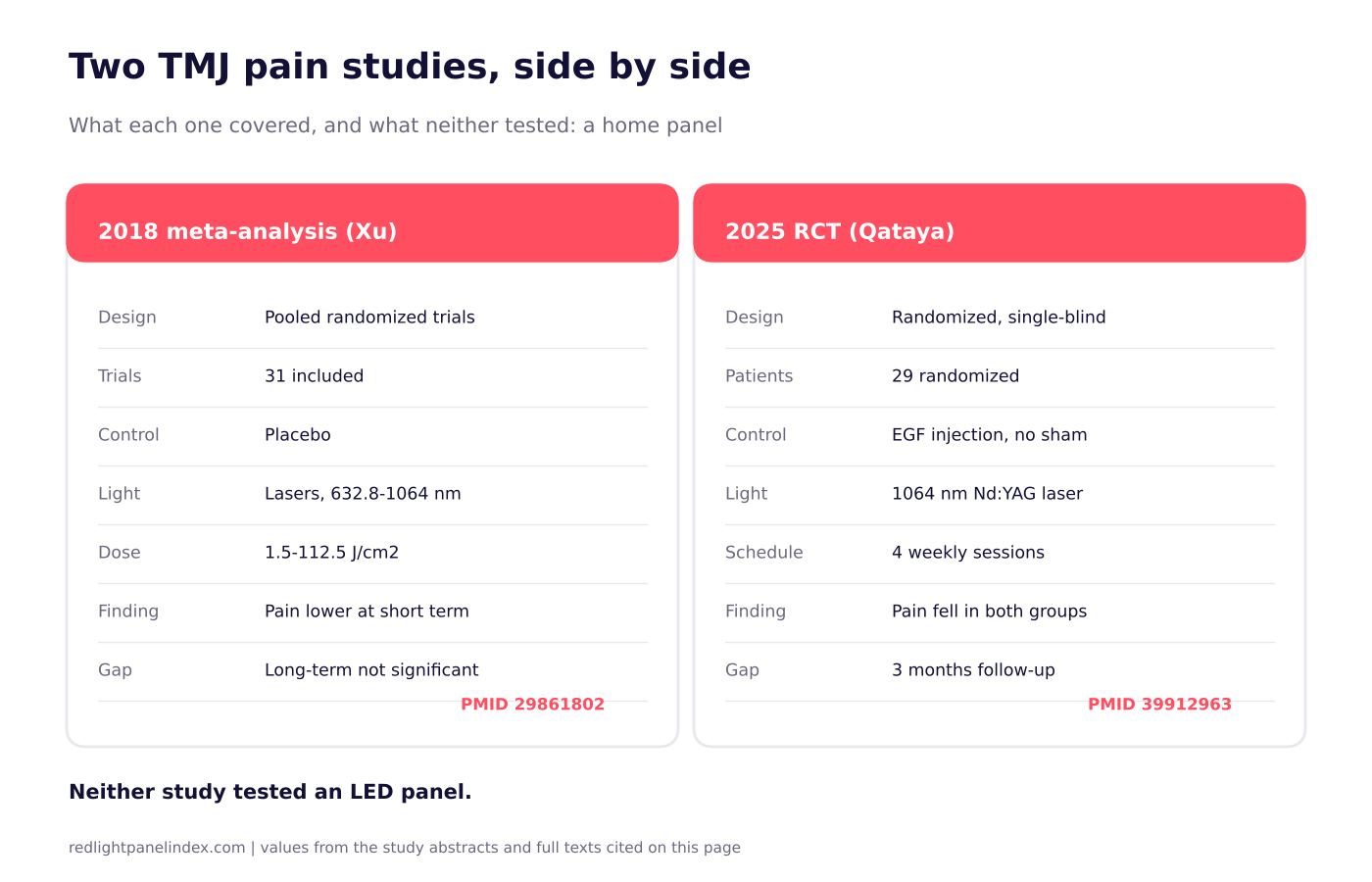
The evidence grade for light therapy and temporomandibular (TMJ) pain is Moderate for clinic-delivered laser therapy and Insufficient for a home LED panel: a 2018 meta-analysis of placebo-controlled trials found lower pain at short follow-up, but every study used a laser applied to the jaw, the results varied enormously between trials, and no study tested a panel.
Choosing a panel? Our ranking of the best red light therapy panels is computed from published, method-labeled specs across 188 devices. For jaw pain, the spec that matters is whether a device's measured irradiance and beam can reach a small area at close range, because the trials delivered light to specific spots on the jaw muscles.
How this page grades the evidence
Each condition on this site is graded Strong, Moderate, Limited or Insufficient, and the evidence grades page explains the scale. Jaw pain gets a split grade for the same reason the gum and dental health page does: the research is real but it is about clinic lasers (the same pattern appears on the periodontitis evidence page), and a grade for lasers says little about a device you can hang on a door. The split is stated up front so the Moderate grade is not read as a statement about panels.
What temporomandibular disorders are
Temporomandibular disorders (TMD) are a group of conditions that cause pain and dysfunction in the jaw joint and the chewing muscles. Some cases are mainly muscular, some mainly about the joint itself, and many are mixed. That mix matters here, because the pooled review below combined muscle and joint types, and a light dose that might plausibly reach a masseter muscle is a different question from one that reaches a joint. Persistent or worsening jaw pain, locking, or pain with a clicking joint is a reason to see a dentist or physician, not to self-treat with a lamp.
The 2018 meta-analysis of laser therapy
The anchor study is a systematic review with meta-analysis published in 2018 in Pain Research and Management (PMID 29861802). It compared low-level laser therapy with placebo in randomized trials of people with TMD. The last literature search was on May 16, 2017, and the authors included English and Chinese articles. Of 31 randomized trials in the review, 22 contributed data to the meta-analysis. On the modified Jadad quality scale, 30 of the 31 scored as high quality.
Pain
Pain was pooled on a 0 to 100 visual analog scale. For final pain scores, 643 participants across 17 studies gave an overall weighted mean difference of -14.05 points (95% CI -25.67 to -2.43; P = 0.02), with heterogeneity (I-squared) of 96 percent. Split by follow-up time, the short-term result (two weeks or less) was -14.66 points (95% CI -21.04 to -8.29; P < 0.00001), while the long-term result (over two weeks) was -14.84 points (95% CI -35.35 to 5.68; P = 0.16) and was not statistically significant. The change-score analysis, with 679 participants across 19 studies, pointed the same way: an overall difference of 15.43 points favoring laser (95% CI 3.61 to 27.26; P = 0.01), significant at short term and not at long term.
The numbers say two things at once. The average trial favored laser over placebo, and the confidence intervals are wide enough that the true size of the effect is uncertain. An I-squared of 96 to 98 percent means the trials disagreed with each other far more than chance explains, so the pooled number is a summary of very different studies, not a measurement of one treatment.
Function
Mouth opening was measured as maximum active vertical opening and maximum passive vertical opening. The pooled difference was 6.37 for active opening (95% CI 2.82 to 9.93; P = 0.0004) and 6.96 for passive opening (95% CI 1.99 to 11.93; P = 0.006), both favoring laser. Heterogeneity was again high, the review flagged possible publication bias for these outcomes, and the active-opening result was not significant at short-term follow-up.
Wavelength and dose
The trials in the review spanned wavelengths from 632.8 to 1064 nm and doses from 1.5 to 112.5 J/cm2, with four studies not reporting dose. Seven laser types were used, and the most common was the GaAlAs diode laser (20 studies). When the authors split trials into low dose (50 J/cm2 or less) and high dose (above 50 J/cm2), the two outcome measures disagreed: the final-score analysis was significant for high dose (P = 0.03) and not for low dose (P = 0.06), while the change-score analysis was significant for low dose (P = 0.002) and not for high dose (P = 0.33). The authors concluded that laser therapy relieves pain and improves function in TMD, that the effect may be short-term, and that the existing evidence does not establish an effective dose window.
Limits the authors state
The review lists high heterogeneity in diagnosis, laser parameters, treatment regimens, outcomes and follow-up; many small trials; possible publication and language bias; and pooling of muscular and joint types. GRADE certainty ranged from very low to moderate. Those caveats are why the clinic-laser grade stops at Moderate.
The 2025 trial at 1064 nm
A 2025 randomized trial in Clinical Oral Investigations compared a 1064 nm Nd:YAG laser with intramuscular injections of epidermal growth factor (EGF) in adults with chronic painful myogenic TMD (PMID 39912963). It is the recent study this page uses to show what deep-infrared research looks like in the jaw, and it is also the 2025 jaw-pain trial summarized on the 1064nm page.
Who was studied. The trial was single-center, in Egypt, with 29 patients randomized and 27 completing. Participants were adults aged 20 or older with chronic (more than three months) myogenic TMD in the masseter or temporalis who had not responded to conservative care. Mean age was about 28, and 25 of the 29 were women.
What was done. The laser group received four weekly sessions using a Fotona LightWalker 1064 nm Nd:YAG laser, with two passes per session over three zones of each chewing muscle. The comparison group received EGF injections at baseline and day 14. The authors chose the pulsed 1064 nm source because they expected it to reach deeper tissue and a wider area than conventional low-level laser therapy.
What was found. Pain on a numerical rating scale fell within both groups over follow-up to three months, and the between-group comparison showed no significant difference for pain, pain-free opening, maximum opening or quality of life. Within the laser group, maximum unassisted opening improved significantly (P = 0.007), while the injection group's change in that measure did not reach significance (P = 0.109). The authors noted that baseline opening differed between groups, which could partly explain that result. In a post-hoc look at pain at three months compared with one month, the laser group's rebound was not significant (P = 0.06) and the injection group's was (P = 0.011).
Limits. The sample was small, follow-up ended at three months, patients and the treating clinician knew which treatment was given, and there was no placebo or sham arm. A trial without a sham cannot separate the effect of the light from expectation, attention, or the natural course of a painful condition. The abstract and tables also disagree on one p value for pain-free opening in the injection group, a reminder to read small trials cautiously.
Together the two studies give a consistent but narrow picture: laser therapy delivered to the jaw muscles in a clinic is associated with lower reported pain in the short term, and the 1064 nm trial adds a single small comparison without a placebo.
What was not studied
- Home LED panels. Neither study, and none of the 31 trials in the review as described, tested a panel placed at a distance from the face. See the LED versus laser page for why laser doses cannot be copied onto a panel.
- Long-term outcomes. The pooled long-term pain result was not statistically significant, and the 2025 trial stopped at three months.
- A best dose. The review states the evidence does not establish an effective dose window.
- Joint-specific disease. The review pooled muscular and joint types, so it does not say which kind of TMD responds.
- Prevention, night grinding, or headache from clenching. None of these were outcomes in the studies described here.
A practical section for panel owners
Panels deliver a broad field of light, usually at distances of several inches or more, while the trials delivered light to marked points on the masseter and temporalis, often with a handpiece. A panel's output is described by irradiance in mW/cm2, and the irradiance page explains why a figure's measurement method matters. The dose calculator converts an irradiance and a distance into a session dose in J/cm2, but a calculated dose only tells you what reaches a patch of skin at that distance, not what reaches a chewing muscle under the cheek.
Wavelength is the second consideration. Longer wavelengths are absorbed less by water and pigment, which is why 1064 nm is of interest for deeper tissue, but the penetration depth page is explicit that longer is not simply deeper. Only two brands in the site's database carry 1064 nm at a meaningful LED share, listed on the 1064nm panel ranking, and the share is a guide to the spectrum, not a measurement of how much 1064 nm energy reaches the jaw. For related areas, the neck pain page covers the neighboring muscles, which are often involved when the jaw hurts.
Cautions
- Jaw pain has many causes, including dental problems, ear problems and joint disease. Get a diagnosis before choosing any home approach.
- Light aimed at the face reaches the eyes. Read the eye protection guide before any facial session, and note that 1064 nm light is invisible, so the eyes give no warning.
- Do not substitute a panel for the care a dentist, physician or physical therapist recommends. The trials above were clinic treatments for people who had not responded to simpler care.
- Stop use and seek care if pain worsens, if you cannot open your jaw, or if you have fever or facial swelling.
Bottom line
Clinic laser therapy for TMD has a moderate body of evidence for short-term pain relief, with high variability and no established dose. The 2025 1064 nm trial is a single small study without a placebo. Home panels have no direct evidence for jaw pain, so the honest grade for them is Insufficient. For how this site ranks devices in general, see how rankings work.
Another oral topic with its own grade is photobiomodulation in cancer care, covered on the oral mucositis page, which is a supervised clinic use rather than a home one.