The evidence grade is Moderate for one specific use: low-level laser photobiomodulation applied by a dental professional after basic periodontal therapy, because a 2024 systematic review and meta-analysis of 13 pooled studies reported gains in probing depth and clinical attachment level and judged the technique a possible complement to treatment (PMID 39093490). It is Insufficient for any home panel, because the review looked at clinic laser techniques applied inside or against the gum, not a wall or stand panel aimed at the face.
Choosing a panel? Our ranking of the best red light therapy panels is computed from published, method-labeled specs across 188 devices. For periodontitis, the spec that matters is not on a panel at all, because the evidence concerns dental-office lasers; for general use, wavelength and a method-labeled irradiance figure are what to check.
What periodontitis is
Periodontitis is a chronic inflammatory disease of the tissues that support the teeth. Basic periodontal therapy (BPT) is the standard dental treatment of cleaning below the gum line, and it is what every study in this page's review used as the base. Photobiomodulation in these trials was an add-on to that cleaning, never a replacement for it. Anyone with bleeding gums, loose teeth or persistent bad breath needs a dentist or periodontist first. For the broader oral picture, see the oral health evidence hub.
The grades follow the scheme in evidence grades explained. Moderate here reflects a single pooled analysis of clinical trials with mixed techniques, not a body of large, uniform, consumer-device trials.
The 2024 meta-analysis
The review, published in Lasers in Medical Science by da Silva and colleagues, asked which low-power laser application techniques have been used as a complement to basic periodontal therapy and what clinical outcomes they reported (PMID 39093490).
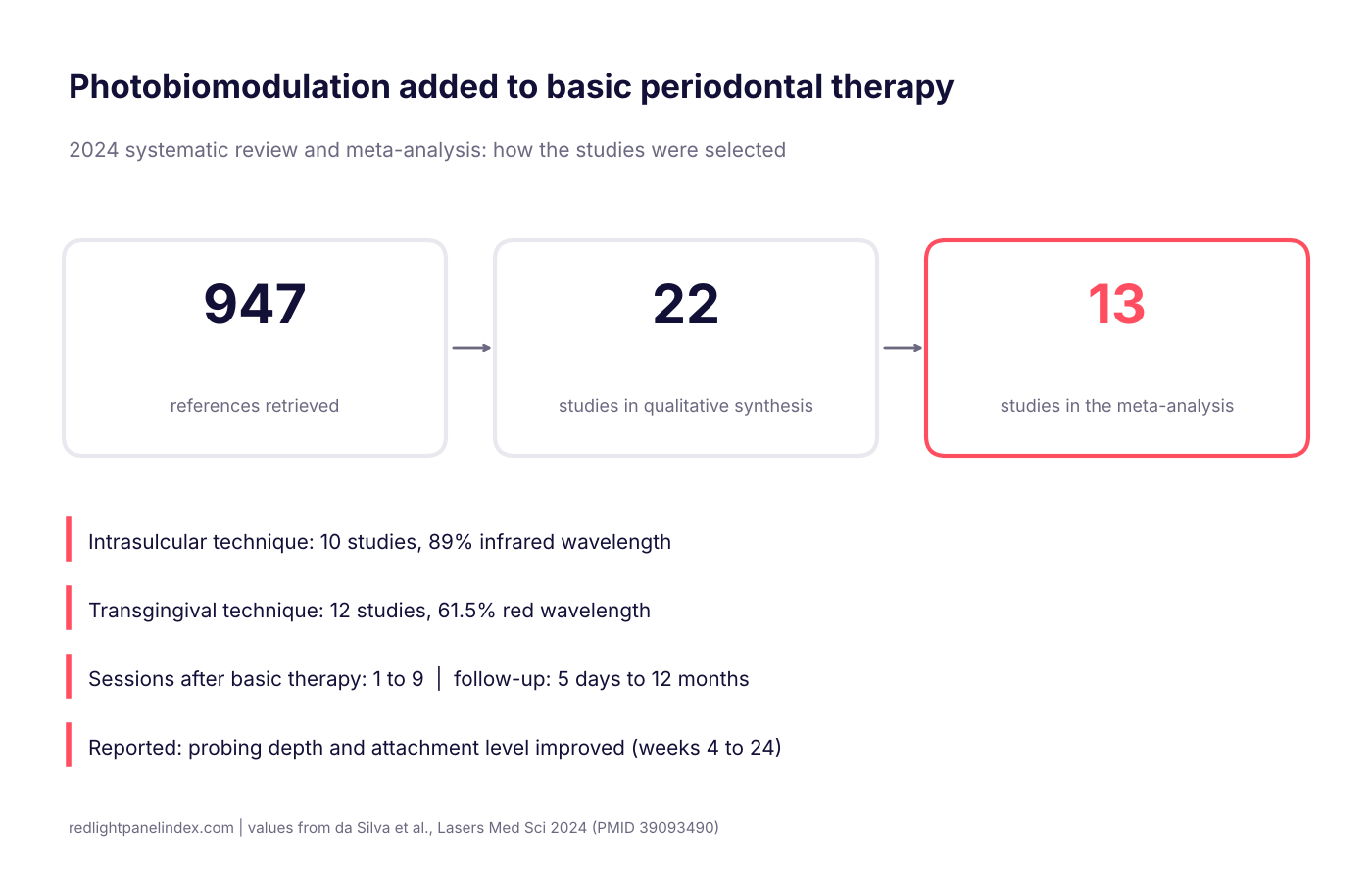
How it was built. The authors searched PubMed, Cochrane and Scopus for clinical trials published from January 2013 to August 2023 that used photobiomodulation alongside BPT and clearly described the laser technique. They retrieved 947 references. Of these, 22 studies were included in the qualitative synthesis and 13 in the random-effects meta-analysis. Risk of bias was assessed with the Joanna Briggs Institute checklist, and it was rated low in 16 studies and moderate in six.
Techniques. The review separated two ways of delivering the light. In the intrasulcular technique, the fiber goes into the gum pocket. Of the 10 intrasulcular studies, 89% used an infrared wavelength. In the transgingival technique, the light is applied through the gum from outside. Of the 12 transgingival studies, 61.5% used a red wavelength. Photobiomodulation sessions after BPT ranged from 1 to 9, and follow-up ran from 5 days to 12 months.
What was reported. The meta-analysis reported that BPT reduced probing depth at 4, 12 and 24 weeks and improved clinical attachment level at 6, 12 and 24 weeks after treatment. The authors concluded that photobiomodulation may be a valuable complement in the treatment of periodontitis and suggested the transgingival technique may be especially useful.
For readers new to the terms, probing depth is how deep a dentist's probe sinks beside a tooth, and clinical attachment level is a measure of how much supporting tissue has been lost. Both are measured by a clinician.
Reading the result carefully
Two points limit what this review can support.
First, the reported gains were stated for the combined treatment period. As summarized in the abstract, the improvements are tied to BPT followed by photobiomodulation, and the abstract does not give a separate effect size for the light alone. This page therefore quotes no numbers beyond the counts above.
Second, the abstract does not report energy, power or other dose parameters. The review grouped studies by technique, not by a single protocol. That means no dose in this page can be called a recommended dose, and the dose calculator cannot be used to reproduce a periodontal protocol.
What was not studied
The abstract describes a pooled analysis of published trials, so gaps in the individual trials are not visible from it. With that in mind, these are the questions the review leaves open:
- Home panels. The reviewed techniques place light in or against the gum. A panel directed at the face delivers light to skin and cheek, not to the periodontal pocket.
- Light without cleaning. Every included study paired the light with basic periodontal therapy.
- Long-term outcomes beyond 12 months. The longest follow-up in the abstract is 12 months.
- A single optimal wavelength or dose. The review describes red and infrared use, with no single winner stated in the abstract.
- Safety in specific groups. The abstract does not address people with implants, pregnancy or systemic illness.
A practical section for home users
If you already use a panel for other reasons, the sensible reading is narrow. Wavelength matters for what reaches tissue, and our pages on photobiomodulation, 660 nm red light and 810 nm near-infrared light explain how each band behaves. The review's pattern of mostly infrared inside the pocket and mostly red through the gum is a clinic-technique detail, not an instruction for a panel.
When comparing devices for any use, check whether irradiance is labeled with a method; the irradiance explainer shows how to read it, and how rankings work describes how we handle unlabeled figures.
A jaw-area concern is a different question from gum disease. If your symptom is jaw pain or clicking, see the temporomandibular joint evidence page instead.
Cautions
- Gum disease is a dental condition. Delaying professional care to try light at home risks tooth loss, and no home device replaces cleaning below the gum line.
- Do not point a bright panel at the eyes. Wear eye protection; see the safety and side effects page.
- Clinic lasers differ from LED panels in delivery, and the review does not say LED panels reproduce its results.
- People in cancer treatment with mouth sores should read the separate oral mucositis page, which covers a different condition and a supervised-clinic setting.
- This page is informational and is not medical advice.
Questions to ask a dental office
If a clinic offers laser add-ons to periodontal care, the review suggests useful questions. Which technique is used, intrasulcular or transgingival, and why? How many sessions follow the cleaning? How will progress be tracked, and with which measures? The review used probing depth and clinical attachment level, so asking for those numbers before and after is reasonable. A clinic that cannot say which wavelength it uses, or cannot describe its protocol, is giving you less information than the trials did.
It is also fair to ask whether the add-on changes the cost or the number of visits, since the evidence here supports it only as a complement. The outcomes named in the abstract are clinical measurements taken by a professional.
Bottom line
Photobiomodulation added to basic periodontal therapy has a Moderate evidence grade in a dental-office setting, based on one 2024 meta-analysis of 13 pooled studies (PMID 39093490). That grade does not transfer to a home panel. If you have gum disease, treat it with a dentist; if you wish to try light at home for other reasons, choose on labeled specs and expect no periodontal claim from the device.