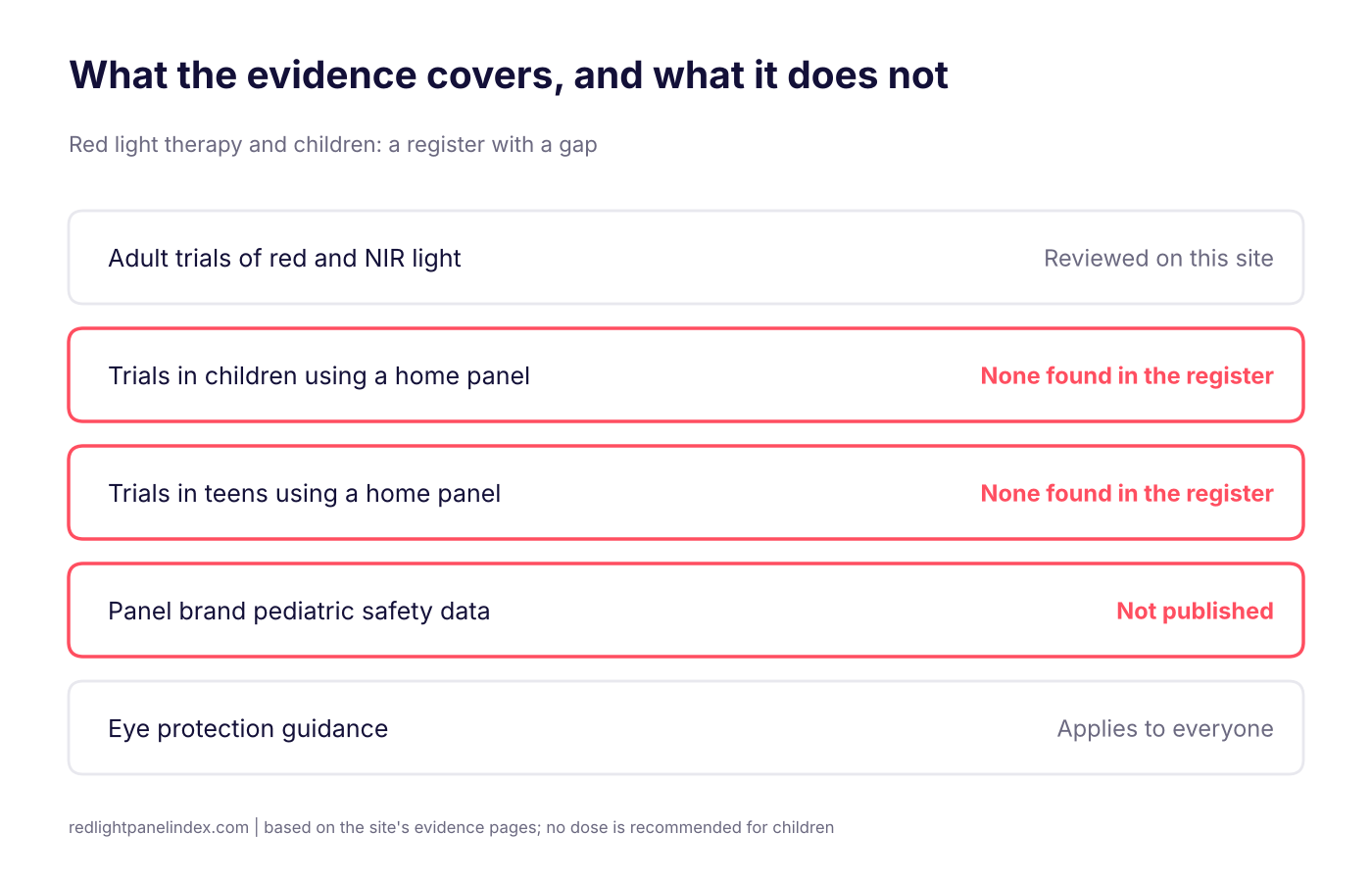
Nobody can give a safe dose of red light therapy for a child, because this site's evidence pages found no trial of a home panel in children or teens. That is a gap in the evidence, not a finding of harm and not a finding of safety, and the practical answer is to ask your child's pediatrician before using a panel on them, and to keep a running panel away from young eyes in the meantime.
Choosing a panel? Our ranking of the best red light therapy panels is computed from published, method-labeled specs across 188 devices. If a household with children owns a panel, the spec worth checking is whether it emits anything below 500nm, because blue and violet channels are the ones that change the eye-safety advice.
What "no data" means here
The trials behind the panel market enrolled adults. The site's safety and side effects page grades safety as Limited overall and lists the groups with little or no dedicated data, and children and teens fall in the same position as pregnancy: the register has nothing either way. Where this site's pages touch younger people at all, they say the same thing. The eczema evidence page, for example, notes that children make up a large share of people with eczema and that the light literature it summarizes does not give a basis for advice on them.
Both halves of the sentence matter. A parent hoping for reassurance should not read "no documented harm" as "studied and fine," and a parent hoping for alarm should not read "not studied" as "known to be dangerous." What the gap supports is a decision rule. When the answer is unknown, the benefit is usually optional and the person is a growing child, asking first is the reasonable default.
Why adult results do not transfer by default
Children are not small adults, and the trials say nothing about the ways they differ. Skin thickness, body size, temperature regulation and how long a child will stay still under a light are all different from the adults in the studies. A session length chosen from an adult protocol would be a guess when applied to a child, and this site does not offer one. The dose calculator converts a panel's method-labeled irradiance and a session length into joules per square centimeter, but it can only tell you what dose a panel delivers, not what dose is appropriate for a child. For that, no published number exists on this site.
The biphasic dose response page explains why more light is not simply safer or better, and that point is a reason against improvising a pediatric dose, not for it.
The eye question
Eyes are the first practical concern in a house with children, and the site's eye protection guide is the place to start. Its core advice for adults is not to look into a running panel, and it points out that goggles matter most when a panel emits blue or violet light or when the face is treated at close range. It also notes that children's lenses transmit more short-wavelength light to the retina than an adult lens does, which is a reason for more caution with any blue or violet channel, not less.
Two further facts from that guide apply directly. No panel brand in the index publishes a photobiological risk group for its devices, so "safe for the eyes" is a marketing sentence rather than a measured one, and a published classification under IEC 62471 is the number that would settle it. Check the 480nm blue light explainer if your panel has a blue mode. A bright, interesting light invites a look, which is why a household rule is more dependable than a pair of goggles that may not fit a small face.
Heat, skin and medications
A panel at working distance is a light source and also a mild heat source. A child may not tell you a session is too warm, or may not stay in position. Skin that is broken, sunburned, newly treated or inflamed is a reason to stop and ask a clinician. Some medications make skin more sensitive to light, and the guide to photosensitizing medications explains why that evidence is almost entirely about ultraviolet light, not the red and near-infrared band a panel uses, and why asking the prescriber is still the careful step. If a teen uses a prescription skin treatment, that question is the first one to ask.
Teens and skin goals
Teens are the group most likely to ask about a panel, usually for acne or skin appearance. The site's acne evidence page covers what two trials of blue-plus-red LED light reported, and it does not turn those results into a recommendation for a home panel in a teenager. A dermatologist, who can look at the skin and know the medication list, is a better first step than a device, and a parent can bring the questions below.
What to ask a pediatrician
- Is there any reason, given my child's health, medications or skin, to avoid light therapy?
- If I use a panel anyway, what distance and session length would you want, given that no published pediatric home-panel protocol exists?
- Does my child have an eye condition, a history of eye surgery or a medication that changes light sensitivity?
- If the goal is a skin condition, is there an established treatment to try first?
What not to do
- Do not scale an adult protocol down by weight or age. No trial supports that arithmetic.
- Do not let a child look into a running panel, and do not treat the face at close range without a clinician's input.
- Do not use a panel on a child as a substitute for care of a condition that needs a diagnosis.
- Do not leave a panel running in a space where a child can reach it. A switched-off panel is the safest configuration. The same logic applies to household animals, covered in the pets guide.
The practical version
If you already own a panel and have children in the house, treat it like any bright light source and electrical device: switch it off and out of reach when you are not using it, keep it away from children's eyes, and ask before using it on them. Until a controlled pediatric trial using a home-type panel exists, the honest summary is that the question has not been answered. For the same reason, the site's pregnancy safety guide takes the same stance on another group that trials left out.