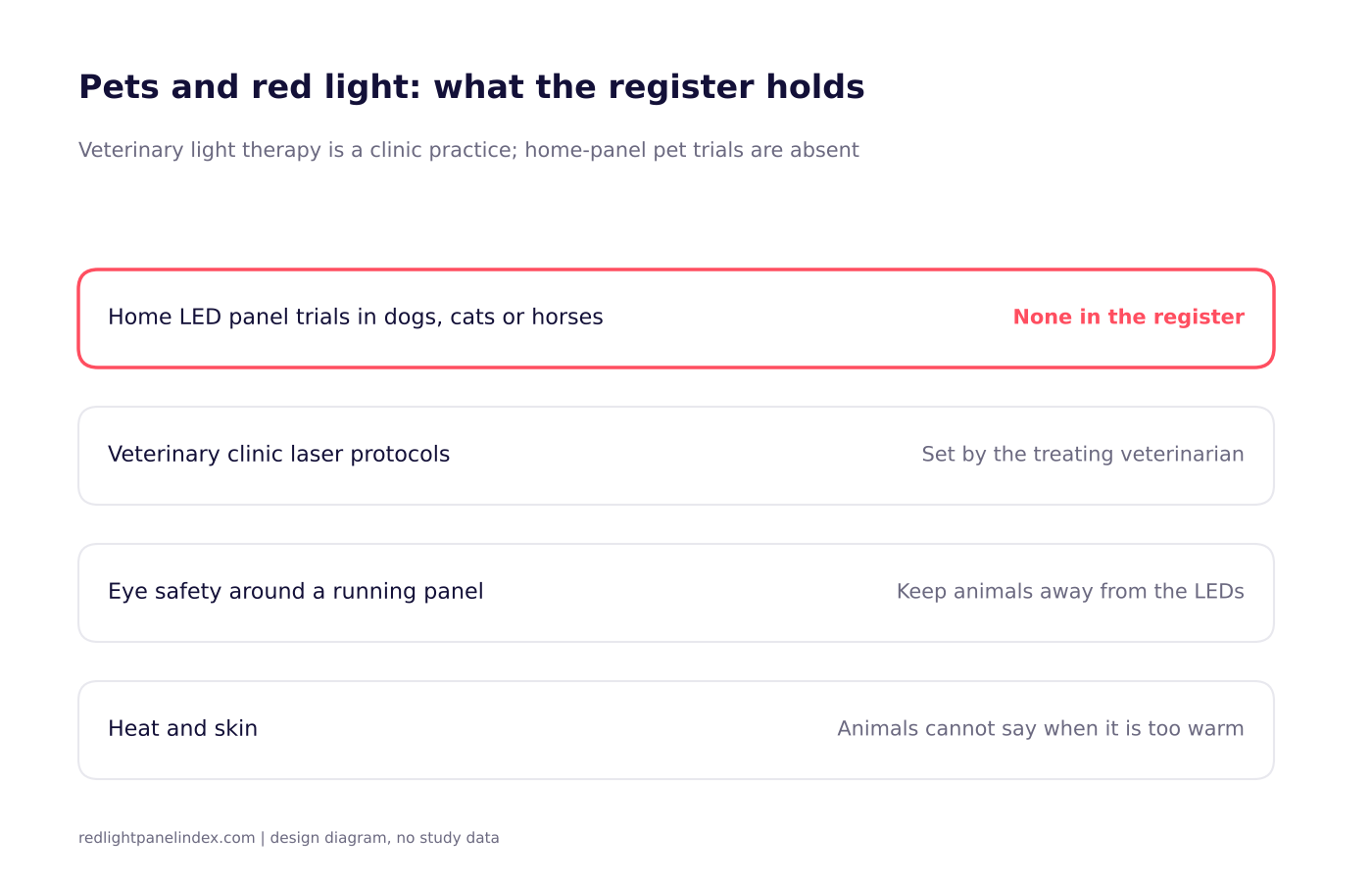
Red light therapy for dogs and other pets exists, but as a veterinary clinic practice, and this site's register holds no trial of a home LED panel used on a pet. That means there is no tested dose, distance or session length to give an owner, so the sensible step is to ask your veterinarian before pointing a panel at an animal, and to keep a running panel away from your pet's eyes in the meantime.
Choosing a panel? Our ranking of the best red light therapy panels is computed from published, method-labeled specs across 188 devices. For a household with pets, the spec that matters is whether the panel emits anything below 500nm, because a blue or violet channel changes the eye-safety advice for every living thing in the room.
What veterinary light therapy is
The same underlying idea described on the photobiomodulation science page is used in some veterinary clinics, usually with therapy lasers or clinic-grade light heads applied by trained staff. The clinic setting matters. The person holding the device chooses the area, watches the animal's reaction, keeps the animal still and stops when it is uncomfortable. A home panel running on a timer has none of those safeguards.
This site does not review veterinary protocols and has no veterinary study registered, so it gives no animal figures here. Any veterinary study cited on this site would first have to be verified and registered. If a clinic recommends a course of sessions for your pet, the dose and schedule come from that clinic, not from the human protocols summarized elsewhere on this site.
Why human trials do not transfer
Every trial this site grades enrolled people. The safety and side effects page grades safety as Limited even for adults, and lists groups with little or no dedicated data. Pets are further outside the evidence than any of those groups, for several practical reasons:
- Fur absorbs and scatters light, and coat density and color differ widely between breeds. A dose calculated for bare human skin does not describe what reaches a dog's skin through a thick coat.
- Body size ranges from a few pounds to over a hundred, so one working distance cannot suit every animal.
- Skin and eye anatomy differ by species, and the human eye-safety guidance was not written for them.
- An animal cannot report warmth, tingling or discomfort, and may not stay in position.
The dose calculator turns a panel's method-labeled irradiance and a session length into joules per square centimeter at the panel's surface. It tells you what a panel delivers to a surface at a given distance. It cannot tell you what dose is appropriate for a dog, because no published number on this site covers that.
The eye question
The core rule in the eye protection guide is not to look directly at the LEDs of a running panel at any distance. Pets will not follow that rule. A dog or cat can wander into the beam, look toward a bright light out of curiosity or sit directly in front of the panel.
Two further points from that guide apply. No panel brand in the index publishes a photobiological risk group for its devices, so eye safety for these products has not been independently measured, as the page on IEC 62471 photobiological safety explains. And goggles matter most when a panel has a blue or violet channel, which the 480nm blue light explainer covers. Goggles made for people are not designed for animals, so the practical measure is to keep a pet out of the room, or out of the panel's line of sight, whenever it is running.
Heat and skin
A panel is a light source and also a mild heat source. The thermal versus photochemical page explains that warmth tracks irradiance and distance and that strong near-infrared can feel warm on skin. A person can move back or stop a session when it feels too warm. A pet cannot, and a dog under a fur coat may not show discomfort until the skin is already hot.
Skin that is broken, sore, newly operated on or inflamed is a reason to see a veterinarian, not to point a light at it. Light does not disinfect a wound and does not replace the care an animal with an injury or infection needs.
Choosing between a clinic and a panel
For most owners the real decision is not which panel to buy but whether to use light at all. A clinic offers a trained operator, a diagnosis and a record of how the animal responded. A panel offers convenience and costs less per session, and it offers none of those safeguards. If your veterinarian already uses light therapy, ask whether a home maintenance plan is something they support and what they would want you to watch for. If they do not, that is useful information too.
Medications and conditions
Some human medications make skin more sensitive to light, and the guide to photosensitizing medications explains how limited that evidence is even for people. Nobody has mapped the same question for pet medications on this site. If your pet takes a prescription, asking the prescribing veterinarian is the step that matters.
Older pets with joint stiffness are the usual reason owners consider light. The site's joint pain evidence page and knee osteoarthritis evidence page cover human trials, and they should not be read as a statement about a dog's hips or a cat's knees. Pain in an animal also needs a diagnosis, since the cause could be something a light cannot address.
What to ask a veterinarian
- Is there any reason, given my pet's age, health, medications or skin, to avoid light therapy?
- If you offer light therapy in the clinic, what device do you use and how many sessions do you recommend?
- Would you want me to use a home panel at all, and if so at what distance and for how long, given that no published home-panel protocol for pets exists?
- Is there an established treatment for this problem that should come first?
What not to do
- Do not scale a human protocol to an animal's weight or coat.
- Do not leave a running panel where a pet can reach it or look into it.
- Do not use a panel on an animal in place of a diagnosis, wound care or prescribed treatment.
- Do not hold a pet in place for a session. A frightened animal and a hot, bright light is a poor combination.
- Do not assume that a product marketed for pets has been tested. Check whether the maker publishes a trial, a measured irradiance and an eye-safety classification.
The practical version
If you already own a panel and share your home with pets, treat it like any bright light and electrical device: switch it off and keep the cord and unit out of reach when it is not in use, keep animals out of the room during your own sessions, and ask your veterinarian before using it on them. The same stance applies in the site's kids safety guide, which covers another group the trials left out. Until a controlled trial of a home-type panel in animals exists, the honest summary is that the question has not been answered, which is a gap in the evidence and not a finding of harm or of safety.